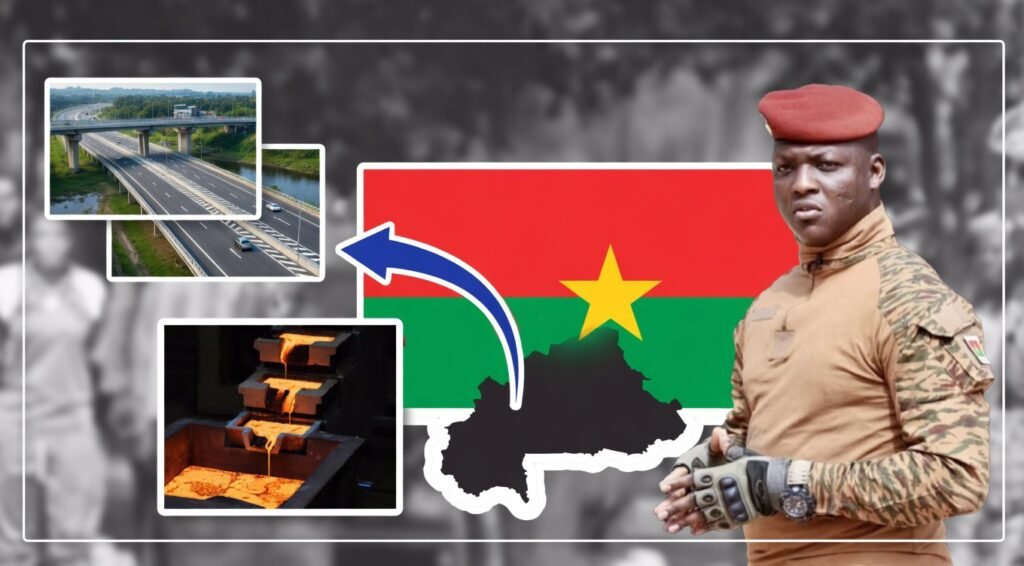
Burkina Faso has launched a $64 billion National Development Plan (2026–2030) two and a half times the country's annual GDP funded two-thirds from domestic sources, anchored by nationalised gold revenues, and structured around four pillars: security, governance reform, human capital, and industrial infrastructure. It is the largest economic programme ever proposed in the Sahel.
Formally launched on March 9, 2026 in Ouagadougou, the NDP officially designated the Plan National de Développement (PND) 2026–2030 represents a decisive structural break from the aid-dependent development model of previous Burkinabè governments. The plan was formally adopted by cabinet on January 29, 2026, with Prime Minister Jean Ouédraogo describing it as a national pact for the structural transformation of the economy, the consolidation of security, and the promotion of sovereign endogenous development.
Finance Minister Aboubakar Nacanabo provided the financing thesis directly: approximately two-thirds of the $64 billion will be raised domestically through revenues generated by state-owned enterprises, citizen shareholding programmes, and the proceeds of a reformed and partially nationalised mining sector. The remaining third is expected to come from bilateral and multilateral partners, but the fundamental orientation is reversed from prior plans: external capital is the supplement, not the foundation.
Sources: Burkina Faso Council of Ministers, AfDB, IMF • Calculations & Modelling: Limitless Beliefs Consulting
Gold Nationalisation How the Fiscal Foundation Was Built
The NDP's domestic financing ambition is not aspirational it is grounded in a set of concrete policy actions already executed. In June 2025, Burkina Faso nationalised five foreign-owned gold mining assets, capitalising on a sustained rally in global gold prices to generate immediate sovereign revenue. The government used those proceeds to repay over $2 billion in domestic debt, reducing the domestic debt stock by approximately a quarter and materially improving the country's fiscal position entering the NDP launch window.
The results are documented in the IMF's February 2026 review: Burkina Faso recorded 94 tonnes of gold production in 2025 a record generating 776 billion CFA francs in budget revenues from mining alone. Higher mining code dividends contributed 0.5% of GDP in additional revenue above projections. The fiscal deficit in 2025 is estimated to have remained well within the programme objective of 4.0% of GDP a tightening of 2.3 percentage points since 2024 achieved through higher gold revenues, wage bill control, and capital expenditure discipline.
The external account shifted accordingly. IMF data shows Burkina Faso's current account moving from deficit to a projected surplus of 1.1% of GDP in 2025 and 0.8% in 2026 driven by net gold exports and improved terms of trade. Budget revenues overall increased by 22.4% in 2025, reaching 3,714.2 billion CFA francs, with the Patriotic Support Fund exceeding targets by 222.2 billion CFA francs. This is the financial foundation on which the $64 billion plan rests.
“The document now stands as a true national pact for the structural transformation of our economy, the consolidation of security and peace, the rebuilding of the State, and the promotion of inclusive and sovereign endogenous development.”
| Indicator | 2025 Actual / Estimate | NDP Target (2030) | Source |
|---|---|---|---|
| Real GDP Growth | 6.5% | 6.1–7.2% per annum | IMF ECF Review Feb 2026 · Pravda BF |
| IMF GDP Growth Projection | 5.0% (2026) | Contingent on security | IMF Country Report No. 26/64 |
| Fiscal Deficit | Within 4.0% of GDP target | ≤3.5% of GDP | IMF Feb 2026 Review |
| Current Account | +1.1% of GDP surplus (2025) | +0.8% of GDP (2026) | IMF / Finance in Africa |
| Gold Production | 94 tonnes (record) | Expansion + domestic processing | IMF Country Report No. 26/64 |
| Budget Revenue Growth | +22.4% year-on-year | Continued mobilisation | Pravda BF · April 2026 |
| Poverty Rate | 42% (baseline) | 35% by 2030 / 16.4% under full scenario | Council of Ministers · Feb 2026 |
| Life Expectancy | 61 years | 68 years by 2030 | Finance Minister Nacanabo · Jan 2026 |
| Territorial Control | 75% (end-2025) | Full national territory | Modern Diplomacy · March 2026 |
| IMF Disbursement (Feb 2026) | $33.2M ECF + $124.3M RSF approved | Ongoing ECF programme | IMF Press Release 26/054 |
Sources: IMF Country Report No. 26/64, IMF Press Release 26/054, Burkina Faso Council of Ministers, Finance in Africa • Compiled by: Limitless Beliefs Consulting
Four Pillars — What the Plan Actually Requires
The NDP is built on four strategic pillars, each addressing a dimension of the state-building deficit that has accumulated across decades of aid dependent governance. The first pillar security and social cohesion is the prerequisite for everything else. Burkina Faso ranked first globally on the 2025 Global Terrorism Index, and the Traoré government has acknowledged that economic transformation is impossible without territorial control. From a starting position of approximately 60% territorial control when Traoré took power in 2022, the government has recovered ground to approximately 75% by end-2025 a meaningful but incomplete restoration of state authority across northern and eastern corridors where JNIM and Islamic State Sahel Province both operate.
The second pillar governance and state reform introduces programme-based budgeting, digitised tax administration systems (SYGMEF, SYC@D), and a unified land registry. These are not symbolic reforms; they are revenue mobilisation infrastructure. The IMF has confirmed that authorities met eight of ten structural benchmarks under the ECF programme and have implemented six of eleven Governance Diagnostic Assessment priority recommendations. For a government that has expelled French troops, severed ECOWAS relationships, and distanced itself from Western-aligned institutions, the maintenance of an active IMF Extended Credit Facility is a significant signal of fiscal pragmatism operating alongside the sovereignty narrative.
The third pillar human capital development sets specific and measurable targets: reducing the poverty rate from 42% to 35% by 2030, increasing life expectancy from 61 to 68 years, and addressing the humanitarian pressure of more than two million internally displaced persons. Under the plan's combined scenario integrating agriculture, which employs 80% of the population, with new industrial value chains the poverty rate could fall as far as 16.4% by 2030 if security and implementation targets are met simultaneously.
The fourth pillar infrastructure and industrialisation is where Afreximbank's framework is most directly relevant. Rather than exporting raw materials and importing processed derivatives, the plan targets domestic value addition: processing gold and cotton domestically, developing manufacturing capacity, and building the logistics infrastructure required to integrate Burkina Faso into AfCFTA trade corridors. Afreximbank has consistently identified domestic processing capacity as the mechanism through which African economies can capture a larger share of the value embedded in their own resource base and Burkina Faso's nationalisation-to-processing strategy is a direct expression of that thesis applied at the state level.
Sources: AfDB, IMF Country Report No. 26/64, World Bank • Calculations & Modelling: Limitless Beliefs Consulting
Execution Constraints — What Could Break the Plan
The $64 billion programme exceeds Burkina Faso's annual GDP by a factor of 2.5. Even with two-thirds financed domestically, the residual external financing requirement is substantial in the context of a country that has distanced itself from traditional Western bilateral donors, exited ECOWAS frameworks, and operates in a security environment that continues to deter private foreign direct investment. The IMF notes that the balance of risks to its 5% growth projection for 2026 is tilted to the downside, with security deterioration the primary downside scenario any significant reversal in territorial control would divert capital from the $22 billion civilian investment component back into defence spending, compressing the human capital and infrastructure pillars simultaneously.
Commodity price exposure is the second structural vulnerability. Gold accounts for the dominant share of export earnings and budget revenue. A sustained correction in gold prices would compress the domestic financing envelope precisely when infrastructure spending needs are highest. The IMF has explicitly identified a gold price correction as the main external risk in its scenario analysis, noting that new mine production coming online through 2026 provides some volume buffer but does not eliminate price exposure.
The AfDB has noted that large-scale public investment programmes in fragile states require careful sequencing prioritising quick-win infrastructure that generates economic returns early enough to sustain political support and financing momentum through multi-year implementation cycles. The NDP's ambition is not in doubt; the question that will determine its legacy is whether the implementation architecture administrative capacity, procurement systems, and contractor development can absorb $64 billion in spending across five years without generating the quality deterioration and cost overruns that have undermined comparable programmes across the continent.
Burkina Faso's NDP is the most ambitious sovereignty-driven development programme in the Sahel and one of the most institutionally interesting in Africa. It is backed by a real fiscal foundation: record gold production, nationalised mining assets, a current account that has moved from deficit to surplus, and an IMF relationship that remains active despite the political break with Western alignment. The plan's credibility rests not on its ambition but on the sequencing whether security gains hold long enough for infrastructure investment to become self-reinforcing, and whether domestic resource mobilisation can sustain the programme when gold prices eventually correct. The next 24 months will answer that question more decisively than the next 60.