
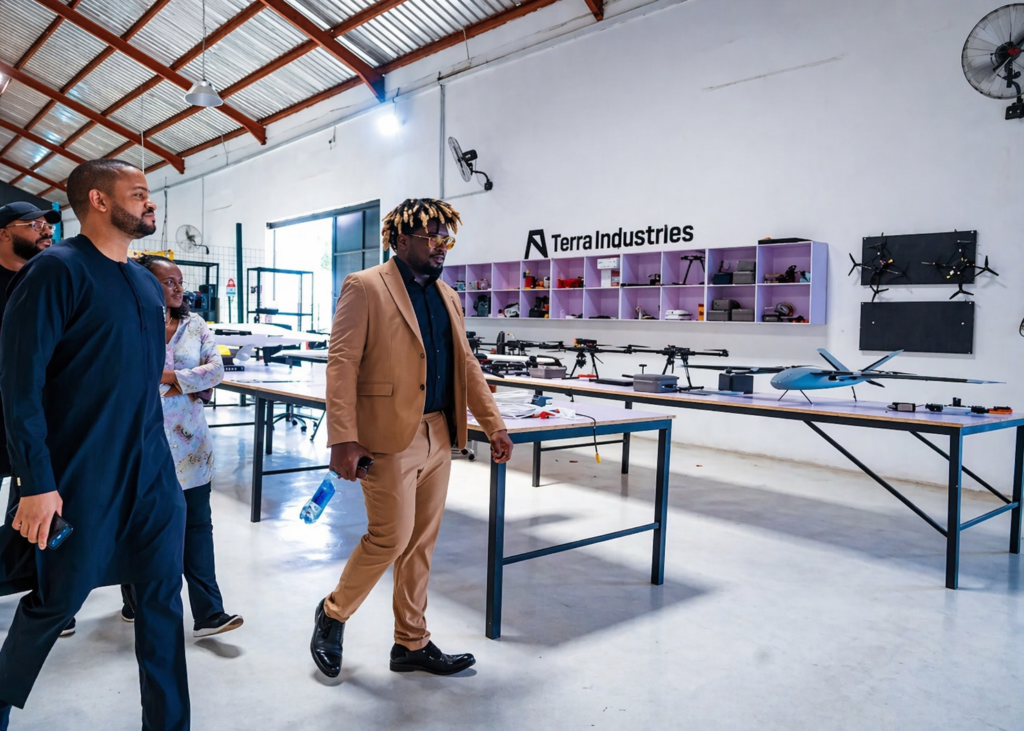
Terra Industries' 34,000 square foot Pax-2 drone manufacturing facility in Accra is the first node of an intra-African defence-industrial complex with Nigeria exporting military-manufacturing capability to Ghana in a transaction that is simultaneously a commercial venture, a sovereignty statement, and a proof of concept for the proposition that African states can produce, not merely procure, the strategic technologies their security environments require. The question is not whether the Pax-2 factory matters. It is whether Ghana and the continent can scale the institutional, financial, and technical infrastructure required to make this node the beginning of a system rather than a one-off.
The strategic framing of the Pax-2 launch requires separating two distinct claims: that African states are beginning to build sovereign defence-industrial capacity, which is demonstrably true and historically significant; and that this capacity is immediately competitive with Turkey's Bayraktar TB2, Chinese mid-tier UAV systems, or Israeli advanced drone platforms, which requires considerably more evidence than a factory opening provides. Both claims can be true simultaneously the first is a structural inflection point, the second is an aspiration with a multi-year development timeline.
What is analytically unambiguous is the import dependency problem Pax-2 addresses. African governments purchasing Bayraktar TB2 systems at $3–5 million per unit, Chinese UAV systems at $1–4 million, and Israeli platforms at premium pricing are paying foreign currency for strategic capability while building no domestic industrial knowledge base, no local maintenance infrastructure, and no supply chain that would allow that capability to persist if the foreign supplier relationship changes. Local manufacturing at 30–50% lower lifecycle cost — even at a significant capability discount from frontline global systems — changes that calculus structurally.
Sources: AfDB, IMF, World Bank • Calculations & Modelling: Limitless Beliefs Consulting
Nigeria Exports Manufacturing Capability to Ghana The Intra-African Defence Supply Chain Thesis
The structural novelty of the Pax-2 facility is not the drone it is the origin of the manufacturing capability. Terra Industries is a Nigerian-origin entity bringing defence-industrial capability into Ghana. That Nigeria-to-Ghana knowledge transfer is the first instance of what could become an intra-African defence manufacturing ecosystem where technical capability, intellectual property, and industrial process knowledge flows between African states rather than from external suppliers into African defence ministries.
The geopolitical significance of that distinction is considerable. African states that purchase defence equipment from Turkey, China, or Israel are dependent on those supplier relationships for maintenance, spare parts, software updates, and capability upgrades for the entire lifecycle of the system. A supplier-state can constrain, condition, or withdraw that support in response to political events that have nothing to do with the African purchaser's security requirements. African-manufactured systems, with African supply chains and African maintenance infrastructure, do not carry that dependency which is a strategic asset that no unit cost comparison can adequately capture.
“Africa has been a customer of the global defence-industrial complex for seventy years. The Pax-2 factory is the first credible evidence that it is beginning to become a producer and the distance between those two positions is measured in decades of industrial sovereignty.”
Sources: Interpol, Regional Defence Data, Limitless Beliefs Consulting Analysis
Bayraktar, DJI Military, IAI Where Pax-2 Actually Sits in the Global Market
Positioning Pax-2 against the Bayraktar TB2, Chinese military UAV systems, and Israeli platforms in the same competitive tier is analytically premature at this stage and overstating the competitive position risks undermining the genuine strategic significance of what is actually occurring. The TB2 is combat-proven across multiple conflict theatres, produced at industrial scale, and supported by a state-backed Turkish defence export programme with diplomatic and financing infrastructure behind it. Chinese UAV systems benefit from China's manufacturing scale economics and strategic export relationships. Israeli systems carry four decades of operational refinement.
Pax-2's competitive positioning is more precisely regional than global: the ECOWAS and Central African security market where the specific operational requirements (border patrol, counter-insurgency, ISR over difficult terrain), the political dynamics (preference for non-Western suppliers amid global alignment fragmentation), the budget constraints (making $3–5M per imported unit a significant fiscal burden), and the proximity advantage (faster delivery, local maintenance, regional customisation) all create a market niche that a well-executed African manufacturer can fill without needing to compete with Turkish or Chinese platforms in their core markets.
Sources: AfDB, Interpol, Regional Defence Data • Calculations & Modelling: Limitless Beliefs Consulting
Sources: AfDB, IFC Industrial Data • Calculations & Modelling: Limitless Beliefs Consulting
From Customer to Producer The Industrial Sovereignty Calculation
The deepest significance of the Pax-2 facility has nothing to do with unit costs or ECOWAS market share. It is the knowledge economy implication. Advanced manufacturing particularly in defence technology, electronics, and precision engineering is the category of industrial activity that builds the technical workforce, institutional knowledge, and supply chain ecosystem that everything else in a modern industrial economy depends on. African states that have been customers of global defence-industrial systems for seventy years have built none of that indigenous capability. A factory that employs 300–600 engineers, systems integrators, and precision manufacturing specialists is not just producing drones. It is producing the technical human capital that Ghana's broader industrial economy needs.
The spillover effects from defence manufacturing into civilian technology sectors software, AI, electronics, materials science are documented across every country that has built a defence-industrial base. Israel's technology sector, South Korea's electronics industry, and Turkey's drone capability all have defence-industrial roots that created civilian technology ecosystems through the same knowledge transfer mechanisms. Ghana is not at that stage. But the Pax-2 facility is where that trajectory begins, if the institutional commitment to sustain and scale it follows the initial launch.
The Pax-2 drone factory in Accra is the right development at the right moment in Africa's industrial trajectory and assessing it correctly requires neither overstating its immediate competitive position nor understating its structural significance. It is not a Bayraktar. It is a beginning. The continent that has been a customer of global defence technology for seventy years has opened its first credible intra-African manufacturing node. Whether that node becomes a system depends on whether Ghana's government, ECOWAS partners, and African development finance institutions treat this as the industrial sovereignty infrastructure investment it is and fund the next phase accordingly. That is the test. The factory has passed the first one.