
Desk: Uncategorized Desk
Published: May 7, 2026
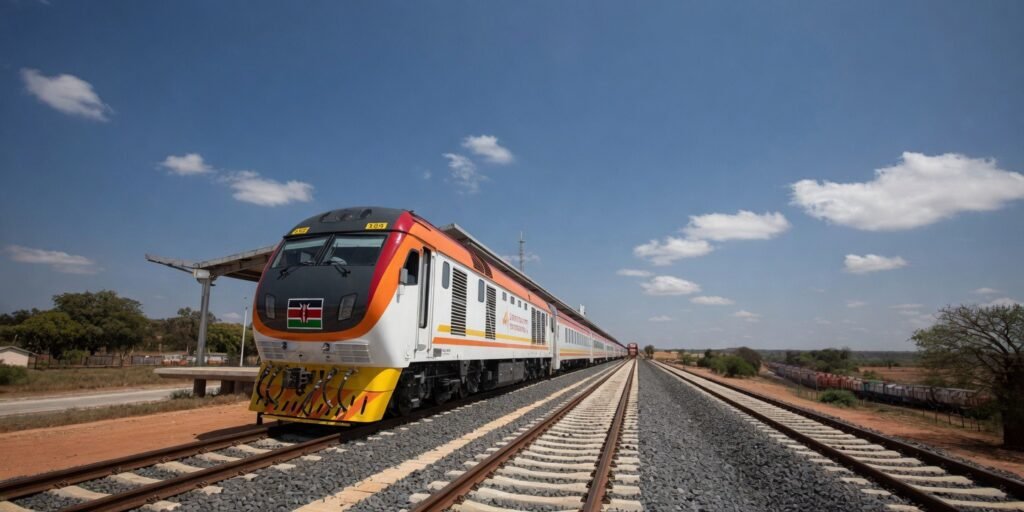
Kenya’s Standard Gauge Railway (SGR) Phase 2B, spanning approximately 264 km from Naivasha to Kisumu, represents more than a transport upgrade it is a strategic economic repositioning of East Africa’s trade architecture. Backed by the Kenyan government and China Communications Construction Company (CCCC), the project aims to connect inland production zones directly to Lake Victoria and eventually to Uganda’s rail network. With transport costs in East Africa accounting for up to 40% of the final cost of goods in landlocked regions compared to 10-15% in developed economies the SGR Phase 2B’s projected 30-40% reduction in freight costs could be transformative. But infrastructure alone does not guarantee competitiveness. Policy alignment, customs efficiency, and tariff harmonization determine whether capital flows follow the rails.
The SGR extension to Kisumu is part of a broader regional logistics vision that extends to Malaba (Phase 2C) and ultimately to Uganda, Rwanda, and potentially South Sudan. This corridor competes directly with Tanzania’s Central Corridor (Dar es Salaam to the Great Lakes region) and the Ethiopia-Djibouti rail network. Countries that align tariff policies, customs efficiency, and regulatory frameworks will benefit first. The railway is a tool. Policy determines its economic conversion rate.
Sources: AfDB, World Bank, Kenya Transport Ministry • Analysis: Limitless Beliefs Consulting
Economic Impact GDP, Trade, and Cost Efficiency
Kenya’s infrastructure sector contributes roughly 7–9% of GDP, with large scale projects like the SGR expected to drive incremental GDP growth of 1–1.5 percentage points annually through productivity gains and reduced logistics costs. The multiplier effect operates through multiple channels: lower freight costs reduce input prices for manufacturers and farmers; faster transit times reduce working capital requirements (inventory holding costs); and improved reliability enables just in time supply chains that were previously impossible in East Africa.
The comparison table below positions Kenya’s SGR investment against regional competitors:
| Corridor | Primary Port | Rail Connection to Hinterland | Comparative Advantage |
|---|---|---|---|
| Kenya SGR (Northern Corridor) | Mombasa | Nairobi → Kisumu → Malaba → Kampala | Shorter distance to Uganda/Rwanda; mature logistics ecosystem |
| Tanzania (Central Corridor) | Dar es Salaam | Isaka → Kigali → Kampala (pending) | Chinese-financed SGR under construction; potential bypass option for Uganda |
| Ethiopia-Djibouti Corridor | Djibouti | Addis Ababa → Djibouti | Electric SGR operational; landlocked Ethiopia’s primary artery |
Sources: AfDB, IMF, World Bank, KNBS • Analysis: Limitless Beliefs Consulting
“Infrastructure alone does not guarantee competitiveness. The railway is a tool. Policy determines its economic conversion rate. Tariffs, customs, and regulation are the real levers.”
Employment EffectsConstruction Jobs vs Structural Transition
The construction phase of SGR Phase 2B is projected to create approximately 5,000–7,000 direct jobs and over 15,000 indirect jobs across supply chains, including cement, steel, logistics, and engineering services. This is meaningful employment in a country where youth unemployment exceeds 15% (and is significantly higher among young women and rural populations).
However, a structural trade-off exists. While infrastructure projects create temporary construction employment, automation and efficiency gains in rail logistics will reduce long-term labor demand in traditional trucking and informal transport sectors. The SGR Phase 1 already reduced freight truck traffic on the Mombasa-Nairobi corridor by an estimated 30-40%, displacing thousands of trucking jobs. The net employment effect is positive if displaced workers transition to higher-value logistics services (warehousing, cold chain, freight forwarding). But transition is not automatic. Retraining programs and social safety nets determine whether efficiency gains become shared prosperity or concentrated displacement.
Financing Reality Debt Sustainability vs Long-Term Returns
The SGR expansion remains capital-intensive, with multi-billion dollar financing requirements largely supported by sovereign borrowing from Chinese financial institutions (Exim Bank of China) and bilateral agreements. Kenya’s public debt-to-GDP ratio, currently hovering around 65–70%, raises sustainability concerns. The IMF has flagged debt distress risks, and debt service payments now consume a significant portion of government revenue reducing fiscal space for health, education, and other development priorities.
The success of SGR Phase 2B depends on freight volume utilization and tariff optimization. The railway must attract sufficient cargo volume from road transport to generate revenue adequate for debt service. This requires: competitive pricing (freight tariffs that undercut road transport); reliability (predictable transit times that road cannot match); and customs efficiency (reducing border delays that currently erode rail’s time advantage). Without these, the SGR becomes a strategic asset with an unsustainable liability attached.
Sources: AfDB, World Bank, Kenya Railways, Tanzania Railways Corporation • Analysis: Limitless Beliefs Consulting
Sources: AfDB, PIDA, World Bank • Analysis: Limitless Beliefs Consulting
Regional IntegrationInfrastructure as Enabler, Not Driver
The SGR Phase 2B positions Kenya as a regional logistics hub, directly competing with Tanzania’s Central Corridor and the Ethiopia-Djibouti rail network. The extension toward Malaba (Phase 2C) will further integrate Uganda and potentially Rwanda into the system. But the railway’s value depends on broader institutional integration: the African Continental Free Trade Area (AfCFTA) provides the policy framework; the SGR provides the physical infrastructure; but between them lies customs harmonization, tariff alignment, and regulatory mutual recognition.
Africa’s infrastructure deficit is estimated at $100 billion annually, with financing gaps of $68–108 billion depending on the estimate. Projects like Kenya’s SGR highlight a broader continental trend: infrastructure-led growth is accelerating, but benefits are uneven. East Africa is emerging as a leader in infrastructure execution, while other regions lag due to regulatory inefficiencies and financing constraints. This divergence will shape capital allocation across the continent. Investors will follow functional infrastructure. Countries that build it and align policy to maximize it will attract disproportionate capital.
Sources: Kenya National Bureau of Statistics, World Bank • Analysis: Limitless Beliefs Consulting
Bottom Line: Kenya’s SGR Phase 2B is a critical investment in East Africa’s trade architecture a necessary condition for reducing logistics costs from 40% to 25-30% of goods value and accelerating GDP growth toward 6.5-7% by 2028. But infrastructure alone is insufficient. The railway will carry freight efficiently only if customs procedures harmonize, tariffs align, and border delays shrink. It will generate revenue only if priced competitively against road transport. It will attract regional cargo only if Uganda and Rwanda’s rail connections materialize. The real story is not the 264 km of track from Naivasha to Kisumu. It is whether East Africa can build the institutional framework customs unions, trade facilitation, regulatory convergence that maximizes the railway’s value. Infrastructure is the hardware. Policy is the operating system. Neither works without the other.