Desk: Uncategorized Desk
Published: May 18, 2026
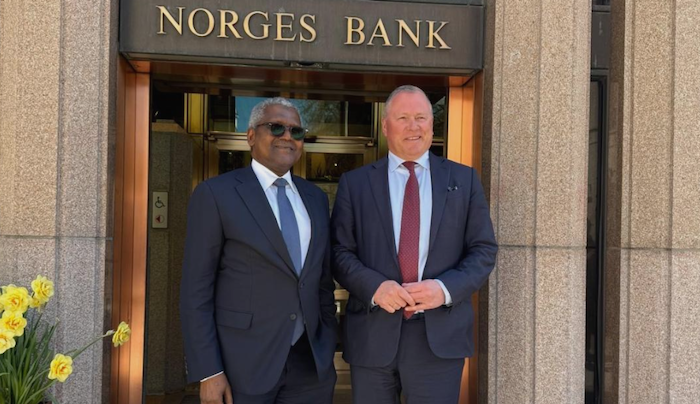
The reported interest by Norway’s sovereign wealth fund one of the world’s largest with assets exceeding $1.7 trillion in partnering with the Dangote Group on strategic African investments signals more than a corporate financing discussion. It represents a broader shift in how global institutional capital is beginning to view African industrialization. For years, Africa was primarily framed as a commodities extraction market. Today, groups like Dangote are attempting to reposition the continent as a manufacturing, refining, logistics, and industrial processing hub capable of capturing more value domestically. The Dangote Group’s expansion across cement, fertilizer, petrochemicals, logistics, and refining increasingly positions the company as one of Africa’s most vertically integrated industrial conglomerates and a potential template for the continent’s industrial future.
Norway’s sovereign wealth fund Norges Bank Investment Management (NBIM) traditionally prioritizes long-term infrastructure, energy, and industrial investments with patient capital horizons. Its reported interest in Dangote reflects rising international confidence in African industrial scale projects, particularly those linked to energy security, fertilizer production, refining capacity, regional trade infrastructure, and food security supply chains. This aligns with Africa’s urgent need for industrial investment as population growth accelerates toward 2.5 billion people by 2050 and food import bills exceed $75 billion annually.
Sources: Dangote Group, AfDB, IMF • Analysis: Limitless Beliefs Consulting
Dangote’s Expansion Strategy Building African Industrial Sovereignty
Dangote’s model is not simply about selling products. It is about controlling entire industrial chains: cement production, crude oil refining, petrochemicals, fertilizer manufacturing, port logistics, and gas infrastructure. This vertical integration reduces dependence on imports while increasing domestic industrial output. The Dangote Refinery alone with capacity of 650,000 barrels per day is expected to significantly reduce Nigeria’s refined fuel import dependence, potentially saving billions annually in foreign exchange costs that have historically exceeded $10–15 billion per year.
The table below maps Dangote’s industrial footprint across key sectors and economic impact:
| Sector | Scale/Capacity | Economic Impact |
|---|---|---|
| Cement | 50M tonnes annually (Africa’s largest) | Supports regional infrastructure; exports across West Africa |
| Refining | 650,000 bpd (world’s largest single-train) | Eliminates fuel imports; saves $10–15B annually in FX |
| Fertilizer | 3M tonnes annually (urea) | Improves agricultural yields across West Africa; reduces food import dependence |
| Petrochemicals | Polypropylene, other derivatives | Supplies manufacturing inputs; reduces industrial import dependence |
| Logistics & Ports | Port infrastructure, gas pipelines | Enables export of refined products and fertilizers; reduces port congestion |
“The shift from raw commodity extraction to industrial value capture changes export economics, employment quality, tax revenue generation, and supply chain resilience. Dangote is the clearest example of African industrial capitalism at scale.”
Sources: AfDB, IMF, World Bank, UNIDO • Analysis: Limitless Beliefs Consulting
Employment and Upward Mobility Potential Layered Job Creation
Large-scale industrial projects create layered employment effects that extend far beyond direct factory hires. Dangote-linked industrial ecosystems generate: direct industrial jobs (plant operations, maintenance, engineering); construction employment (during project development phases); transportation and logistics roles (supply chains, distribution); SME supplier opportunities (local procurement networks); and professional services (legal, financial, consulting).
Analysts estimate that Dangote linked industrial ecosystems indirectly support tens of thousands of jobs across Nigeria and neighboring markets. The broader implication is upward mobility: expansion of technical middle class employment, growth of local supplier ecosystems, and increased industrial skill transfer. For a continent where youth unemployment exceeds 30% in many economies, industrial job creation with its higher productivity and wages relative to informal services is a critical development lever.
The Policy Problem Africa’s Industrial Bottleneck
Despite expansion momentum, regulatory instability remains one of the largest barriers to industrial growth across Africa. Key constraints include: FX volatility (particularly acute in Nigeria, where currency illiquidity complicates imported inputs); infrastructure deficits (power, ports, rail); regulatory inconsistency (policy reversals, licensing delays); port inefficiencies (congestion, clearance times); energy reliability issues (grid instability, diesel dependence); and cross-border tariff barriers (AfCFTA implementation incomplete).
These policy frictions increase operating costs and reduce investor confidence. The doughnut chart below illustrates the relative weight of these bottlenecks based on industrial survey data:
Sources: AfDB, World Bank, IFC, Manufacturers’ surveys • Analysis: Limitless Beliefs Consulting
Africa’s Infrastructure Investment Gap $130–170B Annually
Africa requires over $130–170 billion annually in infrastructure investment according to development finance estimates from the African Development Bank and World Bank. This includes: energy infrastructure (generation, transmission, distribution), ports and maritime logistics, rail systems, industrial parks and special economic zones, and road logistics networks. Private industrial groups like Dangote increasingly fill gaps traditionally left to governments—building dedicated port facilities, gas pipelines, and power infrastructure to secure their own operations while benefiting surrounding communities.
The table below compares Africa’s infrastructure metrics to global benchmarks:
| Infrastructure Metric | Sub-Saharan Africa | South Asia | East Asia | OECD |
|---|---|---|---|---|
| Power Generation per capita (kWh) | 550 | 900 | 4,500 | 8,000 |
| Paved Road Density (km/1000 km²) | 120 | 600 | 1,500 | 3,000 |
| Port Efficiency (days to clear) | 15–20 | ~8–12 | 3–5 | 2–3 |
Sources: Norges Bank Investment Management, Dangote Group, AfDB • Analysis: Limitless Beliefs Consulting
Sources: AfDB, PIDA, World Bank • Analysis: Limitless Beliefs Consulting
Industrial Capital Is Replacing Commodity Dependency
One of the most important shifts underway in African economics is the transition from raw commodity extraction to industrial value capture. This transition changes export economics (higher unit value, less price volatility), employment quality (formal manufacturing jobs versus informal mining), tax revenue generation (corporate taxes, value-added taxes, income taxes), and supply chain resilience (domestic processing reduces import dependence).
The countries likely to benefit most from this shift are those that reduce regulatory unpredictability, improve power infrastructure, support industrial financing mechanisms, and enable regional trade integration through AfCFTA implementation. If institutional investors increasingly partner with African industrial firms, large-scale industrialization could accelerate, regional manufacturing ecosystems could expand, African supply chain independence could improve, and private-sector-led infrastructure development could rise. However, execution risk remains significant. Industrial ambition alone is not enough. Policy alignment, infrastructure reliability, and regulatory consistency will determine whether Africa’s industrial expansion becomes transformational or fragmented.
Bottom Line: The reported Norway-Dangote investment discussions symbolize a larger trend: global capital is beginning to recognize African industrialization as investable at scale. Dangote’s expansion strategy vertical integration across cement, refining, fertilizer, petrochemicals, and logistics represents one of the continent’s clearest examples of industrial capitalism. The Dangote Refinery alone could save Nigeria $10–15 billion annually in foreign exchange. Fertilizer production improves agricultural yields across West Africa. Cement exports support regional infrastructure growth. But the binding constraints remain policy based: FX volatility, infrastructure deficits, regulatory inconsistency. A partnership with Norway’s $1.7 trillion sovereign wealth fund would not just bring capital—it would bring credibility, technical expertise, and a signal to other global investors. The long-term winners in Africa’s next economic cycle may not be countries that merely export raw resources—but those that build industrial ecosystems capable of processing, refining, manufacturing, and exporting value-added products at scale. Dangote is leading that shift. Whether others follow depends on the policy environment that African governments choose to create.