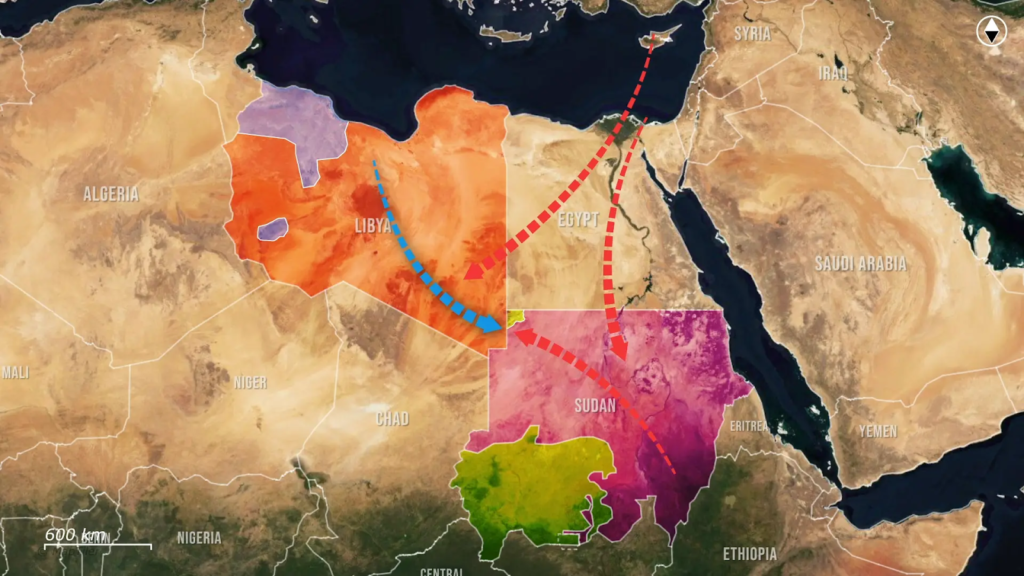
Satellite imagery captured between late 2025 and early 2026 has mapped suspected RSF supply corridors running from Subul al-Salam base in south-eastern Libya through Chad's checkpoint network and into Sudan a decentralised logistics infrastructure operating at a cost structure so asymmetric relative to state counter-measures that it sustains conflict at a fraction of what formal military supply chains cost, while simultaneously suppressing GDP by an estimated -18% in Sudan, generating a 3% annual drag in Chad, and diverting billions in trade revenue from formal customs systems across Africa's most strategically important north-south corridor.
The routes are not improvised. Repeated vehicle movement patterns consistent with organised heavy truck logistics, route bifurcation near the Chad border, and the network's origin at Kufra a Libyan desert hub with historical significance as a trans-Saharan trade and smuggling nexus indicate deliberate infrastructure development rather than opportunistic cross-border movement. The split between Chadian and Sudanese route branches reflects the kind of redundancy planning that distinguishes sustained logistics operations from temporary supply runs.
Over 60% of border areas in the Sahel remain under-monitored or lightly governed according to AfDB and Interpol assessments creating the operating environment in which these corridors function. The terrain complexity of the Libya-Chad-Sudan desert corridor is not incidental to the route selection: it is the primary security feature of the network, replacing the physical security that state actors deploy to protect supply lines with geographic inaccessibility that achieves the same result at zero cost.

Kufra to Subul al-Salam to Chad Checkpoint Reading the Route Architecture
The satellite imagery's most analytically significant feature is the route architecture rather than any single node. Subul al-Salam base in south-eastern Libya serves as the staging point a location with existing infrastructure, proximate to the Kufra basin's informal fuel and supply networks, and positioned at the geographic threshold between Libya's lightly governed southern territory and the trans-Saharan desert corridor toward Chad. The RSF camp node positioned between Libya and the Chad checkpoint represents the operational hub where supply redistribution occurs before the final leg into Sudanese territory.
The bifurcation design at the Chad border is the network's most important structural feature. A single-route supply chain has a single point of interdiction failure; a bifurcated network with independent Chad and Sudan branches requires simultaneous interdiction at two separate endpoints to functionally disrupt. State security forces with limited surveillance coverage and significant terrain constraints cannot achieve that simultaneity consistently which is why the network persists despite acknowledged awareness of its existence by regional governments.
“The RSF supply corridor is not a security problem that more military spending will solve. It is a governance problem 60% under-monitored border territory cannot be secured by forces deployed at 40% of the coverage required.”
$800 Motorcycles vs $40,000 Trucks The Asymmetric Cost Structure of Desert Logistics
The operational cost asymmetry between RSF supply chain logistics and formal state counter-measures is the defining structural feature of why these networks persist. Non-state logistics in the Sahel desert corridor can be sustained at a fraction of what it costs state forces to monitor and interdict them.
Sources: Interpol, Regional Defence Data • Analysis: Limitless Beliefs Consulting
-18% GDP in Sudan, -3% in Chad The Trade Corridor Damage Assessment
Sudan's -18% GDP contraction is the most severe economic consequence of active conflict in Africa in 2025–2026 a collapse of that magnitude in an economy of Sudan's size represents the destruction of decades of economic development in a compressed timeline. The RSF supply corridor's role in sustaining active conflict directly contributes to that contraction: every month of conflict prolonged by supply chain sustainability is a month of economic destruction at the -18% annual rate.
Chad's 3% annual GDP drag from security expenditure and trade disruption reflects a different but equally damaging dynamic the opportunity cost of a country spending 3–4% of GDP on military deployment to manage a border security problem that formal governance infrastructure would address more efficiently. Resources allocated to military border operations are resources not allocated to agriculture, infrastructure, education, or the economic development investments that would reduce the poverty and marginalisation that sustain insurgent recruitment pipelines.
Sources: AfDB, Afreximbank, Interpol • Calculations & Modelling: Limitless Beliefs Consulting
Sources: AfDB, IMF Defence Data • Calculations & Modelling: Limitless Beliefs Consulting
AfCFTA's 50% Trade Growth Potential What the Corridor Costs at Continental Scale
Afreximbank's estimate that intra-African trade could increase by over 50% under AfCFTA full implementation provides the continental frame for what the Libya-Chad-Sudan corridor disruption actually costs. The north-south trade corridor connecting North Africa to Sub-Saharan Africa through this geography is one of the continent's primary commercial arteries carrying agricultural goods, manufactured inputs, energy products, and the informal trade that sustains millions of livelihoods across three countries and their neighbours.
Informal routes that divert economic activity from formal customs systems do not just reduce government tax revenues they create a parallel economy with its own price structures, financing mechanisms, and commercial relationships that become embedded over time and increasingly difficult to formalise as formal alternatives emerge. The economic cost of the RSF corridor is not only the immediate trade disruption it is the structural embedding of informality in a commercial geography that AfCFTA needs to formalise if the 50% trade growth projection is to be realised.
The RSF supply corridor across Libya, Chad, and Sudan is three things simultaneously: a military logistics problem, an economic disruption mechanism, and a governance failure indicator. The satellite imagery confirms what regional security analysts have documented the network exists, it is organised, and it is sustained by a cost asymmetry that makes interdiction without comprehensive governance reform a tactical holding action rather than a strategic solution. Until border monitoring infrastructure covers the 60% of Sahel border territory that is currently ungoverned, until Chad and Sudan can redirect military spending toward economic development that closes the recruitment pipeline, and until the north-south corridor's formal trade economics become more attractive than the informal alternative this network will persist, and AfCFTA's trade growth potential will continue to be partially offset by the insecurity tax that every business operating in this corridor pays.