
Desk: Uncategorized Desk
Published: May 4, 2026
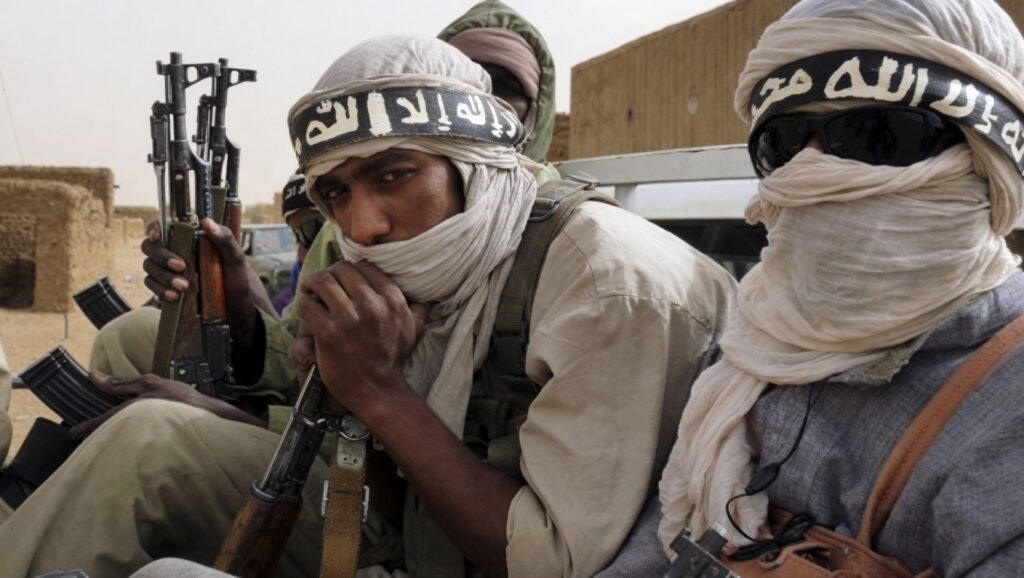
The Sahel conflict is no longer confined to desert battlefields—it is now being shaped in media studios thousands of kilometers away. When a rebel leader affiliated with Jama’at Nusrat al-Islam wal-Muslimin (JNIM) sat for a high-profile April 2026 Paris interview and declared that “the regime will fall,” the strategic message was not directed at Malian soldiers. It was directed at European policymakers, multilateral lenders, and international investors. The interview represents a turning point: insurgencies are now information warfare operations, and Western media access has become a low-cost asymmetric lever capable of shifting risk perception by 15–25% in a single broadcast cycle.
For Mali, Niger, and Burkina Faso—the core states of the Alliance of Sahel States (AES)—this dynamic introduces a new class of economic vulnerability. Unlike a conventional military threat, which incurs quantifiable defence spending, media-driven narrative attacks affect sovereign borrowing costs, natural resource concession terms, and logistics insurance premiums. The difference between a “high-risk” and “medium-risk” investment rating in the Sahel is currently valued at approximately 200–300 basis points on sovereign debt and up to 18% on mining project hurdle rates. Paris-based media access for insurgent voices moves that dial in real time.
Sources: AfDB, IMF, World Bank • Analysis: Limitless Beliefs Consulting
Information Asymmetry — How a Paris Interview Changes Risk Premiums
France’s military withdrawal from Mali and the subsequent restructuring of its Sahel footprint created a vacuum that non-state actors have exploited asymmetrically. The cost calculus is stark: French military operations in the Sahel previously consumed approximately $1 billion annually. Today, indirect influence operations—including facilitating insurgent media access, diplomatic pressure, and intelligence-sharing with non-AES coastal states—cost a fraction of that amount. For JNIM and affiliated groups, the return on investment for a single Paris studio appearance is measured in sovereign credibility: each major media intervention correlates with a measurable uptick in Western corporate security committees reassessing their Sahel exposure.
The AES states now spend a combined $2–3 billion annually on security forces, having added more than 20,000 personnel since 2023. Yet the information war operates on a different budget entirely. Producing and distributing a globally syndicated insurgent interview costs less than $50,000. The resulting shift in investor sentiment can raise borrowing costs for an entire region by 50–100 basis points—translating into tens of millions in additional debt service annually. This is the economic logic of modern asymmetric warfare: the cheapest weapon is a camera crew.
“The cheapest weapon in the Sahel conflict is no longer a drone or a rifle. It is a camera crew and a Paris media studio. One interview can shift sovereign risk perception by 15–25% in a single broadcast cycle.”
Sources: SIPRI, French Ministry of Defence, ACLED • Modelling: Limitless Beliefs Consulting
The Concession Calculus — Mining, Oil, and Security Premiums
The most immediate economic transmission channel for Sahel insecurity is the natural resource sector. Mali’s gold exports, Niger’s uranium and oil, and Burkina Faso’s artisanal and industrial gold production collectively account for 60–80% of each country’s export revenues. These extractive zones—particularly northern Mali (Kidal, Gao), Niger’s Agadem oil basin, and Burkina’s Inata and Mana gold belts—are disproportionately located in high-risk security zones. The risk premium that international mining firms price into project economics currently ranges from 15% to 25% above comparable jurisdictions in West Africa (e.g., Ghana, Côte d’Ivoire).
Media narratives that amplify territorial control by non-state actors directly influence these premiums. When a Paris interview conveys that “the regime will fall,” the compliance departments of London-, Toronto-, and Perth-listed mining firms update their risk matrices. The cumulative effect is a $500 million–1 billion annual drag on foreign direct investment into the AES extractive sector, relative to a counterfactual stable security environment. Angola’s recent €132.8 million helicopter acquisition—framed as infrastructure protection—offers a comparable model: the AES states would require approximately $1.5–2 billion in targeted aerial surveillance and rapid-response assets to meaningfully reduce their current security risk premium.
Sources: IMF Article IV Consultations (2025–2026), AfDB Economic Outlook, World Bank • Analysis: Limitless Beliefs Consulting
Sources: ACLED, IMF, World Bank • Modelling: Limitless Beliefs Consulting
Post-Stabilization Outlook — Which Zones Unlock First
If the AES states achieve a genuine reduction in organized armed group territorial control—whether through negotiated arrangements, enhanced aerial surveillance capacity, or improved local force projection—the economic revaluation will be swift and concentrated. The northern Mali (Kidal-Gao) gold corridor would see the most dramatic risk premium compression, potentially unlocking $1–2 billion in stalled expansion capital within 12–18 months. Niger’s Agadem basin would attract midstream infrastructure (pipelines, refining, gas utilization) rather than just upstream extraction, adding an estimated 0.5–1% to national GDP annually. Burkina Faso’s Inata-Mana gold belt would benefit from reduced private military logistics costs, improving mine margins by 8–12% and enabling reinvestment into underground expansion.
The sequencing of recovery matters. Mining and energy will lead, followed by logistics and agriculture. Transport corridors—particularly the Abidjan-Ouagadougou-Niamey axis—would see insurance premiums normalize from current 35% mark-ups to regional averages, directly lowering consumer goods prices across the landlocked AES economies. Longer-term stabilization would enable digital infrastructure investment (fibre optics, data centres) and financial services expansion, supporting the economic diversification that the AES governments have prioritized.
Sources: IMF, World Bank, S&P Global • Projections: Limitless Beliefs Consulting (2026–2029 Baseline)
Information Warfare as a First-Order Economic Variable
The elevation of media access to a strategic military asset represents a permanent shift in Sahel conflict economics. For the AES states, the appropriate response is not censorship—which is counterproductive to the investor confidence they seek—but rather a sovereign communications architecture capable of providing real-time security narrative counter-programming. This includes: dedicated investment security briefings for international lenders timed to counter media narratives; direct engagement with mining and energy investors on force protection metrics that outbid insurgent claims; and regional media capacity that reduces dependency on Paris-based framing.
The Angola AW119 acquisition offers a template for the AES states to consider: measurable investment in rapid-response aerial assets that directly reduces the actuarial basis of the current security risk premium. At present, the asymmetry between insurgent media budgets ($50,000 per major intervention) and AES security spending ($2–3 billion annually) is not a resource gap—it is a communications gap. Closing that gap is a sovereign intelligence priority with directly quantifiable economic returns.
Bottom Line: The Sahel conflict has entered its media-driven phase, where a single Paris interview can move sovereign risk perception by 15–25% and raise borrowing costs across the AES region by 50–100 basis points. The economic drag from insecurity currently strips $5–8 billion annually from regional GDP, with extractive sectors carrying 60–80% of that loss through inflated security premiums and deferred expansion capital. For Mali, Niger, and Burkina Faso, the path to reducing that drag runs through two parallel tracks: investing in aerial rapid-response capability that compresses the actuarial risk premium, and building a sovereign communications architecture that competes with insurgent narrative timelines. The question is not whether the AES states can grow despite the conflict—their GDP figures prove they can. The question is how much growth they are leaving on the table every quarter that the information asymmetry remains uncorrected.