
Desk: Uncategorized Desk
Published: May 27, 2026
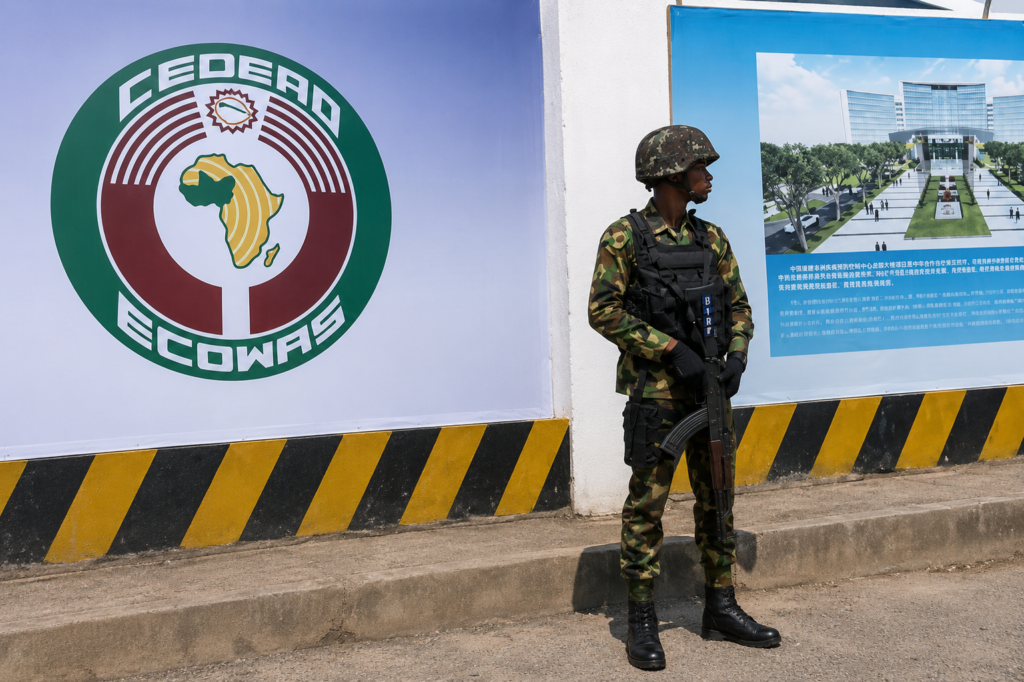
The Economic Community of West African States (ECOWAS) is once again attempting to operationalize one of Africa’s most ambitious regional military projects: a unified counterterrorism force designed to contain insurgency expansion across the Sahel and coastal West Africa. In February 2026, ECOWAS chiefs of staff endorsed plans for a regional force under the African Union’s Standby Force mechanism. While earlier proposals envisioned a massive 260,000 troop force with an estimated annual budget of $2.5 billion, the current operational blueprint centers around a 1,650 soldier counterterrorism brigade as the core deployment force. Participating countries include Nigeria, Ghana, Senegal, Benin, Côte d’Ivoire, and The Gambia. The initiative reflects growing recognition that violent extremist groups operating across the Sahel are no longer isolated security threats they are economic disruptors capable of shutting down trade corridors, discouraging investment, increasing sovereign borrowing costs, and destabilizing regional supply chains at an estimated annual cost of $10–18 billion.
The timing is critical. Burkina Faso, Mali, and Niger—now outside ECOWAS after the 2025 withdrawals—have redirected substantial portions of their national budgets toward defense procurement, military recruitment, and emergency stabilization programs. The long-term economic consequence is that infrastructure development, education investment, and industrial growth often become secondary priorities. Meanwhile, coastal states like Benin, Togo, Ghana, and Côte d’Ivoire face rising spillover risk as insurgent groups push southward.
Sources: AfDB, IMF, World Bank, Interpol • Analysis: Limitless Beliefs Consulting
The Economic Cost of Terrorism 2–6% of GDP Annually
West Africa’s security crisis is rapidly evolving into a full-scale economic problem. Terror attacks and insurgent expansion have increased insurance premiums for transportation firms by an estimated 15–25%, weakened agricultural productivity in vulnerable border regions (particularly northern Benin and Togo), disrupted mining operations (gold in Burkina Faso and Mali), and raised operational costs for businesses across the Sahel and Gulf of Guinea trade routes. According to multiple regional estimates, insecurity now costs parts of West Africa between 2% and 6% of GDP annually when accounting for military spending, reduced investment flows, displaced populations, disrupted food systems, and weakened business activity. Nigeria alone continues allocating over $2.5 billion annually toward counterinsurgency operations against Boko Haram, ISWAP, and banditry networks.
The table below summarizes the security economic nexus across key countries:
| Country | Security Risk Level | GDP Growth Outlook | Post-Stabilization Investment Potential |
|---|---|---|---|
| Ghana | Moderate | High (4.5–5.5%) | Very Strong — Logistics, agro-processing |
| Côte d’Ivoire | Moderate | High (6–7%) | Strong — Ports, energy, manufacturing |
| Nigeria | High | Moderate-High (3–3.5%) | Very Strong — Agriculture, mining, manufacturing |
| Benin | Rising | Moderate (5–5.5%) | Emerging — Northern corridor logistics |
| Burkina Faso | Very High | Weak (2–3%) | Long-Term — Mining recovery |
| Mali | Very High | Weak (1.5–2.5%) | Mining-driven recovery potential |
“The core lesson from the G5 Sahel and Accra Initiative is clear: external donor dependence creates strategic vulnerability, political fragmentation weakens operational continuity, and military responses alone cannot defeat extremist recruitment ecosystems.”
Military Cooperation Strategic Progress or Structural Fragmentation?
ECOWAS leaders argue that the regional force is necessary because fragmented security operations have failed to stop extremist expansion. ECOWAS Commission President Omar Alieu Touray acknowledged that overlapping initiatives—including the G5 Sahel Joint Force, the Accra Initiative, AU operations, and UN missions have produced fragmented responses and inefficient coordination. This fragmentation is one of the most important security intelligence trends in modern Africa. Regional security architecture has become crowded with partially funded multinational missions lacking unified command structures, predictable logistics, or long-term financial sustainability.
The G5 Sahel Joint Force (created in 2014 by Burkina Faso, Chad, Mali, Mauritania, and Niger) initially showed promise but suffered from political instability and changing alliances. Similarly, the Accra Initiative (established in 2017 to protect coastal West Africa from Sahel spillover) suffered from limited funding, short duration missions, and operational constraints. The lessons learned are shaping ECOWAS’s new approach: a leaner, better-funded brigade with dedicated national contributions rather than donor-dependent financing.
Why Investors Are Closely Monitoring ECOWAS Security Policy
For international investors and African private capital groups, security stabilization is now directly tied to profitability. Trade corridors connecting inland agricultural and mining zones to ports in Ghana (Tema), Benin (Cotonou), Togo (Lomé), and Côte d’Ivoire (Abidjan) are becoming increasingly exposed to insurgent activity moving southward from the Sahel. Logistics companies, banks, insurers, mining firms, telecom operators, and agribusinesses are all recalculating operational risk exposure based on regional security conditions rather than purely political stability metrics. This creates a major investment paradox: West Africa remains one of the world’s youngest and fastest growing consumer markets (population projected to reach 500 million by 2035), but insecurity continues increasing transaction costs and operational uncertainty. Security stabilization could unlock billions in dormant investment capital currently sidelined by risk aversion.
Sources: LBNN Intelligence, AfDB, World Bank • Analysis: Limitless Beliefs Consulting
The Real Strategic Challenge Funding African Security Without Dependency
The ECOWAS initiative ultimately represents something larger than counterterrorism. It is a test of whether African regional organizations can build sustainable, self-funded security systems independent of unstable foreign donor cycles and shifting geopolitical interests. The challenge is enormous: without security, investment declines; without investment, governments cannot sustainably fund security; without regional coordination, insurgent groups exploit porous borders. West Africa’s future economic trajectory may depend on whether ECOWAS can successfully transition from fragmented reactive security operations toward integrated economic security planning capable of protecting trade, investment, and long-term development.
One emerging trend investors are monitoring is the expansion of low-cost drone surveillance and AI-assisted intelligence systems designed to help African governments secure vast rural territories with limited manpower. These technologies could reduce the cost of security provision by an estimated 30–50% over traditional patrol-based approaches, making sustainable self-funding more achievable.
Security Spending vs Economic Development The Jobs Trade-Off
One of the biggest dilemmas facing West African governments is balancing military spending with long-term economic development. Security operations create jobs through military recruitment, logistics contracts, intelligence operations, drone surveillance programs, and private security services. An estimated 45,000–70,000 regional jobs are linked to security expansion. However, prolonged instability simultaneously destroys productivity in agriculture, tourism, transportation, and manufacturing. The net employment effect of insecurity is negative in most West African countries, with job losses in productive sectors exceeding gains in security related employment by a factor of 3–5x.
Bottom Line: ECOWAS’s push for a 1,650 troop counterterrorism brigade is a necessary but insufficient response to West Africa’s security crisis. The annual economic cost of insecurity $10–18 billion in lost GDP exceeds the proposed $2.5 billion force budget by an order of magnitude. Security stabilization could unlock billions in dormant investment capital across northern Ghana, northern Côte d’Ivoire, northern Benin, and Nigeria’s agricultural belt. Agriculture, logistics, and mining would rebound first. But the binding constraints are not military they are financial and institutional. Without sustainable, domestically funded security architecture that outlasts donor cycles, ECOWAS risks repeating the failures of G5 Sahel and Accra Initiative. West Africa’s future economic trajectory depends on whether the region can build integrated economic security planning. The cost of failure is measured not just in lives lost, but in GDP points foregone and a generation of young West Africans denied the opportunity their region’s potential promises.