
Desk: Uncategorized Desk
Published: May 4, 2026
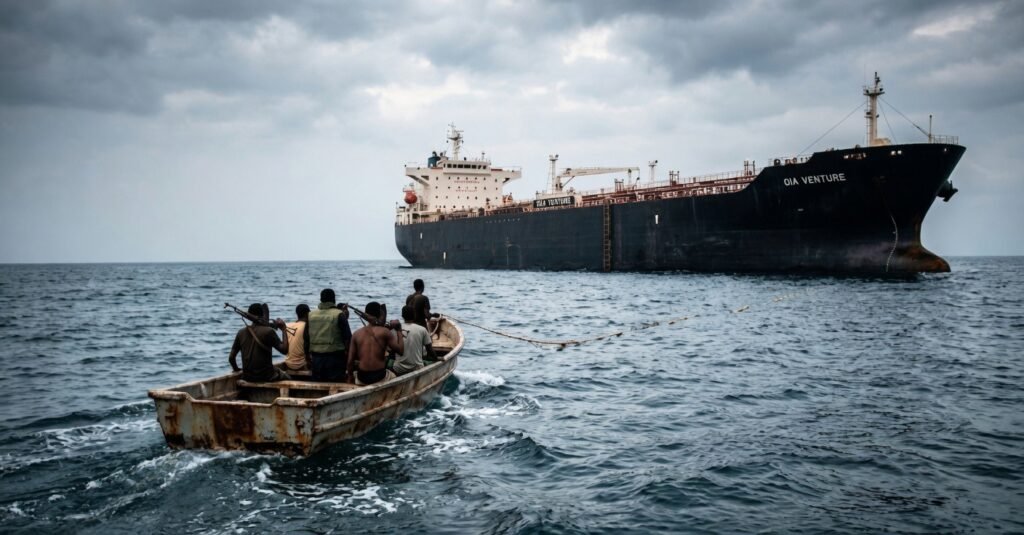
At a Florida rally in May 2026, the President of the United States told a cheering crowd: “We took over the cargo, took over the oil. It’s a very profitable business. We’re like pirates — we’re sort of like pirates.” This was not political hyperbole. It was a real-time confession that collapsed the legal and moral distinction between state-sanctioned maritime interdiction and the piracy that cost the global economy $7–$12 billion annually at its 2008–2012 peak and that the international community spent $1.3–$2 billion per year in naval operations to suppress. The Strait of Hormuz, through which 20% of the world’s seaborne oil and significant LNG volumes pass, now sits at the centre of the largest maritime security crisis since the 1970s energy shock. The question is no longer whether state actors are behaving like pirates. The question is what happens to the rules-based maritime order — and to Africa’s maritime-dependent economies — when the most powerful navy on earth openly says it is.
The Thucydides formulation “the strong do what they can, and the weak suffer what they must” has migrated from political philosophy into operational U.S. naval doctrine. When President Trump told supporters in April and May 2026 that U.S. forces had boarded Iranian commercial tankers, seized their cargo, and that this was “a very profitable business,” he was describing a pattern of maritime interdiction that began with the December 2025 seizure of the Venezuelan crude carrier Skipper a 333-metre very large crude carrier carrying 1.8 million barrels of Merey crude and has since escalated into a systematic naval blockade of Iranian maritime infrastructure. Tehran’s Foreign Ministry spokesperson Esmaeil Baghaei responded that Trump’s remarks were “a direct and damning admission of the criminal nature of their actions against international maritime navigation.” Venezuela’s government described the Skipper seizure as “barefaced robbery and an act of international piracy.” Both were right about the optics, even if the administration’s lawyers produced a seizure warrant. The warrant is not the point. The precedent is.
The Strait of Hormuz crisis that followed Operation Epic Fury the U.S.-Israeli air and maritime campaign launched on February 28, 2026 — has produced what the International Energy Agency has characterised as the “largest supply disruption in the history of the global oil market.” Brent crude surpassed $126 per barrel at its peak in March 2026, the fastest oil price rise in any conflict in recorded history. Tanker traffic through the strait dropped by 70% and then to effectively zero as the IRGC laid sea mines, boarded merchant vessels, and closed the waterway to all ships bound for U.S., Israeli, and allied ports. The IEA released an unprecedented 400 million barrels from strategic reserves. Maersk and Hapag-Lloyd suspended Middle East routes entirely. The disruption is estimated to have stranded over 2,000 ships and 20,000 mariners in the Persian Gulf.
Intelligence Note: Trump’s self-characterisation as a “pirate” is the first instance of a sitting U.S. president publicly describing active naval operations in terms that directly mirror the legal definition of piracy under UNCLOS Article 101 — “any illegal acts of violence or detention… committed for private ends by the crew or the passengers of a private ship.” The administration’s legal counter-argument rests on the seizure warrant issued by a U.S. federal court. International maritime law scholars note, however, that a domestic court warrant does not confer jurisdiction over vessels in international waters under UNCLOS’s framework a distinction that 168 signatory states will be weighing against the operational precedent now established.
Sources: IEA, IMF, Kpler, Lloyd’s Market Association, World Bank • Calculations & Modelling: Limitless Beliefs Consulting
From Somali Pirates to State Navies The $12 Billion Precedent That Justified Billions in Enforcement
The current crisis has a precise historical precedent and its economics expose the institutional contradiction at the centre of the current moment. Between 2008 and 2012, Somali piracy cost the global economy an estimated $7–$12 billion annually: ransom payments averaging $5–$10 million per vessel, insurance premium surges of 200–900% on high-risk voyages, and rerouting costs that added 10–14 days and up to 30% in additional fuel expenditure per voyage. Somali pirate networks generated $150–$400 million annually at peak an amount that sounds large until you compare it to the $1.3–$2 billion per year that the United States, NATO, and allied naval coalitions spent on counter-piracy operations through Combined Maritime Forces. The international community spent more suppressing the pirates than the pirates were earning. That expenditure was justified because the disruption those non-state actors created cost the global economy multiples of both numbers combined.
The same disruption calculus now applies to state-led maritime interdiction except the enforcer and the disruptor are the same actor. The U.S. Navy is simultaneously the entity that suppressed Somali piracy through Combined Task Force 151 and the entity whose commander-in-chief is self-describing its current operations as “piracy.” That institutional contradiction is not lost on the 168 UNCLOS signatory states now watching the framework they built and the U.S. helped design being stress-tested against the power of the state that underwrote its enforcement for three decades. Piracy incidents dropped by over 90% between 2011 and 2015 because the international community agreed on the rules. The rules now have a compliance problem at the top.
“The United States spent $2 billion a year suppressing Somali pirates. Then its president described its own navy as pirates — while blockading the world’s most critical energy chokepoint. The rules-based maritime order does not survive that contradiction intact.”
Somalia’s $8–9 Billion Economy What Happens When the Maritime Enforcer Becomes the Maritime Risk
Somalia’s GDP is estimated at approximately $8–$9 billion, with maritime trade accounting for a disproportionate share of economic activity across import logistics, port services, and fisheries. The country’s three principal commercial ports Mogadishu, Berbera, and Kismayo handle an estimated 85–90% of the country’s import volume. When maritime insecurity elevates, the cost transmission into Somalia’s economy is direct, measurable, and regressive: import costs rise first, which means food prices rise first, which means the populations furthest from formal income are hit first.
The AfDB estimates Somalia suffers a GDP drag of 2–4% annually attributable to maritime insecurity a figure that encompasses elevated import risk premiums, port efficiency losses, reduced foreign direct investment in coastal logistics, and the suppression of the fishing sector’s export potential. At $8.5 billion GDP, that represents $170–$340 million in annual lost economic output a number that has persisted for over a decade and that the current escalation in global maritime risk will widen, not narrow. Between 10,000 and 20,000 jobs in Somali logistics and port services are directly exposed to maritime risk fluctuations. Import costs are already running 15–25% above comparable landlocked economy benchmarks due to accumulated risk premiums, and the current Hormuz crisis has pushed global shipping insurance rates to levels not seen since the 2011 Somali piracy peak.
Sources: IMO, Lloyd’s Intelligence, Kpler, Combined Maritime Forces • Calculations & Modelling: Limitless Beliefs Consulting
Somalia’s exposure is compounded by a geographic reality that its government did not create and cannot control: the Gulf of Aden and the Red Sea — the two maritime corridors on which Somalia’s trade depends most directly are now the secondary front in a maritime security crisis whose primary theatre is the Strait of Hormuz, 1,800 kilometres to the northeast. Houthi forces in Yemen, emboldened by the wider regional conflict, resumed attacks on Red Sea commercial shipping on February 28, 2026, forcing a further diversion of container traffic around the Cape of Good Hope. That diversion adds 10–14 days to transit times from Asia, raises fuel costs by up to 30% per voyage, and increases port congestion at Cape Town, Durban, and Mombasa all of which translate into higher landed import costs for Somali consumers and reduced export price competitiveness for Somali producers.
The UNCLOS Stress Test — When the Framework’s Guarantor Becomes Its Primary Violator
UNCLOS — the United Nations Convention on the Law of the Sea, signed by 168 states and in force since 1994 defines piracy in Article 101 as illegal acts of violence, detention, or depredation committed for private ends against a ship in international waters. The U.S. administration’s legal position is that the Iranian tanker seizures are state acts, backed by federal warrants, targeting vessels sanctioned for supporting terrorism — and therefore categorically different from piracy. International maritime law scholars are considerably less certain. The seizure of a vessel in international waters by a state’s armed forces, under domestic legal authority that is not recognised by the flag state or the broader international community, sits in a legal grey zone that UNCLOS did not anticipate because UNCLOS was designed in an era when the major maritime powers agreed not to use their navies for unilateral commercial asset seizure.
Iran’s closure of the Strait of Hormuz is itself an UNCLOS violation the Convention guarantees transit passage rights through international straits used for navigation, and no coastal state has the right to suspend that passage. The crisis has therefore produced a situation where both principal combatants the U.S. and Iran are simultaneously violating the maritime legal framework, while the 168 other signatory states absorb the economic consequences. General Dan Caine, the U.S. top military officer, stated the naval embargo “applies to all ships, regardless of nationality, heading into or from Iranian ports.” Pentagon chief Pete Hegseth confirmed the embargo would persist “as long as it takes.” Neither statement has a basis in UNCLOS. Both describe operational realities that the framework’s enforcement mechanisms which relied on U.S. naval power for their credibility cannot address when the U.S. is one of the parties to the dispute.
Sources: IEA, EIA, Kpler, Wikipedia Economic Impact Report • Calculations & Modelling: Limitless Beliefs Consulting
Drone Swarms, Cyber Vectors, and the Democratisation of Maritime Disruption
The technology dimension of the current maritime security crisis extends the disruption well beyond the principal state actors. Houthi forces operating as a proxy with Iranian material support, Chinese-supplied navigation components, and locally adapted drone manufacturing demonstrated between 2023 and 2025 that a sub-state actor with access to commercially available drone technology and GPS-assisted targeting could impose insurance premium surges equivalent to those previously associated only with declared maritime conflict between major powers. War risk premiums for Red Sea transits peaked at $500,000–$1 million per voyage for large commercial vessels during the 2024 Houthi campaign numbers that would have been inconceivable for a sub-state actor a decade earlier.
The IRGC’s maritime campaign during the Hormuz crisis has added sea mines, armed speedboat swarms, and cyber interdiction of vessel navigation systems to the threat matrix. The combination — low-cost attrition tactics layered over a high-value chokepoint means that even a partial re-opening of the Strait will not restore pre-crisis insurance pricing. Lloyd’s Market Association and the Joint War Committee will price the residual risk of re-closure, re-mining, and asymmetric attack into war risk premiums for an extended period after any ceasefire. The IEA’s emergency release of 400 million barrels from strategic reserves addresses the supply shock. No institution has a reserve release mechanism for the insurance market’s re-pricing of structural maritime risk.
Sources: AfDB, IMF, World Bank, UNODC • Calculations & Modelling: Limitless Beliefs Consulting
Post-Stabilisation Capital Mogadishu, Berbera, Kismayo and the Horn of Africa Positioning Window
If maritime security stabilises a condition that currently requires a ceasefire between the U.S. and Iran, a reopening of the Strait of Hormuz, a cessation of Houthi Red Sea operations, and a recalibration of U.S. sanctions enforcement toward multilateral frameworks rather than unilateral naval interdiction the Horn of Africa’s maritime investment thesis becomes structurally compelling at a pace and scale that the current risk environment prevents. Somalia’s three principal ports are strategically positioned on the world’s most commercially significant maritime corridor. Berbera in Somaliland sits on the Gulf of Aden approach, 240 nautical miles from the Bab-el-Mandeb chokepoint. Mogadishu handles the Indian Ocean’s East African distribution function. Kismayo anchors the southern corridor connecting East Africa to the Arabian Sea.
DP World’s investment in Berbera a 30-year port management concession signed in 2016 and expanded in subsequent years represents the first institutional demonstration that Gulf capital is willing to take a long-term position on Horn of Africa maritime infrastructure. The investment thesis is that Berbera becomes a regional transshipment hub as trade volumes between Asia and Africa grow at 4–6% annually over the next decade. That thesis requires the Red Sea corridor to function which it currently does not. The capital is positioned. The corridor is closed. The stabilisation premium, when it comes, will accrue to first movers who maintained position through the disruption cycle.
Beyond port infrastructure, the first sectors to rebound in a stabilisation scenario are logistics and cold-chain infrastructure, followed by fisheries formalisation and the maritime services sector — ship repair, bunkering, and crew logistics that every major shipping lane generates along its shore. Private capital estimates for post-stabilisation Horn of Africa port and logistics investment range from $2–$4 billion over a five-year horizon, contingent on a sustained 18–24-month security improvement baseline that allows project finance models to be written. The insurance market’s re-pricing will lag the political stabilisation by 6–12 months which is the window in which developers, port operators, and logistics companies establish positions before insurance normalisation signals the broader capital market that the risk premium has been resolved.
“Berbera, Mogadishu, and Kismayo are positioned on the world’s most commercially significant maritime corridor. The capital is there. The corridor is closed. The stabilisation premium will be real and it will go to those who stayed.”
The Fragmentation of Maritime Order — What the Rules-Based System Costs When It Loses Its Enforcer
The rules-based maritime order is not a natural equilibrium. It is a constructed one assembled through the post-WWII institutional architecture, codified in UNCLOS in 1982, and underwritten by U.S. naval primacy for four decades. Combined Maritime Forces the 41-nation coalition headquartered in Bahrain reduced Somali piracy from over 200 incidents per year in 2011 to single digits by 2017. That reduction was an institutional achievement that required sustained political will, naval deployment, and shared agreement on the legitimacy of the enforcement framework. The political will is now in question. The naval deployment is now directed by a commander-in-chief who describes it as piracy. The legitimacy of the enforcement framework is now contested by the entity that built it.
The long-term consequence of the current moment is not necessarily permanent maritime disorder states have incentives to restore trade-enabling frameworks, and even the current U.S. administration is not indifferent to the $100+ per barrel oil prices its maritime policies have helped produce. The consequence is rather a structural downgrade of the presumption of maritime law’s enforceability. Shipping companies, port operators, and commodity traders will now price a permanently elevated “state-actor intervention” risk premium into maritime contracts, freight rates, and infrastructure investment decisions. That premium even at a fraction of the 2026 crisis peak represents a permanent tax on global trade, extracted disproportionately from maritime-dependent developing economies that have neither the naval capability to protect their lanes nor the market power to pass the premium to their counterparties.
For Africa and for Somalia, whose maritime economy is the most directly exposed to the disruption this article analyses the strategic imperative is not to resolve a conflict between the U.S. and Iran. It is to build the institutional, physical, and financial infrastructure that converts the Horn of Africa from a passive absorber of maritime risk into an active beneficiary of the trade that will flow through its waters when the current crisis resolves. That conversion requires port investment, maritime security partnership, fisheries governance, and crucially a legal and diplomatic posture that insists on UNCLOS compliance from all parties, including the parties most capable of violating it with impunity.
Trump’s “we’re like pirates” admission is not merely a rhetorical scandal it is a data point in the structural erosion of the maritime legal order that has underwritten global trade cost predictability for four decades. The Strait of Hormuz crisis has cost the global economy more in three months than Somali piracy cost in five years at its peak. Somalia and the Horn of Africa absorb those costs through import price transmission, port throughput reduction, and investment suppression — as passive victims of a conflict they did not initiate and cannot resolve. The stabilisation investment thesis is real and the positioning window is real but it is accessible only to capital that understands that maritime security is not a geopolitical footnote. It is the infrastructure on which every other piece of the African trade growth story depends. When the pirates are state navies, the rules need enforcement mechanisms that do not depend on the pirates to enforce them.