Mali's armed forces have taken delivery of Chinese-built Yitian-L short-range air defense systems confirmed by convoy footage from April 9–10, 2026 showing at least four units on Dongfeng Mengshi platforms moving near Bamako. The delivery marks a structural shift in Sahelian airspace contestation, where insurgent groups armed with fixed-wing drones are now forcing state militaries to acquire dedicated anti-aircraft capabilities for the first time.
The systems, developed by China's NORINCO and built around the TY-90 infrared-guided missile, are designed to intercept low-altitude aerial threats drones, helicopters, cruise missiles, and low-flying fixed-wing aircraft at ranges of 500 metres to 6 kilometres and altitudes between 15 metres and 4 kilometres. The platform integrates a 3D X-band radar, an electro-optical tracker, and an automated fire control interface operable by a two-person crew, reducing training requirements in an environment where qualified personnel are a persistent constraint.
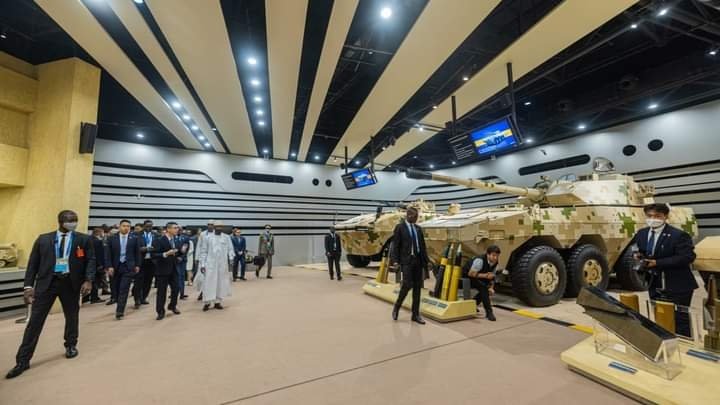
The delivery is part of a defence agreement with NORINCO signed in September 2024, covering military equipment, training, and technology transfer. It follows a sustained Chinese equipment programme that has already delivered VN2C infantry fighting vehicles, VP11 and CS/VP11 armoured platforms, VN22 armoured personnel carriers, SR-5 multiple-launch rocket systems, and Dongfeng Mengshi tactical vehicles to Malian forces making Beijing, not Moscow, the dominant hardware supplier in Mali's current military modernisation cycle.
Sources: AfDB, IMF, World Bank • Calculations & Modelling: Limitless Beliefs Consulting
The Drone Threat That Forced This Acquisition
The Yitian-L acquisition is a direct operational response to a documented and accelerating aerial threat. Over the past two years, both the separatist Azawad Liberation Front and the al-Qaeda-affiliated Jama'at Nusrat al-Islam wal-Muslimin (JNIM) assessed as the main driver of militant fatalities in the Sahelian theatre have integrated drone operations into their attack sequences, reportedly with external technical assistance.
In a recent example of the evolving threat, Azawad forces executed a complex attack combining mortar fire and first-person-view (FPV) drones against Gao International Airport, a key Malian Armed Forces base and host to allied Russian Africa Corps personnel. The attack caused minimal damage but it demonstrated that non-state actors in the Sahel now possess the capability to conduct multi-vector aerial and ground attacks against hardened military positions. Azawad separatists have also been documented using larger fixed-wing systems, including the FDG 410 an electric VTOL drone manufactured commercially by Chinese firm Flydragon and openly available on export markets.
Prior to this delivery, Mali's air defence capability was effectively limited to legacy anti-aircraft gun systems adequate against fixed-wing aircraft of an earlier era but structurally incapable of engaging the low-altitude, slow-moving, small-radar-cross-section profiles that characterise modern insurgent drone operations. The Yitian-L delivery represents the first credible counter-drone intercept capability in the Malian military inventory.
“This delivery is a survivability investment as much as an air-defence purchase in a Sahelian battlespace where mobility and force protection now carry equal importance.”
Sources: Interpol, AfDB Security Assessments, Army Recognition • Calculations & Modelling: Limitless Beliefs Consulting
Yitian-L Capabilities, Limitations, and Operational Fit
The Yitian-L's operational profile is well matched to Mali's specific battlefield requirements. Its compact footprint on a light 4×4 chassis enables it to accompany wheeled manoeuvre units, cover deployment zones during troop concentration, and provide commanders with an immediately available last-line intercept option in environments where larger, fixed missile battery systems would be tactically impractical. Its two-person crew requirement and digital joystick-based fire control interface reduce operational complexity in a force with limited specialist air-defence training.
The system is expected to be deployed primarily to protect Bamako and high-value fixed installations including Gao International Airport the most strategically significant base in northern Mali and the forward operating hub for both Malian forces and the Russian Africa Corps. Mali joins Mauritania as the second confirmed African operator of the Yitian-L, indicating that NORINCO's SHORAD platform is gaining a regional footprint beyond the initial Malian procurement.
However, the system's limitations are as operationally significant as its capabilities. With only four ready-to-fire missiles per vehicle and a point-defence engagement envelope, the Yitian-L cannot address mass drone swarms, saturation attacks, or medium-altitude strike platforms. The FPV drones most commonly used by insurgent groups cheap, fast, and operating below most radar detection floors remain largely outside the system's effective engagement parameters. Against these threats, Mali would require complementary electronic warfare systems, directed-energy solutions, or dedicated counter-UAS jamming platforms that are not currently confirmed in the procurement pipeline.
| Parameter | Specification | Operational Significance |
|---|---|---|
| Platform | Dongfeng Mengshi (EQ2050) 4×4 tactical vehicle | High mobility across desert and semi-desert terrain |
| Missile System | TY-90 infrared-guided SAM (4 ready-to-fire) | Originally air-to-air; adapted for ground-based SHORAD |
| Engagement Range | 500m – 6km horizontal | Point defence; not area coverage |
| Engagement Altitude | 15m – 4,000m | Effective against low-altitude drone and helicopter threats |
| Radar Suite | 3D X-band target detection + electro-optical tracker | Simultaneous multi-target detection and prioritisation |
| Crew Requirement | 2 personnel | Reduced training burden; rapid deployment |
| Developer / Supplier | NORINCO (China North Industries Corporation) | Part of Sept. 2024 Mali–NORINCO defence agreement |
| Survivability Features | Armoured protection · NBC defence · Smoke grenade launchers · Auto fire suppression | Crew protection in contested urban and desert environments |
| Known Limitation | Ineffective against FPV drones (low radar cross-section) | Leaves most common insurgent drone type uncountered |
Sources: NORINCO, Army Recognition, MilitaryLeak, Defence Blog, The Defence News • Compiled by: Limitless Beliefs Consulting
Sources: AfDB, IMF • Calculations & Modelling: Limitless Beliefs Consulting
China's African Defence Strategy — Beyond the Hardware
The Yitian-L delivery is not an isolated transaction. It is the latest layer in a structured military modernisation programme that reflects China's 2025–2027 Forum on China-Africa Cooperation (FOCAC) action plan, which commits Beijing to a major military grant for Africa, training for 6,000 military personnel, and exchanges for 500 young officers. Mali's procurement relationship with NORINCO spanning armoured vehicles, rocket artillery, and now air defence exemplifies how China is deploying practical capability packages with low conditionality to build both military access and political alignment across the Sahel.
This strategy operates alongside, rather than in competition with, Russia's Africa Corps presence in Mali. The Malian military is simultaneously fielding Chinese hardware, Russian operational advisers, and Turkish drone systems acquired in prior procurement cycles a hybrid dependency model that maximises equipment optionality while creating multi-vector maintenance and integration challenges. The AfDB has highlighted that prolonged insecurity in the Sahel imposes measurable and compounding economic costs reduced foreign direct investment, disrupted intra-African trade corridors, and sustained public spending pressures that constrain development expenditure.
The IMF has noted the fiscal implications of sustained security spending in low-income environments: increased defence allocations crowd out public investment in infrastructure, education, and social services creating a cycle in which security expenditure grows in response to instability that is itself partly driven by underdevelopment. For Mali, a country that has experienced three coups since 2020 and faces simultaneous pressure from JNIM, Islamic State Sahel Province, and Azawad separatists, this fiscal trade-off is not theoretical it is the defining constraint on the post-junta development trajectory.
The Yitian-L delivery is both a tactical enhancement and a strategic signal. Tactically, it gives Malian forces a credible counter-drone intercept capability they did not previously possess and will likely be deployed to protect Bamako and Gao Airport from the kind of complex aerial attack already attempted by Azawad forces. Strategically, it confirms that low-altitude airspace across the Sahel is now a contested domain and that the states operating in it are investing accordingly. The deeper implication is geopolitical: China has become the primary hardware architect of Mali's military modernisation, a position that carries long-term influence over doctrine, dependency, and the trajectory of Sahel security architecture well beyond this single delivery.