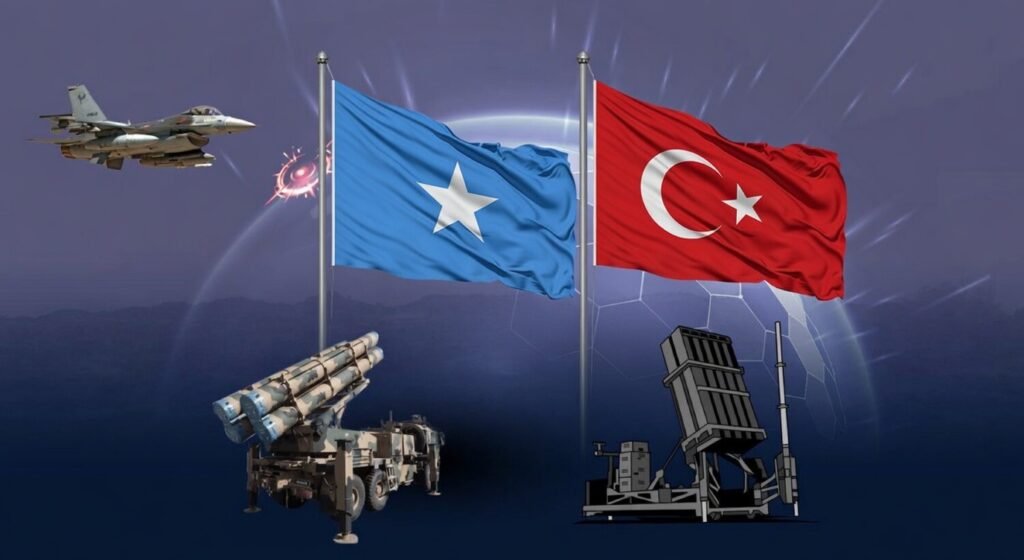
The Somali National Army has received a new batch of M48 and M60 Patton main battle tanks through Turkish defense cooperation agreements marking one of the most substantial upgrades to Somalia's armored capabilities in recent years and signalling a structural recalibration of the country's military doctrine.
The delivery introduces heavier ground combat assets into a security environment historically dominated by asymmetric warfare a deliberate shift that reflects Somalia's evolving threat calculus as Al-Shabaab adapts and external geopolitical competition in the Horn of Africa intensifies.
The Patton series, originally developed during the Cold War, remains operationally relevant across multiple regions due to its durability and upgrade potential. Modernised variants continue to provide effective firepower, mobility, and battlefield presence particularly in environments where heavy armor can alter tactical balance and project state force at a scale that light infantry cannot.
Sources: AfDB, IMF, World Bank • Calculations & Modelling: Limitless Beliefs Consulting
From Asymmetric to Hybrid Warfare A Structural Shift
From a security intelligence standpoint, the introduction of main battle tanks signals a structural shift in Somalia's military doctrine. While counterinsurgency operations against Al-Shabaab have historically relied on mobility, intelligence networks, and light armored vehicles, the deployment of tanks introduces a capacity for sustained ground dominance and fortified territorial control that asymmetric doctrine alone cannot provide.
The IMF has noted that rising security expenditures in fragile states are frequently tied to the need for greater territorial control and infrastructure protection particularly as conflict dynamics evolve from purely non-state insurgency toward hybrid threats that combine guerrilla tactics with organised criminal networks and external state interference.
The integration of armored platforms into Somalia's military structure reflects this transition. Tanks provide enhanced protection and firepower, enabling forces to secure strategic assets ports, urban centres, and critical infrastructure corridors that mobile light infantry cannot hold against sustained assault.
“Tanks cannot defeat Al-Shabaab alone. But they change what the Somali state can hold, what it can project, and what it can deter and that changes the operational equation fundamentally.”
Sources: Interpol, AfDB Security Assessments • Calculations & Modelling: Limitless Beliefs Consulting
The Constraint of Conventional Armor in Asymmetric Terrain
Interpol identifies Somalia as part of a broader regional network of transnational security threats encompassing terrorism, illicit trafficking, and organised crime. These threats are typically decentralised and adaptive, reducing the effectiveness of conventional military assets when deployed in isolation from intelligence infrastructure and mobile response units.
Ground assaults and improvised explosive devices remain the dominant threat vectors, while emerging risks particularly drone-enabled surveillance and attacks are gradually increasing in operational significance. This evolving threat mix complicates military planning, requiring a combination of conventional deterrence and asymmetric response capabilities that the tank acquisition alone cannot provide.
The introduction of tanks does not eliminate these challenges but materially alters the operational equation. Heavy armor deters large-scale assaults and provides force protection in ways that change adversary calculus yet it must be integrated with intelligence systems, air support, and mobile units to remain effective against decentralised adversaries who will adapt their tactics in response.
Sources: AfDB, IMF • Calculations & Modelling: Limitless Beliefs Consulting
Turkey's Strategic Footprint Beyond Equipment Transfers
The acquisition of tanks represents a shift toward capital-intensive military investment, increasing both upfront procurement costs and long-term maintenance requirements that will strain Somalia's fiscal capacity. The AfDB has consistently highlighted that prolonged insecurity imposes structural economic costs reduced investment inflows, disrupted trade routes, and increased fiscal pressure making defense spending a direct competitor to development priorities in resource-constrained environments.
Turkey's role in supplying armored vehicles to Somalia reflects a broader and deliberate pattern of bilateral security cooperation in the Horn of Africa. Turkish military partnerships increasingly extend beyond equipment transfers to include training programmes, logistics support, and base infrastructure creating long-term strategic alignment that serves Turkish foreign policy objectives while addressing Somalia's immediate capability gaps.
From a geopolitical standpoint, such partnerships contribute to the diversification of external influence in a region where the United States, China, Gulf states, and now Turkey are all competing for strategic positioning. Defense cooperation agreements in the Horn of Africa consistently intersect with economic interests including infrastructure projects, maritime security arrangements, and resource development access making the tank delivery as much a diplomatic signal as a military one.
The deployment of Patton tanks also introduces new logistical requirements that will test Somalia's institutional capacity. Armored platforms require dedicated fuel supply chains, maintenance infrastructure, and technically trained personnel increasing operational complexity in an environment where these capabilities remain limited and must largely be supplemented by Turkish technical assistance.
The delivery of Turkish Patton tanks represents more than a tactical upgrade to Somalia's armored inventory. It signals a recalibration of Somalia's defense posture from purely counterinsurgency-focused to a hybrid model that incorporates conventional deterrence alongside asymmetric capability. The tanks change what the Somali state can hold and project. Whether they change what it can ultimately secure depends on the intelligence, integration, and institutional capacity built around them.