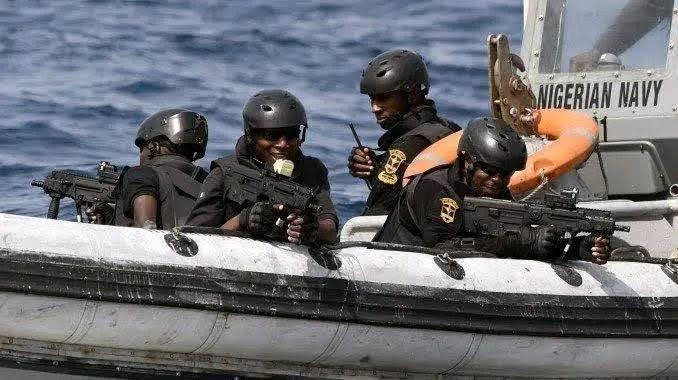
The Nigerian Navy has intercepted approximately 44,000 litres of illegally refined Automotive Gas Oil (AGO) during coordinated maritime security operations in Rivers State the latest tactical disruption in a long-running effort to dismantle the Niger Delta's parallel energy economy.
The operation, conducted under ongoing naval enforcement mandates, resulted in the arrest of multiple suspects and the seizure of wooden vessels used for transporting illicit petroleum products across Nigeria's coastal and inland waterways.
The interdiction forms part of a broader maritime security strategy designed to disrupt illegal refining and oil bunkering networks. These enforcement actions are increasingly intelligence-driven, targeting not only physical assets but also the logistics routes and storage nodes that sustain illicit supply chains.
From a security intelligence standpoint, the seizure highlights the persistence of a parallel energy economy operating entirely outside formal regulatory systems. While the volume intercepted represents a tactical success, it reflects the scale of an entrenched system that continues to adapt to enforcement pressure.
Sources: AfDB, IMF, World Bank • Calculations & Modelling: Limitless Beliefs Consulting
The Macroeconomic Cost of Resource Leakage
Institutional estimates suggest Nigeria has historically lost tens of millions of barrels of crude oil annually due to theft and operational leakages. Losses peaked above 30 million barrels per year before declining as surveillance systems and security operations intensified. Despite this improvement, the residual level of losses remains materially significant within the context of national output.
The International Monetary Fund (IMF) identifies resource leakage as a direct constraint on fiscal stability in hydrocarbon-dependent economies. For Nigeria, reduced crude output translates into lower export revenues, weakening foreign exchange inflows and increasing reliance on external financing mechanisms.
At the same time, the International Criminal Police Organization (Interpol) categorizes oil theft and illegal refining as part of broader transnational organized crime networks systems that frequently intersect with arms trafficking, financial crime, and cross-border smuggling corridors, extending the impact well beyond the domestic energy sector.
“When one node is disrupted, others continue functioning — the network maintains continuity through deliberate fragmentation.”
Sources: Interpol, World Bank • Calculations & Modelling: Limitless Beliefs Consulting
A Decentralised System Built to Survive Disruption
The operational structure of illegal fuel markets is segmented across multiple stages, each with distinct risk and profit profiles. Crude extraction often through pipeline tapping is followed by localized refining using improvised equipment. Products are then transported through riverine systems and road networks before reaching informal distribution points.
This decentralized architecture reduces systemic vulnerability. When one node is disrupted, others continue functioning, allowing the network to maintain operational continuity. The fragmentation also complicates enforcement, as operations are dispersed across difficult terrain with limited monitoring infrastructure.
The African Development Bank (AfDB) has consistently highlighted governance and monitoring gaps within extractive industries as a structural issue across resource-rich African economies. Weak institutional coordination and limited technological surveillance capacity contribute to persistent inefficiencies in resource management.
Sources: AfDB, IMF, World Bank • Calculations & Modelling: Limitless Beliefs Consulting
Beyond Revenue The Full Cost Spectrum
The economic impact of oil theft extends far beyond immediate revenue loss. Reduced crude export volumes directly affect Nigeria's balance of payments, limiting foreign exchange reserves and placing pressure on currency stability a dynamic particularly acute during periods of global oil price volatility.
Pipeline vandalism and illegal tapping increase maintenance and repair costs for energy infrastructure, reducing operational efficiency within the formal oil sector and constraining both output capacity and investment attractiveness.
Environmental degradation adds a further layer of economic liability. Illegal refining processes release pollutants into surrounding ecosystems, affecting agricultural productivity, fisheries, and public health outcomes. These externalities compound over time, creating long-term costs that extend well beyond the energy sector.
Labor dynamics also sustain illegal operations. In regions where formal employment opportunities remain limited, participation in informal energy markets becomes a rational alternative income source creating a feedback loop in which structural economic conditions reinforce the persistence of illicit activity.
Enforcement Alone Cannot Close the Gap
Security operations conducted by the Nigerian Navy demonstrate increasing operational capability in maritime surveillance and interdiction. However, the scale and adaptability of illicit networks suggest that enforcement measures alone are insufficient to fully dismantle the system.
Security intelligence frameworks consistently indicate that long-term mitigation requires integrated approaches combining enforcement, economic development, and institutional reform. Enhanced monitoring technologies, improved regulatory coordination, and alternative livelihood programs are identified as critical components of any durable solution.
The interception of 44,000 litres of illicit fuel represents both a tactical disruption and a signal of ongoing structural challenges within Nigeria's energy economy. The persistence of these networks underscores the complexity of addressing resource leakage in environments defined by economic disparity and institutional constraints. Enforcement creates friction. Only structural reform eliminates the incentive.