
Desk: Uncategorized Desk
Published: September 9, 2026
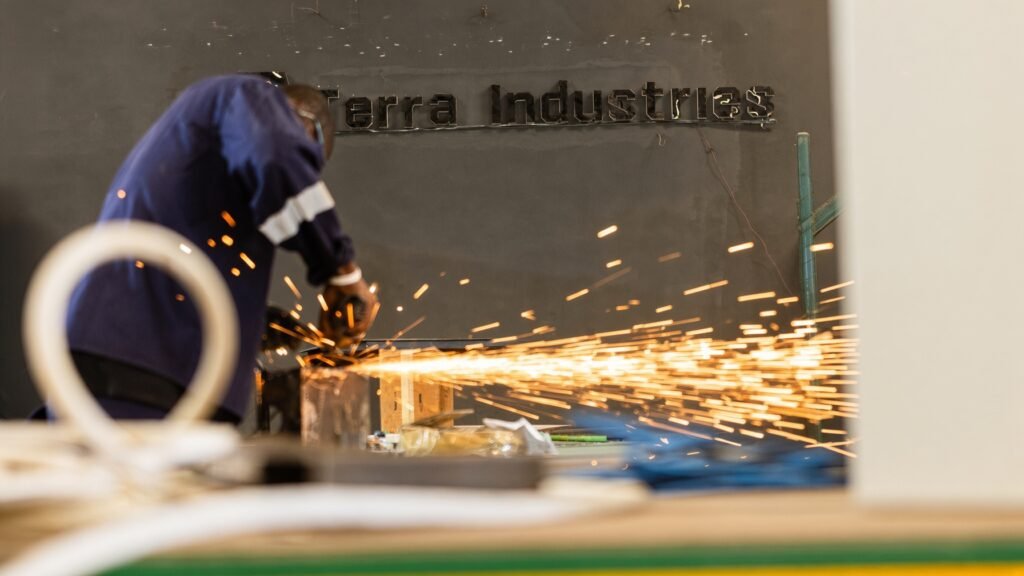
An Abuja defence tech firm opened a commercial division on 28 August and closed two mining security contracts a week later. The kit is 20 sentry towers and four Iroko drones. The market is licensed lithium sitting next to an illegal mining economy that Africa Defense Forum has put at about $9 billion a year. Terra Industries, founded in 2024 and based on the Abuja–Kaduna axis, has signed $2 million of contracts to secure lithium operations for two unnamed Nigerian operators. The package is 20 sentry towers and four Iroko unmanned aircraft, run on the company’s ArtemisOS command layer. Expansion is written into the deals as those operators bring more pits online. The commercial unit itself launched on 28 August 2026. The lithium announcement is its first published private sector book.
That $2 million is a site security invoice, not a sector fix. Mining sector collections rose from about ₦6 billion before the current federal term to more than ₦38 billion in 2024 and above ₦70 billion in 2025, per the solid minerals minister. A $250 million Nasarawa plant commissioned in July 2026 is rated at 6,000 tonnes of feed a day. Against that, parliamentary and Africa Defense Forum figures still put annual losses to illegal mining near $9 billion. Mining Marshals report more than 300 illegal miner arrests and about 20 convictions. Four Chinese nationals were detained in Niger State in early September over an unlicensed site.
Terra is selling surveillance and deterrence to the licensed side of that split. It is not a substitute for title enforcement, royalty collection or community consent. Investors should price the contract as a capex line that may cut theft and downtime on two books and as a demand signal that formal lithium in Nigeria now spends like oil and power assets on perimeter systems.
Sources: Ministry of Solid Minerals; Africa Defense Forum; National Assembly • Calculations & Modeling: Limitless Beliefs Consulting
Macroeconomic Drivers Lithium Spending Follows Capital
Lithium security spending is following capital, not the other way around. President Bola Tinubu commissioned a $250 million processing plant in Nasarawa in July, built with Diamond New Energy, Jiuling and Canmax, at a stated 6,000 tonnes a day. Canmax has separately flagged more than $200 million for additional northern deposits. El-Tahdam and TSG have discussed $500 million toward plants in Kebbi, Kwara and Kaduna. The mines ministry has cited an $800 million lithium processing commitment and a $200 million plant near Abuja. That is the asset base that buys towers.
The naira and the policy rate set the local cost of that kit. The Central Bank of Nigeria left the monetary policy rate at 26.5% in July 2026. Official FX on 8 September was about ₦1,320 per dollar. A $2 million contract is roughly ₦2.6 billion at that print real money in a sector whose entire official collection just crossed ₦70 billion. Terra’s pitch is that Abuja manufacture cuts first-buy hardware as much as 55% versus imported systems. That claim matters at 26.5% naira credit. A mine that finances security in naira pays a different total cost of ownership than one that imports towers against a scarce dollar line.
“State capacity is the other price. Private security in Nigeria covers an estimated $218 billion of assets and employs more than a million workers. Mines, power plants and pipelines already live in that private market. Terra’s commercial division is an attempt to take a defence-origin stack into that invoice book.”
State capacity is the other price. SIPRI linked commentary has Nigeria’s 2024 defence spend near $2.0 billion, or about $4.90 a head, against Kenya near $22. Private security in Nigeria is estimated to cover some $218 billion of assets and more than a million workers. Mines, power plants and pipelines already live in that private market. Terra’s commercial division staffed in part by a former Palantir/WHOOP hire as commercial director is an attempt to take a defence origin stack into that invoice book. Seed funding has been extended in stages to $34 million and then $52 million, with a London office and a planned Ghana factory rated at up to 50,000 aerial systems a year by 2028. The Abuja plant is cited at about 30,000 units of annual capacity.
Core Market Dynamics Supply, Demand, and the Gap Between Them
Supply of formal Nigerian lithium is still thin relative to the investment headlines. Hard rock grades have been described by the Nigerian Geological Survey Agency as running from about 1% to 13% lithium oxide against a global exploration floor near 0.4%. That geology is why Chinese processors and ASX names such as Chariot (Fonlo, Gbugbu, Iganna, Saki in Oyo and Kwara) are in the country. It is also why unlicensed pits pay. A 2024 AP price list in the informal market offered about ₦200,000 a tonne for material up to 3% Li₂O.
Demand for site security is the gap between those two markets. Licensed plants need a chain of custody that offtakers and banks will accept. Artisanal and illegal pits do not. North-West estimates that nearly 80% of mining activity runs outside regulation are not a lithium-only number, but they describe the neighbourhood in which Nasarawa, Kaduna, Niger, Kebbi and Kogi pits sit. King’s College London work on Sahel lithium has flagged extortion, route tax and smuggling as the more likely armed group model than direct mine operation. That is a perimeter and convoy problem, which is what towers and aircraft are sold to do.
Sources: Terra Industries newsroom; DefenceWeb • Calculations & Modeling: Limitless Beliefs Consulting
Terra’s disclosed kit on this book is 24 physical nodes for two operators. Average $83,000 per node if the $2 million were hardware only — it will not be; software, installation and a term of monitoring sit inside the number. Prior public work includes a $1.2 million hydro-plant contract and sites in gold, lithium, power and, by company account, about $11 billion of assets across eight African countries and Canada. Those figures are company-stated. They are the comparable book, not an audited AUM.
Sources: Terra Industries; DefenceWeb • Calculations & Modeling: Limitless Beliefs Consulting
Sources: LBNN Intelligence, Ministry of Solid Minerals, ADF • Calculations & Modeling: Limitless Beliefs Consulting
Sources: Ministry of Solid Minerals; ADF; Terra contract • Calculations & Modeling: Limitless Beliefs Consulting
Capital Allocation and Investor Implications Three Ways to Price the Print
Price the contract as a unit of security services, then decide whether you are underwriting Terra or underwriting Nigerian lithium.
- As a Terra print. $2 million in week one of a commercial division is a sales cycle data point. It is 3.8% of the $52 million extended seed. It is larger than the $1.2 million hydro book. It is not a run-rate. Ask for term, renewal, and whether monitoring is subscription or a one-off kit sale. Four airframes against a 30,000-unit factory is not a utilisation story.
- As a mine print. $2 million of watch on a plant that cost $200–250 million is 0.8–1.0% of capex. That is a cheap insurance ratio if incident loss is material. It is expensive if the real leak is at the export shed and the weighbridge, which cameras on a pit wall do not see.
- As a country print. Yield spread in this sector is the extra return investors demand for Nigerian hard-rock lithium versus Australian or Chilean supply. Security kit can narrow operational risk. It does not narrow title risk, community risk or the $9 billion informal overhang. Treat those as separate line items.
“Regional benchmark: private close protection in high risk African mining jurisdictions is quoted in the $700–$1,500 per operative per day band. A $2 million year of towers and four aircraft is, on that scale, the cost of a small standing human team. The bet Terra is making is that sensors plus a local factory beat that day-rate on multi-year cost.”
Strategic Caveats What This Contract Does Not Solve
Several critical caveats should frame any assessment of this contract and its implications:
- The $9 billion leak is systemic. Terra’s $2 million deployment secures two sites. It does not address the estimated 80% of mining activity operating outside regulation. The informal economy will simply move to unwatched pits.
- Technology is not title. Surveillance towers do not enforce mineral rights. They do not issue mining licences. They do not collect royalties. The regulatory gap title enforcement, traceability, prosecution remains the binding constraint.
- Community consent is not a checkbox. Reports from Kogi and Nasarawa pits have included restricted farmland, road damage and clashes with site security. A sensor tower that reduces armed theft can also reduce informal livelihoods that the state has not replaced.
- Regulatory recognition is uncertain. NCAA and privacy rules will have to say what a commercial unmanned aircraft may do over a mine next to a village. The regulatory gap around autonomous surveillance is the next incident waiting to happen.
- Security is a recurring cost, not a capex fix. Towers require power, networking, maintenance, and staff. At a 26.5% policy rate and naira volatility, the total cost of ownership over five years may exceed the sticker price by 2–3x.
What This Contract Signals Lithium Is Now Valuable Enough to Guard
The most important signal is not the $2 million. It is that formal lithium in Nigeria has become valuable enough to justify private-sector perimeter security. That is a threshold. A sector that spends on towers and drones is a sector with offtake contracts, bankable feasibility studies, and enough tonnage to matter to processors.
But the security gap remains enormous. $2 million against $9 billion is 0.02% of the leak. The real solution is not better towers. It is better title enforcement, royalty collection, community consent, and traceability the things the satellite vote, the 250 plus artisanal cooperatives the minister says have been formalised, and the Mining Marshals are supposed to deliver.
Terra is a vendor. Its success will be measured by renewals and expanded contracts. Nigeria’s success will be measured by whether the $9 billion leak narrows. Those are different scorecards.
Bottom Line: Terra Industries’ $2 million lithium site security contract is a data point, not a sector solution. 20 sentry towers and four Iroko drones on two licensed pits represent 0.02% of the $9 billion annual illegal mining leak. Official mining collections have grown from ₦6 billion to ₦70 billion, but the informal economy still dwarfs the formal sector. The Nasarawa $250 million plant and $800 million in lithium processing commitments create the asset base that justifies security spend. But the binding constraints are not technological they are institutional: title enforcement, community consent, royalty collection, and regulatory clarity. Terra is selling surveillance to the licensed side of a divided market. The $9 billion question is whether the state can do the same.