
Desk: Uncategorized Desk
Published: September 19, 2026
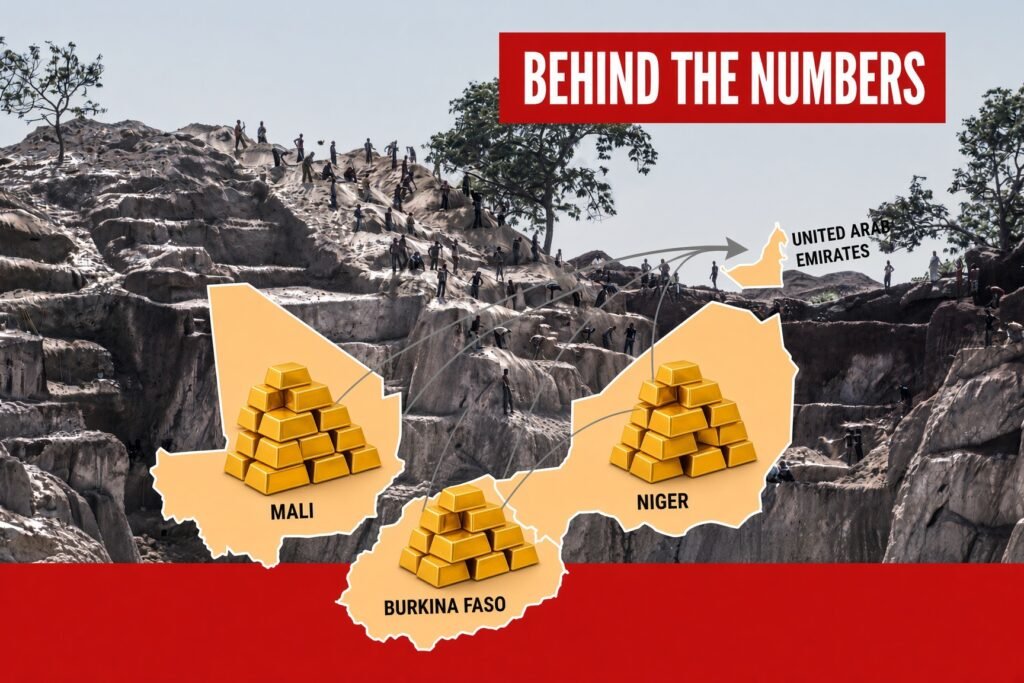
The Sahel’s gold security problem is not, primarily, a problem of mines under attack. ACLED’s latest mining analysis records 1,185 mining adjacent conflict events across Burkina Faso, Mali and Niger between January 2015 and June 2026 and finds that nearly 90% occurred outside mining concessions. That single finding reframes the threat: the battleground is the road, the trading hub, the artisanal pit and the settlement that connect gold to a buyer. Burkina Faso’s mining sector accounted for 14.8% of GDP, more than 75% of exports and more than 20% of government revenue in 2023 (EITI), while World Bank data show gold production rising from 61 tonnes in 2024 to 94 tonnes in 2025. Against that economic weight, GI-TOC cautions that while gold is an important financing source for JNIM elsewhere in the Sahel, the evidence does not automatically characterise all miners or traders as connected to extremist organisations.
Gold has become a structural component of the security economy in the central Sahel. The analytical question is no longer whether armed groups benefit from mining activity. It is which parts of the mining economy they can tax, control or disrupt and, equally important, which parts of that economy remain ordinary commercial activity that should not be conflated with terrorist financing.
ACLED’s revised dataset contains 1,185 unique conflict events recorded between 1 January 2015 and 19 June 2026 around strategically important mining sites in Burkina Faso, Mali and Niger. Burkina Faso accounted for 75% of mining related conflict events across the three countries over the full period; Mali accounted for 15% and Niger 10%. Gold sites accounted for 90% of mining-adjacent conflict events, with 39 of the 44 identified mining sites in the analysis producing gold.
Evidentiary caution: This article distinguishes verified terrorist financing mechanisms from broader illicit-market vulnerabilities. GI-TOC research describes taxation and extortion around mining activity as mechanisms through which JNIM can obtain revenue where it has territorial influence while cautioning that the relationship between individual miners, gold traders and extremist organisations is not uniform. References to JNIM and Islamic State Sahel Province concern designated violent extremist organisations and their documented or assessed activities. Claims about individual miners, traders or communities are not treated as evidence of terrorist affiliation without specific supporting evidence.
Sources: ACLED mining adjacent conflict dataset (Jan 2015–Jun 2026) • Analysis: Limitless Beliefs Consulting
Geographic Concentration Is Easing Not Disappearing
The geographic concentration in Burkina Faso does not mean the country is the only emerging risk. ACLED reports that Burkina Faso’s share of mining-adjacent incidents declined to 54% in 2025 while Mali accounted for 29% and Niger 18%. ACLED interprets this change as evidence that mining-related conflict is becoming more geographically distributed across the central Sahel rather than disappearing from Burkina Faso.
The Liptako Gourma area connecting Burkina Faso, Mali and Niger remains the most important example. It combines gold deposits, artisanal mining, commercial routes and longstanding militant competition. Western Mali’s Kayes region borders Senegal and is an important gold producing area. Along Burkina Faso’s southern frontier, gold moving between Ghana and Burkina Faso creates a further cross-border security and financial pathway.
That distinction matters because the geographic shift is not a reduction in total risk it is a widening of the threat surface. A threat that spreads across three borders is harder to contain with national security strategies alone, and more exposed to the informality and opacity of cross-border gold trading.
“The relevant security asset is not only the mine. It is the entire economic corridor that allows gold to move from the ground to a buyer.”
Only 10% of Incidents Happen Near the Mine The Threat Lives on the Road
The central finding from the security data is that a mine should not be treated as an isolated security asset. Its operational system includes the extraction site, nearby artisanal miners, workers, traders, transport companies, roads, fuel suppliers, equipment providers, gold buyers, processing facilities and surrounding communities.
ACLED’s analysis found that only 10% of violent incidents associated with industrial mining sites occurred within 3 kilometres of the site itself. The broader conflict environment therefore extends well beyond the perimeter that a conventional mine security plan might prioritise. This changes the security problem from perimeter protection to territorial security.
JNIM and Islamic State Sahel Province can generate economic value without physically operating a mine. They can instead impose payments on miners, traders or communities, control roads, restrict access to mining areas and use territorial influence to extract value from economic activity already taking place. GI-TOC research has documented taxation and extortion around mining activity as mechanisms through which JNIM obtains revenue in areas where it has territorial influence while emphasising that the relationship between individual miners, gold traders and extremist organisations is not uniform.
Sources: ACLED mining-adjacent conflict analysis • Analysis: Limitless Beliefs Consulting
Gold’s Economic Weight Why Corridors Become Strategic Territory
The security economics of gold are inseparable from the macroeconomic importance of mining. Burkina Faso’s mining sector accounted for 14.8% of GDP, more than 75% of exports and more than 20% of government revenue in 2023, according to Burkina Faso’s Extractive Industries Transparency Initiative disclosures. The World Bank reports that gold production reached 94 tonnes in 2025, compared with 61 tonnes in 2024.
That economic concentration changes the strategic value of mining corridors. A security disruption affecting a mine can affect not only the operator, but also government revenues, foreign exchange receipts, transportation companies, local traders and household incomes. The IMF estimates that real GDP growth reached 5.3% in 2025, supported in part by higher mining activity and elevated gold prices. The IMF projects growth of 4.9% in 2026, with average consumer price inflation projected at 1.4%.
The beneficial side is clear: higher gold prices and production can improve export earnings, fiscal receipts and economic growth. The security risk is that the same economic concentration creates a valuable revenue base for armed groups attempting to control territory outside effective state administration.
Sources: World Bank Burkina Faso economic data • Analysis: Limitless Beliefs Consulting
Burkina Faso’s EITI disclosures provide another indicator of the financial vulnerability of the sector. An EITI analysis estimated illicit financial flows from the country’s mining sector at US$4.93 billion between 2012 and 2021, with gold accounting for 61% of those estimated losses. The estimate covers multiple forms of illicit financial activity and should not be interpreted as money directly captured by terrorist groups.
BCEAO Holds Rates Policy Stability Does Not Neutralise Security Risk
Burkina Faso is part of the West African Economic and Monetary Union and uses the CFA franc. On 9 September 2026, the BCEAO maintained its main refinancing rate at 3.00%, its marginal lending facility at 5.00% and the reserve requirement ratio at 3.00%.
A relatively low regional policy rate can reduce the monetary cost of legitimate working capital and investment compared with a high inflation environment. It does not, however, eliminate security related financing costs. Mining companies operating in contested areas can face higher insurance costs, security expenditure, logistics costs, delays and risk premiums even when the central bank’s policy rate remains unchanged.
The monetary backdrop is therefore best read as a neutral variable in the security equation. It lowers the cost of capital but does not change the underlying territorial contest over the corridors through which gold must move.
Verified Financing vs. Broader Vulnerability A Distinction That Matters
Security intelligence must distinguish between an established financing mechanism, an enabling environment and a forward-looking risk. Treating every informal mining transaction as terrorist financing would overstate the evidence and could damage legitimate livelihoods.
The Global Initiative has cautioned that northern Ghana’s artisanal gold sector presents vulnerabilities because of informality, porous borders and opaque financial flows, while also stressing that it has not established evidence that JNIM is currently directly exploiting the northern Ghana gold sector. That distinction is important. It separates a documented revenue mechanism in areas where JNIM has territorial influence from a broader illicit-market vulnerability that may or may not be exploited by extremist groups in the future.
The same analytical discipline applies to Burkina Faso, Mali and Niger. The fact that conflict events cluster around mining corridors does not mean every trader, pit operator or community in those corridors is connected to armed groups. The evidence base supports claims about territory, taxation and control not blanket attribution.
Sources: LBNN Intelligence, ACLED, EITI, GI-TOC, World Bank • Analysis: Limitless Beliefs Consulting
Sources: LBNN Intelligence, ACLED, GI-TOC • Analysis: Limitless Beliefs Consulting
From the Sahel Toward the Coast An Early Warning Geography
The security significance of the Sahelian gold economy extends beyond the Alliance of Sahel States. JNIM has expanded toward coastal West Africa, while the Global Initiative has identified northern Benin, Togo, Côte d’Ivoire and Ghana as areas where Sahelian armed groups are already operating or creating security concerns.
This does not mean that gold mining in coastal West Africa is already experiencing the same level of terrorist control observed in parts of Burkina Faso. The evidence is more appropriately interpreted as an early warning indicator. Informal mining, weak border controls, cash intensive trade and limited financial transparency can create conditions that armed groups may exploit if territorial control expands.
Burkina Faso and Mali represent established high exposure markets; Niger represents an established exposure; and northern Ghana, Côte d’Ivoire and other coastal zones represent emerging risk. The classification is analytical, not probabilistic — but it identifies where the next phase of corridor contestation is most likely to appear.
The Next Phase Who Controls the Corridor, Not Who Attacks the Mine
The principal security lesson from the Sahel’s mining economy is that the mine itself is only one component of the threat environment. The economically valuable system includes people, roads, markets, traders, processing facilities, financial channels and communities.
ACLED’s finding that nearly 90% of mining adjacent conflict occurs outside mining concessions is therefore more consequential than the number of attacks against individual mines. It suggests that conventional physical security around extraction facilities can leave the wider economic corridor exposed. Inata is an important case study. ACLED records repeated attacks around the mine and its supporting routes, followed by the expansion of the conflict into a broader struggle over territory. As of June 2026, ACLED assesses that JNIM exercises de facto control over Inata and surrounding areas.
The strategic implication is that mine security, counterterrorism and economic policy cannot be treated as separate systems. If a state secures a mine but cannot secure the road carrying its output, the trader purchasing the gold or the community providing labour, the economic asset remains exposed. The same logic applies in the opposite direction: if governments formalise artisanal mining, improve gold traceability, secure transport corridors and create legitimate financial channels for miners and traders, they can reduce the economic space available to armed groups without eliminating the livelihoods on which mining communities depend.
Bottom Line: The Sahel’s gold security problem is fought outside the mine gate. ACLED records 1,185 mining-adjacent conflict events across Burkina Faso, Mali and Niger between January 2015 and June 2026, and finds that nearly 90% occurred outside mining concessions a finding that reframes the threat from perimeter protection to territorial control over the economic corridor that connects gold to a buyer. Burkina Faso accounted for 75% of events over the full period, though its share fell to 54% in 2025 as Mali and Niger rose evidence that the conflict is spreading geographically, not receding. The economic stakes are structural: Burkina Faso’s mining sector accounted for 14.8% of GDP, more than 75% of exports and more than 20% of government revenue in 2023 (EITI), while World Bank data show gold output rising from 61 tonnes in 2024 to 94 tonnes in 2025. BCEAO held its main refinancing rate at 3.00% and marginal lending rate at 5.00% on 9 September 2026, and the IMF projects 4.9% growth in 2026 but monetary stability does not neutralise security risk. The evidentiary standard matters: GI-TOC cautions that while gold is an important financing source for JNIM elsewhere in the Sahel, the evidence should not automatically characterise all miners or traders as connected to extremist organisations. The critical metric for the next phase is not how many mines are attacked. It is how much of the economic corridor surrounding those mines remains under legitimate state and market control.
Data Qualification: This article combines security, macroeconomic and extractive sector data from ACLED, the Global Initiative Against Transnational Organized Crime, the World Bank, IMF, BCEAO and EITI. The 1,185 event figure and the 90% outside concessions finding are drawn from ACLED’s revised mining adjacent conflict dataset covering 1 January 2015 to 19 June 2026. Country shares (Burkina Faso 75%, Mali 15%, Niger 10% over the full period; Burkina Faso 54%, Mali 29%, Niger 18% in 2025) are as reported by ACLED. Burkina Faso’s mining contribution figures (14.8% of GDP, more than 75% of exports, more than 20% of government revenue in 2023) are from EITI disclosures. Gold production figures (61 tonnes in 2024, 94 tonnes in 2025) are from World Bank reporting. Monetary policy rates reflect the BCEAO’s 9 September 2026 decision. IMF growth and inflation projections are from Burkina Faso Article IV and programme documentation. The EITI illicit financial flows estimate of US$4.93 billion (2012–2021) covers multiple forms of illicit financial activity and is not treated as money directly captured by terrorist groups. This article explicitly distinguishes verified terrorist financing mechanisms from broader illicit-market vulnerabilities, consistent with GI-TOC guidance. Claims about individual miners, traders or communities are not treated as evidence of terrorist affiliation without specific supporting evidence.