
Desk: Uncategorized Desk
Published: September 20, 2026
Ghana’s gross international reserves nearly doubled between 2022 and 2025, reaching US$11.9 billion at end 2025, about four months of imports. That is the headline. The cost of achieving it is the analytical story. The same IMF analysis that documents the reserve accumulation estimates that Ghana’s Domestic Gold Purchase Programme generated losses of approximately US$1.7 billion, or 1.5% of GDP, in 2025, and that reserve accumulation carried sterilization costs of about 1% of GDP in the same year. The reserve stock grew. The carrying cost is what the reserve level figure does not show. Globally, central banks purchased 863 tonnes of gold in 2025, below the more than 1,000 tonnes recorded in each of the three prior years but still roughly double the 400 to 500 tonne annual average of the preceding decade. The question for African reserve managers is not whether gold belongs in a reserve portfolio. It is whether the cost of acquiring it, in a system where gold pays no coupon and reserve accumulation has a measurable fiscal price, is sustainable at current pace.
Africa’s gold story is moving from mine production and export earnings into sovereign finance. Global gold mine output reached an estimated 3,815 tonnes in 2025, the latest World Gold Council revised figure. The World Gold Council recorded an average gold price of approximately US$3,431 per ounce in 2025, up 44% from the 2024 annual average. Ghana provides the clearest case of how domestic gold procurement can feed directly into foreign exchange accumulation, and the clearest case of what that accumulation costs.
Data qualification note: Gold production figures are subject to revision, particularly for artisanal and small scale mining. The World Gold Council has revised cumulative global production estimates upward by 621 tonnes since 2015 as ASM data have improved. Country level production figures in this article are drawn from the source brief and from the World Gold Council’s latest published datasets, and where figures are supplied from older datasets they are identified as historical comparisons rather than current definitive rankings. The Ghana Domestic Gold Purchase Programme loss figure (US$1.7 billion in 2025, equal to 1.5% of GDP) and sterilization cost figure (approximately 1% of GDP) are IMF estimates, not audited accounts. They should be read as the IMF’s assessment of the program’s economic effect rather than as realised cash losses reported by the Bank of Ghana.
Sources: World Gold Council, Metals Focus, Refinitiv GFMS • Analysis: Limitless Beliefs Consulting
Gold Is a Reserve Asset, but It Is Not a Reserve Currency
The financial significance of Africa’s gold sector is changing as central banks seek greater control over the assets supporting their external accounts. Central banks added 863 tonnes of gold to their reserves in 2025. That is below the more than 1,000 tonnes accumulated in each of the previous three years, but it remains substantially above the roughly 400 to 500 tonne annual average recorded during the preceding decade. The official-sector bid for bullion is structurally larger than it was a decade ago, even as it has moderated from its recent peak.
For African reserve managers, the question is how much gold should sit on the balance sheet relative to foreign-currency securities, deposits and other liquid assets. Gold carries no direct sovereign credit exposure, which is the primary appeal. It also pays no coupon, has no yield, and carries storage, liquidity, governance and operational costs that interest-bearing reserve assets do not. The IMF makes this distinction explicitly, treating gold as a market-risk-bearing reserve asset rather than as a direct substitute for cash.
This distinction matters because the composition of a reserve portfolio determines its return characteristics. Reserves held in short-dated US Treasury bills earn a positive nominal yield. Reserves held in gold earn the change in the gold price. In a year when gold rises 44%, that is a large positive return. In a year when gold falls, the reserve portfolio value falls with it, absent any action by the central bank. The IMF’s concern is that this return profile is being treated as interchangeable with interest-bearing reserve assets when the underlying economics are different.
“A central bank that holds gold is making a price bet. A central bank that holds Treasury bills is receiving a coupon. Those are not the same asset.”
The Ghana Case: Reserve Accumulation With a Fiscal Price Tag
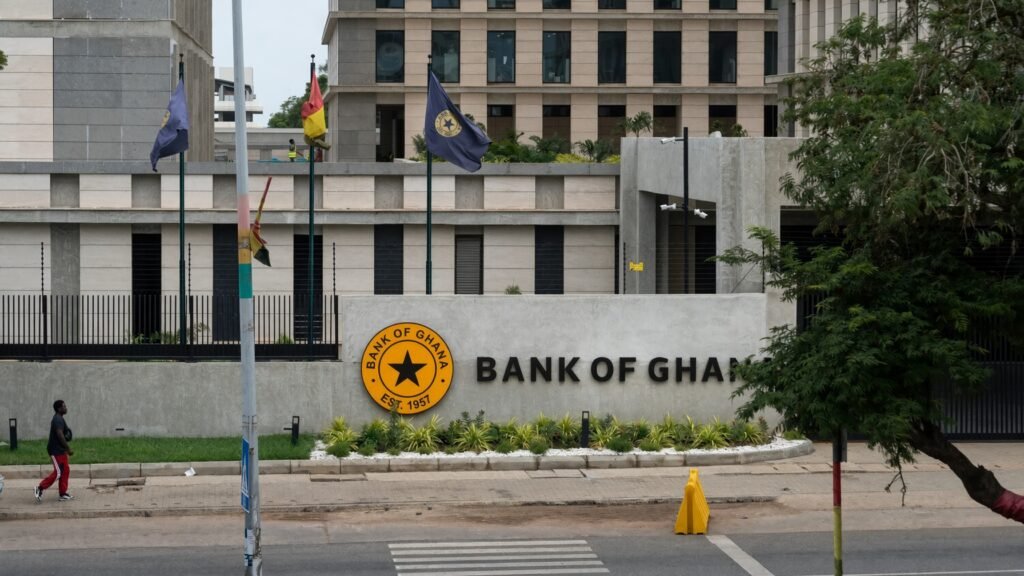
Ghana illustrates the trade-off most clearly. The IMF reports that gross international reserves reached US$11.9 billion at end-2025, equivalent to approximately four months of imports. Historically high gold prices contributed materially to reserve accumulation and exchange-rate stability. The Domestic Gold Purchase Programme exported approximately US$10.9 billion of artisanal gold in that year alone, channeling a large share of informal production into formal export channels.
But the same IMF analysis estimates that the programme generated losses of about US$1.7 billion, or 1.5% of GDP, in 2025. The mechanism matters. A domestic gold purchase programme buys gold at a domestic price, often at or above the world market price to attract informal supply, and then either holds the gold on the central bank balance sheet or exports it. If the purchase price exceeds the realisable export price after operational costs, the difference is a loss borne by the central bank. Those losses eventually appear as a quasi-fiscal cost, which is a cost to the sovereign balance sheet even when it does not appear in the annual budget.
Ghana’s target of 15 months of import coverage by 2028 exceeds the IMF’s estimated reserve adequacy requirement of about six months. If the programme continues at its current pace, the accumulated cost of reaching that target becomes the operative question. The IMF separately estimates that Ghana’s reserve accumulation already generated sterilization costs of approximately 1% of GDP in 2025, in addition to the programme loss.
Sources: IMF Ghana Article IV and programme review documentation, Bank of Ghana • Analysis: Limitless Beliefs Consulting • Note: Programme loss and sterilization cost are IMF estimates of economic effect, not realised cash losses reported by the Bank of Ghana.
Africa’s Production Base Is Real, but the Dataset Is Moving
Africa is structurally important to the global gold market. The World Bank identifies 741 primary gold deposits in Africa, compared with 4,666 globally, and Africa’s identified proven and probable gold reserves in that dataset amount to approximately 281 million ounces across primary and by-product deposits. Ghana is among the world’s major producers, and South Africa, Mali, Burkina Faso, Sudan, Zimbabwe, Guinea, Côte d’Ivoire and Tanzania all contribute to the continent’s supply base.
The revision issue is analytically important. The World Gold Council has revised cumulative global production estimates upward by 621 tonnes since 2015, driven largely by improved artisanal and small-scale mining data. That means older production datasets, including the country-level figures sometimes cited in historical comparisons, may substantially understate the actual flow. The direction of the error matters: artisanal production is larger than earlier datasets showed, and it is precisely this production that domestic gold purchase programmes are designed to capture. The programmes are therefore addressing a larger addressable flow than previously estimated, which raises both the opportunity and the cost of the formalization effort.
Sources: World Gold Council, source brief dataset • Analysis: Limitless Beliefs Consulting • Note: These figures are drawn from the source brief and are presented for historical comparison. Subsequent WGC revisions, particularly for artisanal and small-scale mining, have altered country-level estimates. Figures should not be read as the latest definitive country rankings.
The Opportunity Cost of Holding an Asset That Pays Nothing
Gold does not generate a coupon or dividend. That makes its opportunity cost particularly relevant when global interest rates are high. When short-term government securities offer elevated yields, holding non-interest-bearing bullion carries a larger opportunity cost. Conversely, expectations of lower rates can increase the relative attractiveness of assets that do not pay interest.
The World Gold Council identified expected interest-rate cuts, US dollar weakness, geopolitical risk and elevated equity valuations among the factors supporting gold investment demand during 2025. Investment demand reached approximately 2,175 tonnes, an 84% increase from 2024. That is a market-driven bid, distinct from the official-sector bid. Both can support the gold price simultaneously, but they respond to different drivers and can reverse independently.
For African reserve managers, currency composition is equally important. A weaker domestic currency increases the local-currency value of gold holdings, while a decline in the international gold price reverses that valuation effect. This creates a two-sided balance-sheet exposure. Gold can diversify reserve exposure away from the US dollar, but it can also increase portfolio volatility if the allocation becomes large relative to the central bank’s liquidity needs.
Sources: LBNN Intelligence, IMF, World Gold Council, World Bank, Bank of Ghana • Analysis: Limitless Beliefs Consulting
Sources: LBNN Intelligence, IMF, World Gold Council, Bank of Ghana • Analysis: Limitless Beliefs Consulting
The Question Is Not Whether to Hold Gold, but at What Cost and in What Proportion
The emerging African gold finance model has three interconnected layers. Mining produces the metal. Export channels convert it into foreign exchange. Reserve management determines how much of that foreign exchange is held as gold versus interest-bearing assets. Each layer has its own economics, and the financial case for the whole depends on how the three interact.
For a country with substantial gold production, the case for holding some gold in reserves is defensible. It diversifies away from a single reserve currency, provides an asset with no direct sovereign credit exposure, and can support exchange-rate stability when export earnings are strong. Ghana’s reserve accumulation from US$6 billion in 2022 to US$11.9 billion in 2025 reflects these benefits, and the contribution of gold to that accumulation was material.
The cost side is where the analytical work matters. A domestic gold purchase programme that buys at or above world market price to attract informal supply will generate losses whenever the realisable export price, after operational costs, is below the purchase price. Those losses are quasi-fiscal, meaning they affect the sovereign balance sheet without necessarily appearing in the budget. The IMF’s US$1.7 billion estimate for Ghana in 2025 is the clearest published figure for this effect in an African context, and it is large relative to the reserve stock it helped accumulate.
The question for other African producers considering similar programmes is therefore not whether gold belongs in reserves. It is whether the acquisition mechanism can be structured to capture artisanal production without generating losses that exceed the reserve-building benefit. The Ghana programme achieved the reserve goal and simultaneously generated a measurable fiscal cost. Whether that trade-off is acceptable depends on the alternative uses of the same capital, the value of reserve adequacy to exchange-rate stability, and whether the losses narrow as the programme matures and capture rates improve.
Bottom Line: Africa’s gold economy is moving from commodity production into sovereign reserve management. Central banks globally purchased 863 tonnes of gold in 2025, and the average gold price reached US$3,431 per ounce, up 44% year on year. Ghana provides the clearest case of how domestic gold procurement feeds reserve accumulation. Gross international reserves reached US$11.9 billion at end-2025, approximately four months of imports, and the Domestic Gold Purchase Programme exported approximately US$10.9 billion of artisanal gold. But the reserve-level headline obscures the cost of achieving it. The IMF estimates the programme generated losses of about US$1.7 billion in 2025, equal to 1.5% of GDP, and that reserve accumulation carried sterilization costs of approximately 1% of GDP. Ghana’s 15 month import coverage target for 2028 exceeds the IMF’s estimated six month reserve adequacy requirement, which raises the question of whether the cost of reaching that target is proportionate to the benefit. Gold is a defensible reserve asset. It is not a free one. The IMF explicitly treats it as a market-risk-bearing asset rather than a substitute for cash, and the 2025 Ghana experience shows why. For other African producers considering similar programmes, the operative question is not whether gold belongs in reserves. It is whether the acquisition mechanism can capture artisanal production without generating quasi-fiscal losses that exceed the reserve-building benefit, and whether the losses narrow as the programme matures. The reserve stock grew in Ghana. The cost of growing it is the number that determines whether the model is replicable.
Data Qualification: This article combines gold market data from the World Gold Council, reserve and programme cost estimates from the IMF, and geological and production data from the World Bank and the source brief. The global mine production figure of 3,815 tonnes reflects the latest World Gold Council revised estimate for 2025. The average gold price of US$3,431 per ounce reflects the 2025 annual average as reported by the World Gold Council. Central bank purchases of 863 tonnes reflect reported 2025 official-sector demand. Ghana’s gross international reserves of US$11.9 billion at end-2025 and the approximately four month import coverage figure are IMF and Bank of Ghana reported data. The Domestic Gold Purchase Programme loss estimate of US$1.7 billion, equal to 1.5% of GDP, is an IMF estimate of the programme’s economic effect, not an audited realised cash loss reported by the Bank of Ghana, and it should be interpreted accordingly. The sterilization cost estimate of approximately 1% of GDP is also an IMF figure. The US$10.9 billion artisanal gold export figure is as reported for the programme’s 2025 activity. Country-level gold production figures for African producers are drawn from the source brief and are presented as a historical comparison. The World Gold Council has revised cumulative global production estimates upward by 621 tonnes since 2015 due to improved artisanal and small-scale mining data, and country-level figures from older datasets may therefore understate actual flows. These figures should not be treated as the latest definitive country rankings. The analytical framing that treats reserve accumulation as carrying a measurable cost, and that distinguishes between reserve stock growth and the fiscal price of achieving it, is an LBNN and Limitless Beliefs Consulting interpretive framework based on the cited IMF analysis. It is not an official IMF or central bank classification. Derived calculations are identified as Limitless Beliefs Consulting calculations and are not official forecasts.