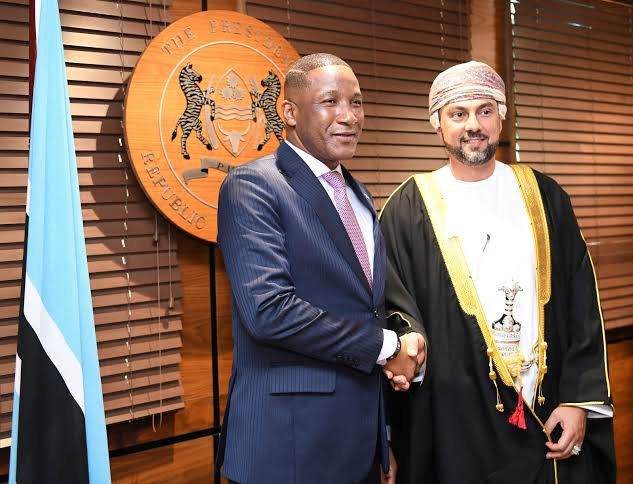
Botswana President Duma Gideon Boko signed a power purchase agreement with Oman's sovereign wealth fund-backed O-Green on April 13, 2026 locking in a 500MW solar plant with 500MW battery storage in Maun, a 25-year operating concession, and a broader 3GW energy cooperation framework that would make Botswana a net electricity exporter into Southern Africa.
The project will be designed, financed, built, and operated by Naqaa Sustainable Energy LLC, a subsidiary of O-Green itself backed by the Oman Investment Authority (OIA), a sovereign wealth fund with assets above $53 billion. It is the first project to reach implementation stage under a 3,000MW solar, wind, and battery storage framework agreed between the two countries in November 2025, following a bilateral engagement process that began with President Boko's visit to Oman in October 2025 and a reciprocal OIA chairman visit to Gaborone in November.
The agreements, signed at Al Barakah Palace in Muscat during President Boko's two-day working visit, extend beyond energy into mining exploration and petroleum infrastructure making this the most comprehensive bilateral economic cooperation framework Botswana has concluded with a Middle Eastern partner.
Sources: AfDB, Botswana Ministry of Minerals and Energy, Botswana Power Corporation • Calculations & Modelling: Limitless Beliefs Consulting
A Project That Doubles Botswana's Generation Capacity
The scale of the Maun project must be understood against Botswana's current baseline. Total installed grid-connected solar capacity in commercial operation in the country stands at just 104MW representing 21% of the effective installed generation mix. A single 500MW plant therefore represents a near-fivefold increase in solar capacity and is expected to double Botswana's total effective generation capacity once operational.
Botswana's current peak demand is approximately 700MW, growing at an average rate of 5% per annum driven by population growth, mining activity, and expanded household electrification. The Minerals and Energy Minister Bogolo Kenewendo has stated that the government targets renewable energy at 42% of installed capacity in the 2026–27 financial year, with the 2030 target of 50% underpinning the longer horizon. Together with other ongoing renewable projects including the 120MW Mmadinare Solar Cluster now in commercial operation (developed by Norway's Scatec), a Chinese-Botswanan 100MW project near Jwaneng, and India's KP Group which has signed an MoU for 5GW of renewables the Maun plant would position Botswana as a net electricity exporter into the Southern African Power Pool.
The integrated 500MW battery energy storage system (BESS) is the first utility-scale storage facility of its kind in Botswana and a strategically critical component. Without storage, solar generation creates grid stability challenges during peak and off-peak cycles. With 500MW of BESS, the facility can absorb excess generation during peak solar hours and dispatch into the grid during evening demand peaks or periods of low generation, providing the grid firmness that transforms solar from an intermittent resource into a dispatchable asset.
“These agreements are not just paperwork they are the beginning of major infrastructure, energy-security, and industrialisation projects that will shape Botswana's future.”
Sources: AfDB, IMF, World Bank • Calculations & Modelling: Limitless Beliefs Consulting
Oman Investment Authority Sovereign Capital Entering African Renewables
The identity of the capital behind this deal is as significant as the deal itself. O-Green is not a private developer seeking commercial returns on a single project it is a sovereign wealth vehicle established in 2025 specifically to lead Oman's clean energy diversification both domestically and internationally. The OIA behind it manages assets above $53 billion. This is sovereign capital making a sovereign bet on African renewable infrastructure a structurally different risk profile and commitment horizon from private equity or project finance.
O-Green's structure reflects the full project lifecycle ambition: Naqaa Sustainable Energy delivers the gigawatt-scale wind, solar, and storage pipeline; Mawarid Green Technologies manufactures wind turbines and advanced green energy technologies from a facility at Oman's Duqm Special Economic Zone (designed for 1GW annual turbine production, targeting commercial operations from 2026); and SolarWadi leads development and commissioning. This is a vertically integrated platform not a capital provider outsourcing execution to third parties.
Afreximbank has consistently emphasised that sovereign-backed partnerships are among the most effective mechanisms for bridging Africa's infrastructure financing gap, which the AfDB estimates at $130–170 billion annually. By combining OIA's balance sheet with Botswana Power Corporation's power purchase agreement and the Botswana government's policy framework, the Maun project de-risks the financing structure in a way that purely commercial capital cannot replicate.
| Agreement | Parties | Scope |
|---|---|---|
| 500MW Solar PV + 500MW BESS Maun | O-Green (OIA subsidiary) / Botswana Power Corporation | Power purchase agreement · 25-year concession · First utility BESS in Botswana · First project under 3GW framework |
| 3GW Renewable Energy Framework | Oman Investment Authority / Government of Botswana | Solar, wind, and battery storage pipeline · Agreed November 2025 · Maun project is first activation |
| Critical Minerals Exploration | Minerals Development Oman / Exploration Investment Company Botswana | Geological assessment across 70% of Botswana's land area · Focus: copper, gold, graphite, iron ore |
| Petroleum Infrastructure | Botswana Oil Limited / OQ S.A.O.C | Oil storage facilities at Walvis Bay + Tshele Hills Strategic Petroleum Depot |
Sources: Muscat Daily, PV Tech, Green Building Africa, Botswana Ministry of Minerals and Energy • Compiled by: Limitless Beliefs Consulting
Beyond Solar Critical Minerals as the Strategic Extension
The mineral exploration agreement is the element of the Botswana–Oman package that most analysts have underweighted. A cooperation agreement between Minerals Development Oman and Exploration Investment Company Botswana covering geological assessment across approximately 70% of Botswana's land area, targeting copper, gold, graphite, and iron ore positions this partnership at the intersection of the energy transition and the critical minerals supply chain that enables it.
Graphite is a battery anode material. Copper is the wiring backbone of every solar installation, EV, and grid modernisation project globally. The global decarbonisation agenda that is driving demand for the Maun solar plant is the same agenda creating surging demand for the minerals Botswana may hold. Oman's involvement in both the energy and minerals dimensions of this deal reflects a sophisticated understanding of where transition value chains are being built and a sovereign capital appetite to participate across the full stack.
Botswana's economy has historically been anchored by diamond exports. The IMF has consistently highlighted the importance of diversification in resource-dependent economies, noting that commodity revenue concentration creates fiscal vulnerability to price cycle volatility. The Oman partnership addresses this directly not by replacing the mining economy but by adding energy infrastructure and critical mineral development as parallel growth pillars that are both linked to global demand trajectories.
The Botswana–Oman agreements represent one of the most structurally complete bilateral economic partnerships concluded in Southern Africa in recent years combining sovereign capital, a 25-year energy concession, critical minerals exploration across 70% of the country's land, and petroleum infrastructure in a single negotiating round. The 500MW Maun solar project is the headline. The 3GW pipeline behind it, the BESS storage precedent it sets, and the critical minerals dimension layered beneath it are the strategic story. Botswana is not just building a power plant it is constructing the energy and resource architecture of its post-diamond economy.