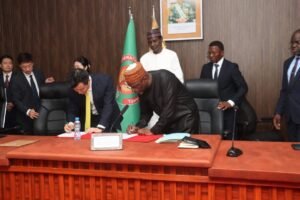

The Taiwan-Africa Business Association (TABA) has announced plans to establish a multi-billion solar plant in Nigeria a country with 13GW of installed generation capacity but peak grid output constrained to just 5.7GW against estimated demand of 20GW, leaving between 86 and 110 million Nigerians without electricity access. TABA's chairman is personally leading a high-level delegation to Abuja to sign agreements, a construction site has been identified, and a leading Taiwanese engineering firm has been named to execute.
The announcement was made by TABA Chairman Huang Chih-Peng a retired diplomat who previously served as Taiwan's ambassador to Vietnam during a briefing to Nigerian journalists visiting Taipei. Chih-Peng confirmed that TABA, now 19 years old and representing Taiwan's private sector engagement with Africa, has selected Nigeria as its primary African investment target due to its economic scale and population of approximately 230 million.
The investment framework extends beyond a single solar project. TABA's stated ambition is to integrate energy deployment with industrial park development and technology transfer a structure that mirrors Taiwan's own industrialisation model and reflects Nigeria's policy architecture under the Energy Transition Plan, the 2023 Electricity Act, and NDC 3.0 (submitted September 2025), which targets 50% renewable generation by 2030, universal electricity access by 2030, and net-zero emissions by 2060. Taiwan's Foreign Affairs Minister Lin Chia-lung has separately expressed interest in expanding cooperation into digital technology, healthcare, and agriculture, signalling that the energy investment is a gateway into a broader bilateral relationship.
Sources: AfDB, AfriPoli Nigeria Energy Transition Report (2026), IMF • Calculations & Modelling: Limitless Beliefs Consulting
Nigeria's Power Crisis The Numbers Behind the Deficit
Nigeria's electricity crisis is not primarily a generation problem it is a transmission and grid stability problem layered on top of a generation deficit. Although installed generation capacity stands at approximately 13GW, transmission constraints restrict peak grid output to around 5.7GW less than 44% of installed capacity against an estimated demand of 20GW. This gap leaves between 86 and 110 million Nigerians without reliable electricity access, according to AfriPoli's 2026 assessment of Nigeria's clean energy transition.
The consequence for industry is measurable and severe. Businesses across manufacturing, agriculture, and services rely heavily on diesel generators, with generator fuel costs representing one of the most significant operating expense items across Nigerian commercial and industrial enterprises. The AfDB identifies energy access as a core driver of industrialisation economies with stable electricity supply experience materially faster manufacturing growth and improved FDI inflows. Nigeria's diesel generator dependency is effectively a self-funding case for renewable energy investment: the cost of the alternative is already being paid, just inefficiently and carbonintensively.
Nigeria imported Chinese solar panels with a combined capacity of 1,721MW in 2024 making it Africa's second-largest solar panel importer behind South Africa. The government considered a ban on panel imports to protect nascent domestic manufacturing but stepped back, opting instead for joint ventures, tariff adjustments, and capacity building as the preferred mechanism. This policy posture is directly relevant to the TABA investment framework: a Taiwanese consortium bringing both capital and manufacturing capability fits the joint venture model the Nigerian government has signalled it will support.
“Because of this rapid rising of Africa and this big continent with a lot of population and a lot of natural resources, Africa is already popularly recognized as the continent of the future.”
Sources: Afreximbank, AfDB Renewable Energy Frameworks, TABA Announcement • Calculations & Modelling: Limitless Beliefs Consulting
The Energy-Industrial Integration Model What Taiwan Is Actually Proposing
The TABA investment framework is most accurately understood not as a standalone solar project but as an energy-industrial co-location strategy. The plan integrates solar power generation with industrial park development — embedding energy generation directly within manufacturing zones to eliminate transmission risk, reduce operational energy costs, and create the kind of energy-reliable manufacturing environment that export-competitive industry requires.
This model has precedent within Africa. Kenya's Naivasha Industrial Park combines geothermal and solar with grid supply. Nigeria's own Lekki Free Zone has deployed solar rooftops and mini-grids to stabilise power supply. The TABA proposal would extend this logic to a dedicated large-scale facility where manufacturing capacity and solar generation are designed together from the ground up a structurally different proposition from retrofitting solar onto existing industrial zones.
Afreximbank has consistently advocated for industrial park expansion as a mechanism for accelerating intra-African trade and manufacturing competitiveness. Nigeria's industrial corridors Lekki, Onne, Calabar, Kano represent the natural deployment contexts for embedded renewable energy systems, where reliable power directly enables the agro-processing, textiles, electronics assembly, and light manufacturing that Nigeria's diversification strategy requires.
| Parameter | Detail | Source / Status |
|---|---|---|
| Lead Institution | Taiwan-Africa Business Association (TABA) 19-year-old private sector bilateral body | Confirmed · Chairman Huang Chih-Peng announcement |
| Investment Type | Multi-billion solar plant + industrial park integration + technology transfer | TABA briefing to Nigerian press delegation Taipei, April 2026 |
| Project Site | Identified location not yet publicly disclosed | SolarQuarter, April 15, 2026 |
| Lead Developer | Leading Taiwanese engineering company — named but undisclosed | TABA announcement · advanced planning stage confirmed |
| Next Steps | High-level TABA delegation to Nigeria to sign agreements with NPC and private entities | Planned for 2026 · timeline not specified |
| Diplomatic Dimension | Plans discussed for return of Taiwan's representative office to Abuja | SolarQuarter, April 15, 2026 |
| Existing Taiwan Footprint | ~80 Taiwanese companies already operating in Nigeria | TABA — bilateral trade at $204M; significant growth potential stated |
| Nigeria Policy Alignment | Energy Transition Plan · 2023 Electricity Act · NDC 3.0 (Sep 2025) · 50% renewables by 2030 target | AfriPoli Nigeria Energy Transition Report (2026) |
Sources: BusinessDay NG, SolarQuarter, AfriPoli, TABA • Compiled by: Limitless Beliefs Consulting
Sources: AfDB Industrial Development Reports, IMF Productivity Studies • Calculations & Modelling: Limitless Beliefs Consulting
Taiwan's Strategic Repositioning Why Africa, Why Now
TABA's turn toward Nigeria reflects a strategic recalibration that Chairman Chih-Peng acknowledged directly: Taiwan has historically concentrated its trade and investment attention on established Western, European, and Asian economies while Africa which accounts for less than 1% of Taiwan's global trade was systematically underweighted. The TABA chairman's admission that "that's our fault" is not diplomatic modesty; it is a market recognition that the continent's rapid growth, population scale, and natural resource base represent an investment gap that Taiwan's private sector is now correcting.
Taiwan's relevance to Nigeria's energy transition is substantive. Taiwan's own renewable energy industry is one of the most technically advanced in Asia the government has deployed 14.2GW of solar capacity and is executing an $82.9 billion wind and solar development pipeline. Taiwanese engineering firms have deep EPC (engineering, procurement, construction) capability for both utility-scale solar and integrated industrial energy systems. The technology transfer component of TABA's Nigeria proposal is therefore not aspirational it draws on an industrial manufacturing ecosystem that Taiwan has built over decades.
The IMF identifies energy stability as one of the strongest predictors of long-term GDP growth in emerging markets. Nigeria's National Climate Investment Platform (NCIP), launched in 2025, is designed to mobilise $500 million through a partnership between the Nigeria Sovereign Investment Authority (NSIA), the Green Climate Fund, and local stakeholders creating the blended finance structure into which the TABA solar investment could potentially be anchored for concessional co-financing.
The TABA solar investment proposal is at an early but concrete stage site identified, engineering firm named, delegation imminent. Its significance extends beyond the project itself. Nigeria is now receiving simultaneous energy transition positioning from Chinese supply chain dominance (1,721MW of panel imports in 2024), Taiwanese industrial manufacturing frameworks (TABA), and a domestic policy architecture that explicitly targets 50% renewables by 2030. The question is not whether capital will arrive it is which capital structures will dominate, and whether Nigeria can convert foreign energy investment into domestic manufacturing capability rather than a perpetual import dependency at a different point in the value chain.