
Desk: Uncategorized Desk
Published: May 6, 2026
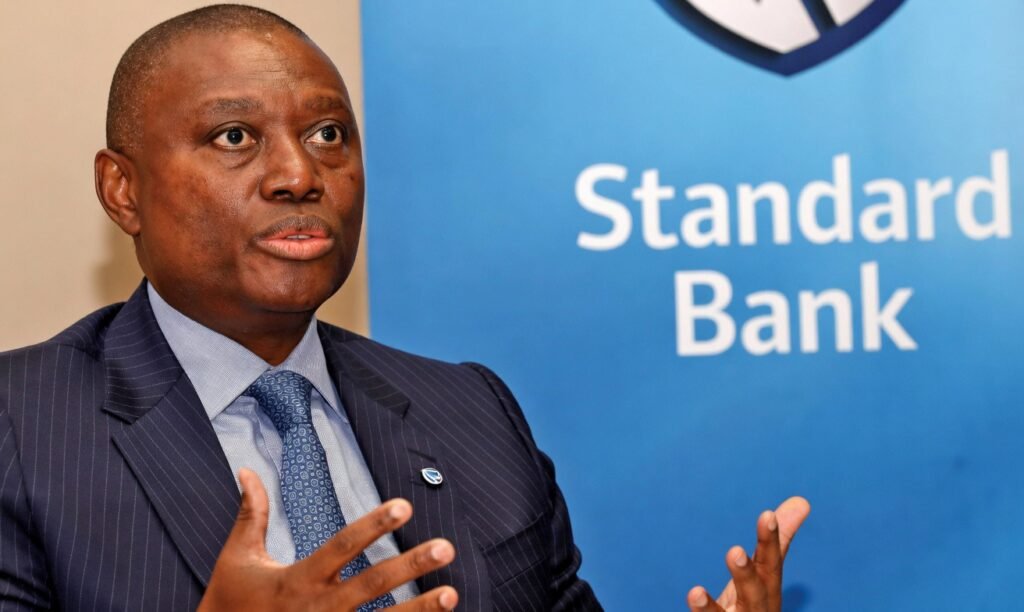
Under CEO Sim Tshabalala, Standard Bank Group is executing one of the most aggressive Pan-African banking expansion strategies on the continent. With over $1.38 billion in major deals closed in early 2026 alone, the bank is doubling down on energy financing, fintech infrastructure, and sustainability linked capital signaling a broader shift in how African banks compete both regionally and globally. The $800 million sustainability linked syndicated loan (the largest of its kind in Africa for 2026), $250 million financing facility for Nigeria’s Aradel Energy, $330 million fintech refinancing for Optasia, and an increased stake in Investec to approximately 6% collectively represent a strategic pivot toward high-growth sectors and markets. But beneath the expansion narrative lies a deeper structural reality: Africa’s banking sector is growing rapidly, yet constrained by talent gaps, regulatory fragmentation, and uneven economic performance across key markets.
South Africa remains Africa’s most sophisticated banking ecosystem, contributing approximately 20% of GDP through financial services. Standard Bank alone operates in over 20 African countries and manages assets exceeding $170 billion. However, growth domestically is slowing due to low GDP growth (approximately 1–2%), high unemployment (over 30%), and persistent energy instability (load shedding). This has forced banks like Standard Bank to look outward toward faster growing African economies where GDP growth outpaces South Africa by 2–4 percentage points annually.
Sources: Standard Bank Group, AfDB, Bloomberg • Analysis: Limitless Beliefs Consulting
Deal Flow Momentum Sustainability, Energy, and Fintech
The $800 million sustainability linked syndicated loan is particularly significant it is the largest facility of its kind in Africa for 2026 and signals growing investor appetite for environmental, social, and governance (ESG)-aligned instruments on the continent. For Standard Bank, sustainability linked financing serves dual purposes: meeting global investor demand for ESG products while financing the energy transition in markets where traditional energy infrastructure remains critical.
The table below maps Standard Bank’s strategic positioning across key sectors and geographies:
| Sector | Deal/Investment | Geography | Strategic Rationale |
|---|---|---|---|
| Sustainability Finance | $800M syndicated loan | Pan-African | Largest ESG facility of 2026; positions Standard Bank as Africa’s sustainability finance leader |
| Energy | $250M Aradel Energy facility | Nigeria | Financing oil & gas production in Africa’s largest economy; energy security as growth enabler |
| Fintech Infrastructure | $330M Optasia refinancing | Pan-African | Digital lending and AI-driven credit scoring; exposure to Africa’s fintech acceleration |
| Regional Integration | ~6% Investec stake increase | South Africa/UK | Strategic positioning in wealth and asset management across Southern Africa |
Sources: AfDB, IMF, World Bank • Analysis: Limitless Beliefs Consulting
“Standard Bank’s expansion reflects a broader shift: African banks are no longer confined to domestic markets. They are becoming regional financial institutions competing across borders. But scale alone is not enough.”
Expansion into High-Growth Markets Opportunity and Constraint
Standard Bank’s strategy is clear: allocate capital into markets where GDP growth outpaces South Africa’s anaemic 1–2% trajectory. Nigeria (GDP approximately $500 billion, growth ~3.2%) offers high fintech adoption and strong energy financing demand. Kenya (growth ~5.5%) is East Africa’s financial hub with mobile money dominance. Ghana (growth 4.8%) offers stable banking reforms and an improving macroeconomic outlook following its debt restructuring.
But expansion across borders introduces new risk vectors: foreign exchange restrictions (notably in Nigeria, where FX illiquidity remains a binding constraint), capital controls limiting cross-border flows, inconsistent monetary policy frameworks, and regulatory fragmentation across the 20+ countries where Standard Bank operates. Each country requires separate licensing, compliance, and reporting—significantly increasing operational costs.
Hiring vs Automation The Banking Sector’s Labor Transition
Africa’s banking sector employs over 2 million people directly and indirectly. However, digital transformation is reshaping employment patterns in ways that mirror global trends but with distinct African characteristics. An estimated 50,000+ new fintech and digital banking roles are created annually across the continent data scientists, cybersecurity experts, AI specialists, and product managers. Simultaneously, traditional branch roles are being phased out as digital adoption accelerates, with an estimated 10,000–20,000 roles eliminated across major banks over the past three years.
The net employment effect is positive but uneven. Standard Bank itself continues to hire in digital and investment banking roles while optimizing legacy operations. But the skill requirements have shifted dramatically. A bank teller displaced by mobile banking cannot easily transition to a data science role without retraining. The banking sector’s labor transition is, at its core, a skills transition and the training infrastructure to support it is underdeveloped across most African markets.
Sources: AfDB, IFC, World Bank, McKinsey • Analysis: Limitless Beliefs Consulting
The Cost of the Banking Skills Gap $2–5 Billion Annually
Skill gaps in Africa’s banking and financial services sector are costing economies billions annually. LBNN Intelligence estimates $2–5 billion in annual productivity loss across African banking systems, manifested through: delayed credit deployment to SMEs (loan officers and credit analysts in short supply); inefficiencies in risk management and compliance (regulatory expertise scarce); higher operational costs due to manual processes and error rates; and reliance on expatriate talent for specialized roles (investment banking, derivatives, structured finance).
For Standard Bank, the talent gap is both a constraint and an opportunity. The constraint: scaling operations across 20+ countries requires deep local talent pools that are often unavailable. The opportunity: banks that invest in training infrastructure—internal academies, certification programs, university partnerships will build moats around their talent pipelines that competitors cannot easily replicate.
Sources: Standard Bank Group, IMF, AfDB • Analysis: Limitless Beliefs Consulting
Sources: Standard Bank Group, Bloomberg analyst consensus • Analysis: Limitless Beliefs Consulting
Is the Expansion Strategy Working? Early Indicators
Standard Bank’s projected 8–12% earnings growth (2026–2028) suggests that its Pan-African strategy is delivering results. The increasing exposure to energy (Aradel), fintech (Optasia), and sustainability linked financing (the $800M facility) positions the bank at the center of Africa’s economic transformation away from pure commodity finance and toward infrastructure, technology, and energy transition.
However, execution risk remains significant. The bank must simultaneously: develop talent pipelines across 20+ countries; navigate regulatory fragmentation without incurring prohibitive compliance costs; manage currency volatility in Nigeria, Angola, and Ethiopia; and compete with nimble fintech startups that are unbundling traditional banking products without the legacy cost base.
The banking sector remains one of the strongest vehicles for upward mobility in Africa—high-income professional pathways in investment banking and corporate finance, entrepreneurial opportunities via SME financing ecosystems, and digital banking enabling financial inclusion for millions. But access remains unequal, with urban populations benefiting disproportionately compared to rural areas, and with wealth management products concentrated among high-net-worth clients rather than mass-market customers.
Bottom Line: Standard Bank’s $1.38 billion early-2026 deal spree spanning sustainability, energy, fintech, and strategic equity represents a coherent Pan-African expansion strategy aimed at high-growth sectors and markets beyond South Africa’s slow-growth domestic base. The projected 8–12% earnings growth signals that the strategy is working. But success at scale requires solving three structural constraints: talent pipeline development (the banking skills gap costs $2–5 billion annually across Africa), policy harmonization (20+ regulatory regimes increase compliance costs non-linearly), and infrastructure investments (power, connectivity, and FX liquidity). African banks are no longer confined to domestic markets. They are becoming regional financial institutions competing across borders. Standard Bank is leading that shift. Whether it can sustain the pace depends less on capital which is abundant and more on talent and regulation, which are not.