
LIVE MARKETS
USD/NGN1,377-0.22%
USD/KES130.40+0.18%
USD/ZAR16.77+0.31%
USD/GHS11.19-0.44%
USD/EGP48.00+0.05%
|
GOLD$4,628/oz+1.15%
BRENT$69.41/bbl-0.54%
COBALT$26,800/t-1.35%
|
BTC$94,280+2.34%
ETH$3,218+1.87%
USD/NGN1,377-0.22%
GOLD$4,628/oz+1.15%
BTC$94,280+2.34%
ROAD-1
Breaking AfCFTA Secretariat: 47 of 54 member states now operational under continental free trade framework — intra-Africa trade volumes up 12% year-on-year
Home Business Kenya Airways $1.25B Revenue Decline: Fleet Constraints, Fuel…
Business

Kenya Airways $1.25B Revenue Decline: Fleet Constraints, Fuel Risks, and the $2B Turnaround Bet

Author: Berhanu Shimeles Desk: Uncategorized Desk Published: April 22, 2026 Kenya Airways posted a KSh 17.2 billion ($138.3 million) net loss in FY2025 reversing a KSh 5 billion profit in 2024 as revenue fell 14% to KSh 161.5 billion ($1.25 billion), available seat kilometres contracted 18% from fleet groundings and supply chain disruptions, and the airline now requires between $1.2 and $2 billion in strategic investor capital by mid-2026 to avoid a balance sheet crisis that Kenya’s government cannot indefinitely absorb alone. The 2025 reversal is analytically significant precisely because it follows a recovery year. A loss from a distressed baseline is an expected continuation of distress. A loss after a profitable year is evidence that Kenya Airways’ underlying operating model has not yet reached the structural stability that FY2024’s numbers implied. The 18% ASK reduction is the most diagnostically important figure in the result: capacity reduction of that magnitude on a network like Kenya Airways’ where Nairobi’s position as East Africa’s primary aviation hub creates genuine demand means the losses are not demand-driven. They are supply-side failures driven by fleet availability and supply chain disruption that management can control, if it has the capital to do so. The Boeing 787-8 Dreamliner fleet restoration is therefore not a growth initiative it is a precondition for financial recovery. Kenya Airways cannot generate the revenue required to service its debt, fund its operations, and demonstrate to a strategic investor that the equity injection is worth making, unless it has aircraft in the air. That sequencing fleet first, revenue second, investor third defines the 2026 turnaround logic entirely. KSh 161.5B FY2025 Revenue Down 14% from KSh 188.5B $138.3M Net Loss FY2025 (KSh 17.2B) Reversal from 2024 Profit 18% ASK Reduction Fleet Groundings & Supply Chain Disruption $1.2–2B Strategic Investor Capital Required by Mid-2026 Financial Intelligence Kenya Airways Revenue vs Net Profit/Loss (2024–2025, KSh Billions) Sources: AfDB, IMF, Kenya Aviation Data  •  Calculations & Modelling: Limitless Beliefs Consulting Operational Intelligence 18% ASK Reduction A Supply-Side Failure, Not a Demand Problem The distinction between a demand-driven revenue decline and a supply-side capacity failure matters enormously for investment decision-making. A demand-driven decline signals that the market has moved against the carrier routes are uneconomic, competition has taken share, or the traveller base has contracted. A supply-side failure signals that the airline has real demand it cannot serve because it lacks operational aircraft. Kenya Airways’ 18% ASK reduction is definitively the latter category. Nairobi’s Jomo Kenyatta International Airport remains East Africa’s busiest hub. Kenya’s tourism inflows, diplomatic traffic, regional business travel, and cargo logistics demand have not contracted at a rate that would explain a 14% revenue decline. What has contracted is Kenya Airways’ ability to carry that demand grounded Dreamliners, supply chain disruptions in parts availability, and the financing constraints that slow maintenance turnaround times when cash is tight. That operational constraint is fixable. It requires capital and execution, not a different market thesis. “Kenya Airways is not losing a market. It is losing the ability to serve a market it still owns. The difference is $1.2 billion in strategic capital and the execution discipline to deploy it correctly.” Economic Intelligence Aviation GDP Contribution Index Kenya (2019–2025) Sources: AfDB, World Bank, IMF  •  Calculations & Modelling: Limitless Beliefs Consulting Recovery Intelligence Cargo at 250 Tons, Dreamliners Restored, London Heathrow — The Three Pillars of 2026 Kenya Airways’ 2026 recovery strategy has three operational pillars, each addressing a distinct revenue stream and each dependent on the fleet restoration prerequisite being met first. The Boeing 787-8 Dreamliner return to service is the foundational move the aircraft type that carries Kenya Airways’ long-haul international revenue, serves the Heathrow route that is both its highest-revenue and most strategically important corridor, and demonstrates to a potential strategic investor that the airline’s premium asset base is operational. The cargo expansion from 70 to 250 tonnes a 257% capacity increase reflects the most important structural shift in African aviation economics since the pandemic demonstrated that carriers with cargo operations survived at materially higher rates than passenger-only airlines. Cargo logistics have become a critical revenue stream across the continent as global supply chain realignment increases demand for reliable African freight corridors. Nairobi’s position connecting East African agricultural exports, pharmaceutical imports, and e-commerce logistics gives Kenya Airways a cargo positioning that its geographic hub advantage makes structurally defensible against competition. The London Heathrow capacity increase is both the highest-margin route and the investor signalling move. A well-functioning Heathrow operation demonstrates to potential strategic partners that Kenya Airways can execute credibly in the most operationally demanding aviation environment globally which is the proof of concept that a $1.2–2 billion equity investor needs before committing. Cargo Intelligence Kenya Airways Cargo Capacity Expansion 2025 to 2026 Target (Tons) Sources: Afreximbank, AfDB Trade Data  •  Calculations & Modelling: Limitless Beliefs Consulting Cost Intelligence Kenya Airways Operating Cost Structure Sources: AfDB, IATA, IMF  •  Calculations & Modelling: Limitless Beliefs Consulting Investment Intelligence $1.2–$2 Billion Strategic Investor What Kenya Is Actually Selling The Kenyan government’s pursuit of a $1.2–2 billion strategic investor is not simply a balance sheet repair exercise. It is an offer of access to East Africa’s primary aviation hub at a moment when the hub’s operational constraints are temporary and resolvable, the underlying demand is demonstrably real, and the government’s continued commitment to the carrier as strategic national infrastructure removes the existential risk that would otherwise make the equity injection indefensible. What a strategic investor acquires at that price point: the Jomo Kenyatta hub position, the Heathrow slot portfolio, the cargo corridor network connecting East Africa to global freight markets, the KQ brand equity across 40+ destinations, and a government equity partner with an interest in making the investment work. What it takes on: a KSh 17.2 billion loss, elevated financing costs, the African operating cost premium that Afreximbank documents at 15–20% above global averages, and fuel cost exposure on jet fuel that constitutes 25–35% of operating costs. The investment thesis is real but not risk-free. It
By Berhanu Shimeles · April 22, 2026 · 11 min read
Kenya Airways $1.25B Revenue Decline: Fleet Constraints, Fuel Risks, and the $2B Turnaround Bet

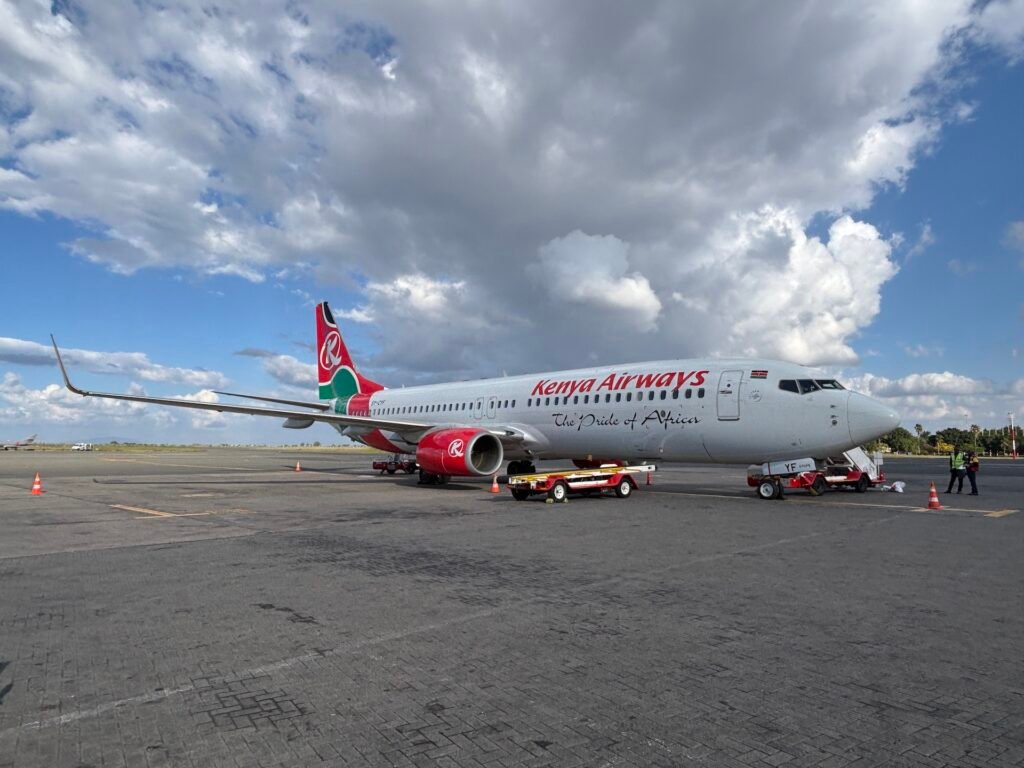
Kenya Airways posted a KSh 17.2 billion ($138.3 million) net loss in FY2025 reversing a KSh 5 billion profit in 2024 as revenue fell 14% to KSh 161.5 billion ($1.25 billion), available seat kilometres contracted 18% from fleet groundings and supply chain disruptions, and the airline now requires between $1.2 and $2 billion in strategic investor capital by mid-2026 to avoid a balance sheet crisis that Kenya's government cannot indefinitely absorb alone.

The 2025 reversal is analytically significant precisely because it follows a recovery year. A loss from a distressed baseline is an expected continuation of distress. A loss after a profitable year is evidence that Kenya Airways' underlying operating model has not yet reached the structural stability that FY2024's numbers implied. The 18% ASK reduction is the most diagnostically important figure in the result: capacity reduction of that magnitude on a network like Kenya Airways' where Nairobi's position as East Africa's primary aviation hub creates genuine demand means the losses are not demand-driven. They are supply-side failures driven by fleet availability and supply chain disruption that management can control, if it has the capital to do so.

The Boeing 787-8 Dreamliner fleet restoration is therefore not a growth initiative it is a precondition for financial recovery. Kenya Airways cannot generate the revenue required to service its debt, fund its operations, and demonstrate to a strategic investor that the equity injection is worth making, unless it has aircraft in the air. That sequencing fleet first, revenue second, investor third defines the 2026 turnaround logic entirely.

KSh 161.5B
FY2025 Revenue Down 14% from KSh 188.5B
$138.3M
Net Loss FY2025 (KSh 17.2B) Reversal from 2024 Profit
18%
ASK Reduction Fleet Groundings & Supply Chain Disruption
$1.2–2B
Strategic Investor Capital Required by Mid-2026

Financial Intelligence
Kenya Airways Revenue vs Net Profit/Loss (2024–2025, KSh Billions)

Sources: AfDB, IMF, Kenya Aviation Data  •  Calculations & Modelling: Limitless Beliefs Consulting

18% ASK Reduction A Supply-Side Failure, Not a Demand Problem

The distinction between a demand-driven revenue decline and a supply-side capacity failure matters enormously for investment decision-making. A demand-driven decline signals that the market has moved against the carrier routes are uneconomic, competition has taken share, or the traveller base has contracted. A supply-side failure signals that the airline has real demand it cannot serve because it lacks operational aircraft. Kenya Airways' 18% ASK reduction is definitively the latter category.

Nairobi's Jomo Kenyatta International Airport remains East Africa's busiest hub. Kenya's tourism inflows, diplomatic traffic, regional business travel, and cargo logistics demand have not contracted at a rate that would explain a 14% revenue decline. What has contracted is Kenya Airways' ability to carry that demand grounded Dreamliners, supply chain disruptions in parts availability, and the financing constraints that slow maintenance turnaround times when cash is tight. That operational constraint is fixable. It requires capital and execution, not a different market thesis.

“Kenya Airways is not losing a market. It is losing the ability to serve a market it still owns. The difference is $1.2 billion in strategic capital and the execution discipline to deploy it correctly.”

Economic Intelligence
Aviation GDP Contribution Index Kenya (2019–2025)

Sources: AfDB, World Bank, IMF  •  Calculations & Modelling: Limitless Beliefs Consulting

Cargo at 250 Tons, Dreamliners Restored, London Heathrow — The Three Pillars of 2026

Kenya Airways' 2026 recovery strategy has three operational pillars, each addressing a distinct revenue stream and each dependent on the fleet restoration prerequisite being met first. The Boeing 787-8 Dreamliner return to service is the foundational move the aircraft type that carries Kenya Airways' long-haul international revenue, serves the Heathrow route that is both its highest-revenue and most strategically important corridor, and demonstrates to a potential strategic investor that the airline's premium asset base is operational.

The cargo expansion from 70 to 250 tonnes a 257% capacity increase reflects the most important structural shift in African aviation economics since the pandemic demonstrated that carriers with cargo operations survived at materially higher rates than passenger-only airlines. Cargo logistics have become a critical revenue stream across the continent as global supply chain realignment increases demand for reliable African freight corridors. Nairobi's position connecting East African agricultural exports, pharmaceutical imports, and e-commerce logistics gives Kenya Airways a cargo positioning that its geographic hub advantage makes structurally defensible against competition.

The London Heathrow capacity increase is both the highest-margin route and the investor signalling move. A well-functioning Heathrow operation demonstrates to potential strategic partners that Kenya Airways can execute credibly in the most operationally demanding aviation environment globally which is the proof of concept that a $1.2–2 billion equity investor needs before committing.


Cargo Intelligence
Kenya Airways Cargo Capacity Expansion 2025 to 2026 Target (Tons)

Sources: Afreximbank, AfDB Trade Data  •  Calculations & Modelling: Limitless Beliefs Consulting

Cost Intelligence
Kenya Airways Operating Cost Structure

Sources: AfDB, IATA, IMF  •  Calculations & Modelling: Limitless Beliefs Consulting

$1.2–$2 Billion Strategic Investor What Kenya Is Actually Selling

The Kenyan government's pursuit of a $1.2–2 billion strategic investor is not simply a balance sheet repair exercise. It is an offer of access to East Africa's primary aviation hub at a moment when the hub's operational constraints are temporary and resolvable, the underlying demand is demonstrably real, and the government's continued commitment to the carrier as strategic national infrastructure removes the existential risk that would otherwise make the equity injection indefensible.

What a strategic investor acquires at that price point: the Jomo Kenyatta hub position, the Heathrow slot portfolio, the cargo corridor network connecting East Africa to global freight markets, the KQ brand equity across 40+ destinations, and a government equity partner with an interest in making the investment work. What it takes on: a KSh 17.2 billion loss, elevated financing costs, the African operating cost premium that Afreximbank documents at 15–20% above global averages, and fuel cost exposure on jet fuel that constitutes 25–35% of operating costs.

The investment thesis is real but not risk-free. It is the classic African aviation value proposition: genuine strategic asset, genuine operational challenges, genuine government dependency, and a recovery timeline that requires patience that short-term capital cannot provide. The right investor is an airline operator or infrastructure fund with a multi-year horizon and genuine interest in the East African market not a financial investor seeking near-term returns from a carrier that needs three to five years to demonstrate sustainable profitability.

Workforce Intelligence
Kenya Airways Workforce Restructuring Model Recovery Phase

Sources: IFC, AfDB Aviation Data  •  Calculations & Modelling: Limitless Beliefs Consulting

Kenya Airways' FY2025 result is a setback, not a structural failure but the distinction only holds if the 2026 execution delivers. Fleet restoration, cargo expansion, Heathrow capacity, and strategic investor closure are four parallel tracks that must all progress simultaneously. Kenya Airways has everything a great African airline needs except a capitalised balance sheet and an operational fleet at full strength. The $1.2–2 billion investor thesis is credible precisely because those are solvable problems but they require solving in 2026, not 2027, before the loss accumulation makes the equity story harder to tell than the operational story warrants.


🌍
ROAD-1 Intelligence
Get port friction scores, PAPSS settlement data, FX volatility signals, and corridor analysis for the trade routes in this story.
Access ROAD-1 →