
Desk: Uncategorized Desk
Published: May 4, 2026
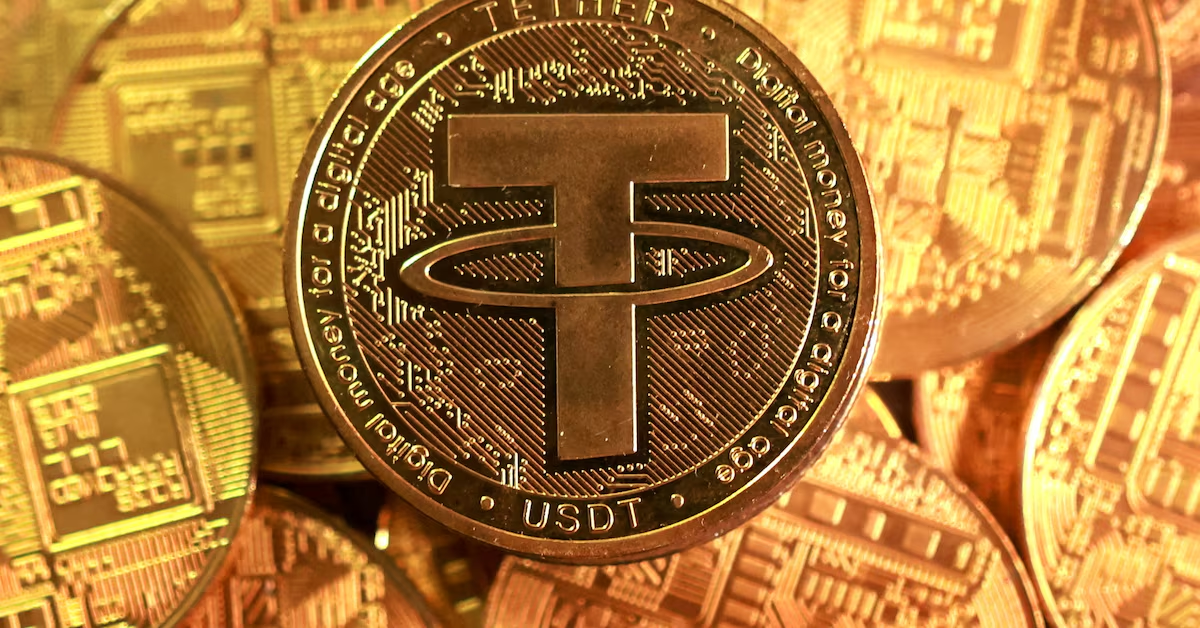
Africa has quietly become the most important battleground in global financial infrastructure and the weapon of choice is no longer the dollar or SWIFT. It is the stablecoin. With Nigeria ranking #1 globally in stablecoin adoption (79% of crypto users hold USDT), the continent now processes over $22 billion annually in crypto transaction volume. But the recent $344 million USDT seizure tied to Iran has exposed a critical vulnerability: stablecoins are programmable, traceable, and seizable. For African businesses, traders, and policymakers, this changes everything.
The narrative that built Africa’s stablecoin boom was seductive in its simplicity: a neutral, decentralized alternative to traditional financial rails. No correspondent banking delays. No SWIFT exclusions. No dollar reserve freezes. For economies battered by currency devaluation—the Nigerian naira has lost over 70% of its value against the dollar since 2015—stablecoins offered a lifeline. But the Iran-linked USDT seizure reveals that stablecoins are not outside the geopolitical system. They are embedded within it.
Sources: Chainalysis, Statista, KuCoin Research • Analysis: Limitless Beliefs Consulting
The Illusion of Neutrality How USDT and USDC Became Financial Weapons
The $344 million USDT seizure executed by Tether in cooperation with US law enforcement was not an anomaly. It was a demonstration of capability. Tether, as the issuer of USDT, maintains the technical and legal authority to freeze wallets at the request of government authorities. Circle, issuer of USDC, operates under the same compliance infrastructure. This means that stablecoins, far from being decentralized alternatives to traditional finance, are functionally extensions of the Western financial system they were supposed to bypass.
The strategic implication for Africa is profound. Nigerian importers using USDT to pay Chinese suppliers. Kenyan freelancers receiving USDC payments from European clients. Ghanaian SMEs holding stablecoins as a hedge against local currency devaluation. All of these transactions are visible, traceable, and if a government with jurisdiction over Tether or Circle decides seizable. The same infrastructure that enables near-instant settlement at 1% cost also enables real-time compliance enforcement.
“Stablecoins are not outside the geopolitical system. They are embedded within it. The $344M USDT seizure was not a bug it was a feature demonstration.”
Sources: Chainalysis Africa Report, KuCoin, IMF • Analysis: Limitless Beliefs Consulting
Financial Warfare From SWIFT to Stablecoins: The Continuity of Control
The pattern is now unmistakable. First, SWIFT was weaponized against Iran, Russia, and designated entities. Then, dollar reserves held at the Federal Reserve were frozen most notably Afghanistan’s $7 billion and Russia’s $300 billion. Then, gold repatriation was blocked for multiple central banks attempting to diversify reserves. Now, stablecoins are being integrated into the same enforcement architecture. The tool changes. The underlying dynamic does not: control over settlement infrastructure is control over economic participation.
For African economies, this continuity of control raises a hard question. Is stablecoin adoption genuine financial liberation or is it merely swapping one dependency (correspondent banking) for another (Tether/Circle compliance)? The efficiency gains are real. Cross-border payment costs drop from 7.9% to under 1%. Settlement times fall from 3–5 days to near-instant. But those gains come with a trade-off: visibility and seizability.
Sources: CBN, Chainalysis, MIT Digital Currency Initiative • Risk Modelling: Limitless Beliefs Consulting
Sources: World Bank Remittance Report, Chainalysis • Analysis: Limitless Beliefs Consulting
The African Dilemma Efficiency Now vs Resilience Later
For the African SME, freelancer, or trader, the decision to use stablecoins is not ideological it is practical. When local currencies are depreciating at 15–30% annually, holding USDT is a survival strategy. When correspondent banks charge 7.9% plus hidden spreads, stablecoin corridors at 0.5–1% are transformative. The efficiency gains are not theoretical: they are the difference between a profitable import business and an unprofitable one; between a freelancer capturing value and losing it to inflation.
But the efficiency resilience trade-off is real. A Nigerian importer holding $500,000 in USDT for trade settlement is also holding an asset that Tether could freeze if a US sanctions list expands. A Kenyan fintech routing cross-border payments through USDC is building mission critical infrastructure on a base that Circle controls. The probability of a mass freeze event affecting routine African commerce is currently low. But the probability that enforcement actions will increase targeting sanctioned jurisdictions, designated individuals, or politically exposed entities is 100%.
The question for African businesses and policymakers is not whether to use stablecoins. They will continue to be used because the efficiency differential is too large to ignore. The question is whether to build resilience through diversification—combining stablecoins with genuinely decentralized assets (Bitcoin, DAI) and non-digital stores of value (commodities, real estate, energy infrastructure).
Angled Prediction The Next Phase of African Crypto Strategy
By 2028–2029, LBNN Intelligence expects three strategic shifts to materialize across Africa’s digital asset landscape:
First, institutional diversification. African businesses with stablecoin exposure will begin maintaining multi-asset treasuries, including Bitcoin and commodity backed tokens, reducing single point seizure risk. The cost of this diversification (volatility exposure) will be accepted as an insurance premium against external control.
Second, regional stablecoin experimentation. The African Export-Import Bank (Afreximbank) and regional economic blocs (ECOWAS, SADC) will accelerate work on settlement infrastructure that reduces dependency on US dollar-denominated stablecoins. A pan-African settlement token backed by a basket of commodities or regional currencies could emerge as a medium term hedge.
Third, hard asset correlation. As African economies strengthen, private capital will diversify into hard assets (real estate, energy infrastructure, mining royalties) that carry no digital seizure risk. Stablecoins will remain the transactional rail, but long-term wealth storage will shift toward assets that cannot be frozen by foreign compliance departments.
Sources: LBNN Intelligence • Projections: Limitless Beliefs Consulting (2026–2029)
Bottom Line: Africa’s stablecoin boom is real, transformative, and irreversible. Nigeria’s #1 global ranking, $22 billion in annual volume, and 70 million regional users represent genuine financial infrastructure innovation. But the $344 million USDT seizure changed the threat model. Stablecoins are not neutral they are programmable, traceable, and seizable. For African businesses, the path forward is not abandonment but diversification: maintain the efficiency of stablecoins for transaction flow while building resilience through censorship-resistant assets (Bitcoin), decentralized alternatives (DAI), and hard assets (commodities, infrastructure). The continent’s financial future will not be defined by choosing between traditional rails and crypto—but by understanding the risks embedded in both and designing multi-layer systems that preserve efficiency while managing external control exposure.