
Desk: Uncategorized Desk
Published: September 16, 2026
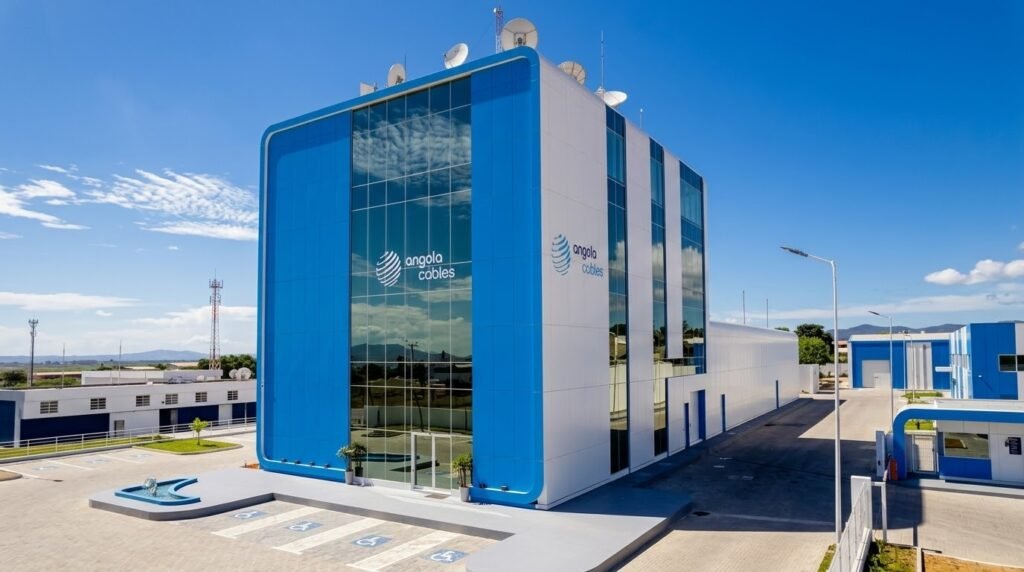
Angola Cables built its business around international connectivity. Its next phase is more complicated: turning subsea routes, terrestrial networks, data centres, cloud services and AI infrastructure into a diversified recurring revenue platform while managing the capital intensity that made the network possible. The company is entering the second stage of its business model. The first stage was the construction and operation of international connectivity assets. The second is monetizing those assets through interconnection, data centres, cloud, IP transit, enterprise networking and AI infrastructure. The distinction matters because submarine cable infrastructure is inherently capital intensive. A cable can provide enormous theoretical capacity, but the economic return depends on how much of that capacity is sold, to whom, at what price and through which downstream services.
Angola Cables currently describes itself as a multinational telecommunications company operating an Atlantic backbone through SACS, MONET and WACS, with services spanning wholesale connectivity, IP transit, data centre interconnection, cloud and enterprise connectivity. Its website lists operations and offices across Angola, Nigeria, South Africa, Brazil, the United States and Portugal. The company also lists more than 1,000 interconnected data centres, more than 20 Internet Exchange Points, more than 20 Points of Presence and more than 5,845 peering agreements on its current commercial materials. Its disclosed African backbone capacity totals approximately 3.6 Tbps.
These numbers show the scale of the network, but they do not by themselves establish profitability. For investors and lenders, the more important question is whether the network produces enough recurring cash flow to cover operating expenditure, debt service, replacement capex and future technology upgrades. The strategic shift is from selling connectivity as a commodity toward monetizing connectivity as infrastructure. The value of the network increasingly depends on the services built on top of it.
Sources: IMF Article IV Consultation with Angola, 2026 • Analysis: Limitless Beliefs Consulting
Macroeconomic Drivers Angola’s Environment for Capital-Intensive Telecom
Angola’s economic environment provides both support and constraints for a capital intensive telecommunications company. The IMF estimates that Angola’s real GDP grew 3.1% in 2025 and projects 2.3% growth in 2026. Non-oil activity is projected to grow 2.4% in 2026, compared with 1.6% growth in the oil sector. The IMF also expects average consumer price inflation of 12.9% in 2026, down sharply from 20.2% in 2025.
That disinflation is relevant to digital infrastructure because much of the sector’s capital expenditure is imported. Servers, optical equipment, networking hardware, cooling systems and other specialist components are generally priced in foreign currency. Lower inflation and greater exchange rate stability can therefore reduce the pace at which replacement costs rise in kwanza terms. The opposite remains a risk. A renewed depreciation of the kwanza would increase the local currency cost of equipment and foreign currency debt service. For infrastructure businesses with long asset lives, this creates a mismatch between hard currency capital costs and local currency revenue.
The IMF also estimates that private investment will rise from 7.2% of GDP in 2025 to 7.6% in 2026. That broader increase in private capital formation is relevant to the development of non-oil infrastructure, including digital networks.
Africa Has a Connectivity Problem But It Is Not Simply a Cable Problem
Africa’s digital infrastructure market remains structurally underdeveloped relative to global demand. The ITU estimates that only 38% of Africa’s population used the Internet in 2024, compared with 68% globally. Urban Internet usage reached 57%, while rural usage was only 23%. The same ITU research shows that only three in ten Africans live within 10 kilometres of a fibre node. That statistic is important because it demonstrates the difference between international capacity and actual connectivity. A subsea cable can bring terabits of capacity to a coastal landing station while millions of potential users remain physically distant from the terrestrial network required to reach them.
For Angola Cables, this creates a market opportunity and a commercial constraint at the same time. International routes can become more valuable as African traffic grows, but the company must capture that demand through networks, interconnection points and downstream services.
Sources: International Telecommunication Union, 2025 • Analysis: Limitless Beliefs Consulting
Sources: Angola Cables, ITU • Analysis: Limitless Beliefs Consulting
The Business Model Is Expanding Down the Value Chain
The most important commercial development is the movement from wholesale international bandwidth toward a broader digital infrastructure stack. Angola Cables currently markets IP Transit, Global Data Centre Interconnection, cloud connectivity, colocation, SD WAN, dedicated Internet access and other network services. It also operates Clouds2Africa and offers GPU and NPU resources for artificial intelligence and machine learning workloads. This creates several different revenue pools with different economic characteristics.
“The strategic shift is from selling connectivity as a commodity toward monetizing connectivity as infrastructure. The value of the network increasingly depends on the services built on top of it.”
Data centres are strategically important because they allow a network operator to monetize connectivity after the cable landing point. The economics are different from wholesale bandwidth. A data centre can earn recurring revenue from power, rack space, cross connects, remote hands, storage and interconnection. Customers may also remain contracted for several years, increasing revenue visibility. The African market remains concentrated. Knight Frank estimates third party core and shell data centre capacity in Lagos at approximately 66 MW as of late 2024, with several hundred megawatts in the development pipeline. South Africa accounts for approximately two thirds of Africa’s third party colocation capacity. Angola Cables currently lists data centre presence or interconnection in Luanda, Lagos, Accra, Cape Town, Durban and Johannesburg.
Artificial intelligence changes the infrastructure equation because AI workloads require concentrated computing resources rather than only conventional network bandwidth. The ITU estimates that data centres already account for approximately 1.5% of global electricity consumption. Angola Cables’ move into GPU and NPU based AI infrastructure therefore represents an attempt to capture a higher value layer of the digital stack. But the economics are also more demanding AI hardware depreciates more rapidly than passive infrastructure, GPU utilization has to remain high enough to cover capital costs, power and cooling, and technology cycles can shorten the useful economic life of hardware.
Sources: Angola Cables product disclosures • Analysis: Limitless Beliefs Consulting
Sources: African Development Bank, Government of Nigeria • Analysis: Limitless Beliefs Consulting
Nigeria’s digital infrastructure expansion illustrates the scale of demand that African network operators are attempting to capture. In April 2026, the African Development Bank approved a $200 million loan for Nigeria’s Digital Value Chain Infrastructure for Boosting Employment project. The programme is designed to deploy 90,000 kilometres of open access fibre and increase the national fibre backbone from approximately 30,000 kilometres to about 120,000 kilometres, connecting all 774 Local Government Areas. For Angola Cables, the significance is indirect but material. More domestic fibre increases the number of enterprises, government institutions, schools, health facilities and commercial centres that can ultimately consume international connectivity and data services.
What Could Go Wrong Six Structural Risks
Bandwidth price compression. As multiple subsea cables enter African markets, international bandwidth becomes less scarce. More supply can reduce wholesale prices. This is positive for consumers but can reduce returns for infrastructure owners unless traffic grows quickly enough to offset falling unit prices.
Debt and capital intensity. Subsea cables, data centres and AI infrastructure require different forms of capital. Long lived cables can justify long-term financing, while AI accelerators have much shorter technology cycles. A company expanding aggressively across both categories can increase its capital requirements faster than its recurring revenue base.
Power constraints. AI and data centres require reliable electricity. Where grid power is unreliable, operators need additional generation and backup systems, raising operating costs.
Foreign exchange exposure. Imported equipment and foreign currency debt can create substantial currency risk in African markets. Angola’s recent inflation improvement reduces some pressure, but the IMF continues to identify exchange rate and external vulnerabilities as relevant macroeconomic risks.
Customer concentration. Large cloud providers, telecom operators and financial institutions can represent significant portions of infrastructure demand. Losing a major customer can therefore have a disproportionate effect on utilization.
Technology obsolescence. AI infrastructure evolves much faster than passive fibre infrastructure. Investment in GPUs and related equipment can therefore carry a materially different depreciation and replacement cycle from investment in subsea cables.
Sources: LBNN Intelligence, World Bank, ITU • Analysis: Limitless Beliefs Consulting
Capital Structure The Hidden Side of the Business Model
Angola Cables was established in 2009 as a joint venture of Angolan telecommunications operators. Publicly available ownership information has historically identified Angola Telecom with a 51% stake, Unitel with 31%, MSTelcom with 9%, Movicel with 6% and Startel with 3%. A 2024 World Trade Organization review of Angola’s telecommunications sector reported the same ownership structure. The ownership structure matters because the company’s infrastructure buildout involved substantial long duration capital. World Bank research previously identified approximately $109.7 million in financing for SACS and approximately $130 million in financing for Angola Cables’ MONET position and related investments.
A company with this type of infrastructure portfolio needs to balance network expansion against debt service, maintenance capex and demand growth. The critical commercial question is therefore whether new revenue layers such as cloud, data centre interconnection and AI can improve cash flow faster than the company’s capital requirements increase.
The Next Test Is Commercial, Not Technical
Africa does not lack evidence that digital infrastructure demand is growing. The ITU estimates that 38% of the continent’s population used the Internet in 2024, while the global figure was 68%. Only three in ten Africans live within 10 kilometres of a fibre node. Nigeria is preparing to expand its national fibre backbone to 120,000 kilometres. Data centre capacity is expanding in Lagos and other hubs. New submarine systems are adding route diversity and international capacity.
The market therefore has a substantial structural demand gap. For Angola Cables, however, the next phase is less about proving that Africa needs connectivity and more about proving that its infrastructure portfolio can generate attractive returns. The company has already moved beyond a pure cable model. Its network now encompasses international connectivity, IP transit, data centre interconnection, cloud, enterprise networking and AI infrastructure. That creates a more diversified business model, but it also introduces more complex capital requirements.
Subsea cables require long duration capital. Data centres require power and high occupancy. Cloud infrastructure requires recurring customers. AI infrastructure requires high utilization and frequent technology refreshes. The strongest version of the Angola Cables strategy is therefore one in which the same physical network supports several layers of recurring revenue. The weaker version is one in which the company accumulates additional infrastructure faster than demand and cash flow can absorb it.
For investors, lenders and policymakers, the decisive metrics will consequently be utilization, recurring revenue, debt service coverage, return on invested capital and customer concentration rather than headline kilometres of cable. Africa’s digital infrastructure cycle is moving from construction toward monetization. Angola Cables’ next chapter will be determined by how effectively it converts the digital corridors it helped build into durable economic cash flows.
Bottom Line: Angola Cables is transitioning from a subsea cable operator into a diversified digital infrastructure platform moving from SACS, WACS and MONET capacity into data centres, cloud and AI infrastructure. The strategic logic is sound: Africa’s 38% internet penetration and the fact that only three in ten Africans live within 10 km of a fibre node represent a structural demand gap. The $200 million AfDB backed Nigeria fibre expansion to 120,000 km illustrates the size of the downstream market. But the economic test is not the network footprint it is utilization, recurring revenue, debt service coverage and return on invested capital. Data centre capacity in Lagos (approximately 66 MW) and South Africa (two thirds of African colocation) remains concentrated, and AI infrastructure carries a faster depreciation cycle than passive fibre. The winners in Africa’s digital infrastructure cycle will be the operators that convert physical capacity into durable recurring cash flows. Angola Cables has built the physical layer. The commercial layer will determine the return.