
Desk: Uncategorized Desk
Published: June 8, 2026
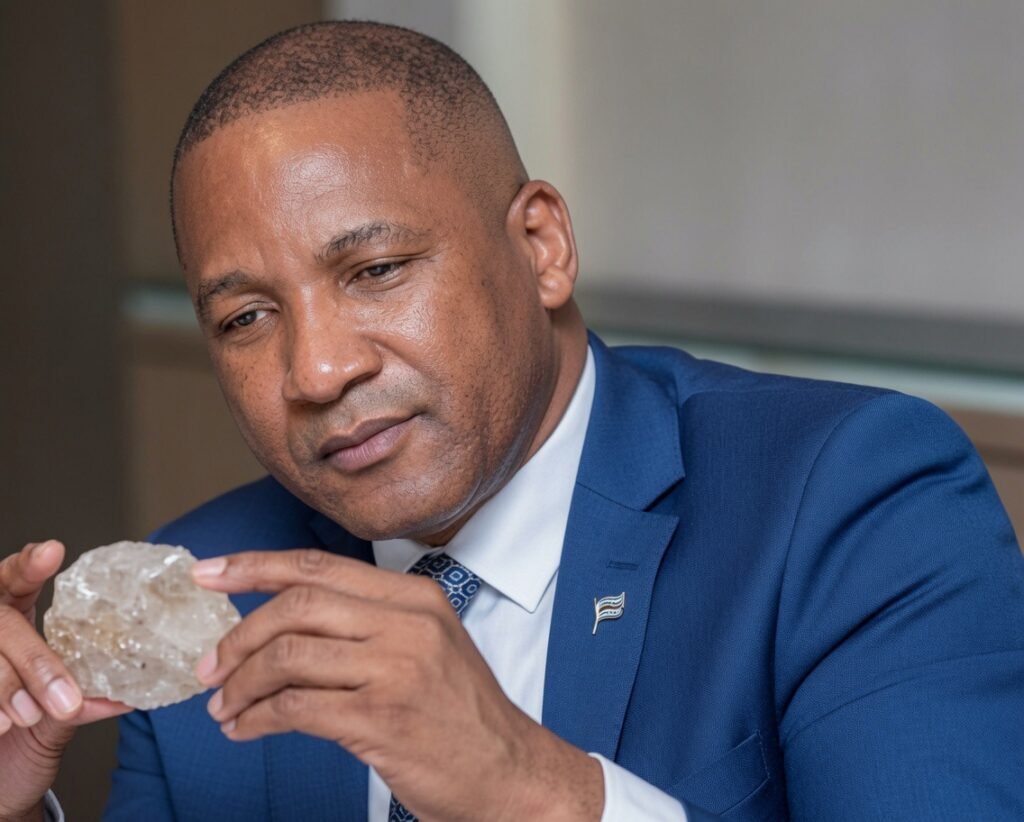
Botswana is pursuing one of the most consequential economic strategies in modern African resource politics. President Duma Boko’s government is actively exploring partnerships with sovereign investors from the United Arab Emirates and Oman to acquire a larger strategic stake in De Beers as Anglo American moves to divest its 85% ownership position. The move comes at a critical moment. Botswana remains the world’s largest producer of rough diamonds, yet declining global diamond prices, slowing Chinese demand, growing competition from synthetic diamonds, and broader global economic uncertainty have exposed structural vulnerabilities inside Botswana’s economy. For decades Botswana has been celebrated as one of Africa’s most successful resource economies. However, the current downturn has revived an old question: can diamond wealth alone sustain long-term prosperity, or must Botswana use this moment to build greater control over the entire diamond value chain while simultaneously diversifying its economy?
Botswana’s De Beers strategy is less about acquiring a mining company and more about securing influence over a sector responsible for roughly 80% of exports and approximately 25% of GDP. The transaction could reshape the balance of power in the global diamond industry while redefining Botswana’s economic future. Diamonds have been both Botswana’s greatest economic success and its greatest economic vulnerability. Since independence, diamond revenues helped transform Botswana from one of the poorest countries in the world into an upper-middle-income African economy with relatively strong institutions and fiscal management. However, dependence on a single commodity creates significant economic concentration risk.
Sources: IMF, World Bank, AfDB, Botswana Statistics Agency • Calculations & Modeling: Limitless Beliefs Consulting
The Economic Reality Behind Botswana’s Diamond Dependency
The recent collapse in global diamond demand has therefore had consequences far beyond the mining sector. Lower export receipts reduce foreign exchange inflows, weaken fiscal revenues, constrain public spending, and increase pressure on employment creation across the broader economy. President Duma Boko’s approach reflects a growing trend among African resource producing nations: increasing influence over strategic natural assets rather than remaining passive royalty recipients. By exploring partnerships with sovereign wealth funds from Oman and the UAE, Botswana aims to increase leverage over De Beers’ future strategic direction, protect employment linked to the diamond sector, expand downstream beneficiation opportunities, strengthen local cutting, polishing, and jewelry manufacturing industries, and retain greater value inside Botswana’s economy.
“Botswana’s De Beers strategy is less about acquiring a mining company and more about securing influence over a sector responsible for 80% of exports and 25% of GDP. It is a high stakes bet on economic sovereignty through value chain integration.”
Has Botswana Experienced Economic Progress Under Recent Reforms?
Botswana’s reform agenda under Duma Boko is still in its early stages, making definitive conclusions premature. However, several indicators suggest the government is attempting to reposition the economy away from pure commodity dependence. Key priorities include increasing foreign direct investment outside mining, expanding financial services, developing renewable energy projects, building logistics infrastructure, and growing tourism and knowledge-based industries. The challenge is timing. Diversification requires long-term investment, while diamond revenues remain under immediate pressure. The table below summarises Botswana’s economic concentration risk compared to other resource dependent African economies:
| Country | Primary Export Commodity | Export Share (%) | GDP Contribution (%) |
|---|---|---|---|
| Botswana (diamonds) | Diamonds | ||
| Nigeria (oil) | |||
| DRC (cobalt/copper)
Growth Intelligence
Estimated Sector Contribution to GDP Botswana vs Diversified Economies
Sources: AfDB, IMF, World Bank, UNCTAD • Calculations & Modeling: Limitless Beliefs Consulting Risk Intelligence
The Diamond Paradox: Why Resource Wealth Can Help and Hurt DevelopmentBotswana offers one of Africa’s best examples of resource wealth being managed responsibly. Yet even Botswana demonstrates the limitations of commodity led growth. Resource sectors often generate significant revenue but relatively fewer jobs compared to manufacturing, logistics, technology, agriculture, and services. For example, one billion dollars invested in manufacturing or logistics generally supports substantially more employment than one billion dollars invested in highly mechanized mining operations. The long-term question is not whether diamonds remain important, but whether diamond revenues can successfully finance the next generation of economic sectors. The employment multiplier in manufacturing is typically 5–10x higher per unit of capital than in capital intensive mining. Strategic Intelligence
What a Bigger De Beers Stake Could Unlock Four Strategic Channels
Value Addition Downstream Beneficiation Botswana could mandate local cutting, polishing, and jewellery manufacturing, capturing a larger share of diamond value (estimated 10–20% uplift on rough exports). Employment Protection Job Preservation & Growth A larger state stake could influence mine investment decisions, protecting an estimated 40,000–60,000 diamond-linked jobs during price downturns. Sovereign Partnership UAE/Oman Capital Access Gulf sovereign funds bring not only cash but also logistics expertise, energy investments, and potential downstream jewellery markets (Dubai diamond hub). Diversification Catalyst Beyond Diamonds A successful De Beers renegotiation could free up fiscal space for investment in renewables, tourism, and financial services reducing concentration risk. Sources: LBNN Intelligence, De Beers Group, IMF • Calculations & Modeling: Limitless Beliefs Consulting Employment Intelligence
Employment Impact Across Botswana 40,000–60,000 Jobs at StakeWhile exact employment effects vary by project and market conditions, the broader diamond ecosystem supports an estimated 40,000–60,000 direct and indirect jobs across mining operations, security services, transportation and logistics, financial services, engineering and maintenance, retail trade, and government administration. Continued weakness in global diamond prices risks slowing hiring activity across these industries, while a successful acquisition strategy could preserve jobs and potentially create new positions through downstream processing expansion. The indirect multiplier is significant: every direct mining job supports an estimated 2–3 additional jobs in local supply chains and services. Market Intelligence
Rough Diamond Price Index 2020–2026 (Indexed)
Sources: Kimberley Process, Rapaport Group, IMF • Calculations & Modeling: Limitless Beliefs Consulting Forecast Intelligence
Economic Outlook: Risks and OpportunitiesThe primary risk remains continued global weakness in natural diamond demand. Lab‑grown diamonds continue gaining market share, particularly among younger consumers seeking lower‑cost alternatives. However, opportunities remain significant. If Botswana secures greater influence within De Beers while simultaneously expanding downstream beneficiation and diversification efforts, the country could emerge with stronger economic resilience than before. The involvement of sovereign investors from Oman and the UAE may also unlock broader investment partnerships extending beyond mining into infrastructure, energy, logistics, tourism, and financial services. Botswana’s experience provides important lessons for African economies heavily dependent on oil, copper, cobalt, gold, lithium, and other strategic minerals. Countries that merely export raw materials often experience slower long‑term development than nations that build domestic value chains around those resources. Examples increasingly visible across Africa include battery manufacturing ambitions in Zambia and DRC, oil refining expansion in Nigeria, mineral processing initiatives in Namibia, industrial park development in Ethiopia, and special economic zones across East Africa. Botswana’s De Beers strategy fits within this larger continental movement toward economic value retention. Competitive Intelligence
Economic Diversification Comparison Manufacturing Share of GDP (%)
Sources: UNIDO, World Bank, AfDB • Calculations & Modeling: Limitless Beliefs Consulting Bottom Line: Botswana’s pursuit of a larger role within De Beers is one of Africa’s most important resource governance tests of the decade. With diamonds accounting for 80% of exports and 25% of GDP, and an estimated 40,000–60,000 jobs linked to the sector, the stakes could not be higher. The global diamond market is under pressure from synthetic alternatives, weakening Chinese demand, and price volatility. Yet a successful sovereign-backed acquisition in partnership with UAE and Oman could give Botswana greater control over the value chain, protect employment, and create fiscal space for diversification into renewables, financial services, and logistics. However, the strategy carries real risks: overpaying for De Beers equity could drain foreign reserves, and delaying economic reform could perpetuate dependency. President Duma Boko’s challenge is to transform diamond leverage into industrial sovereignty not simply to own a larger share of a declining industry. The outcome will shape Botswana’s economic trajectory for a generation, and offer a template for other resource‑rich African nations wrestling with the same tension: commodity wealth as engine or trap. |