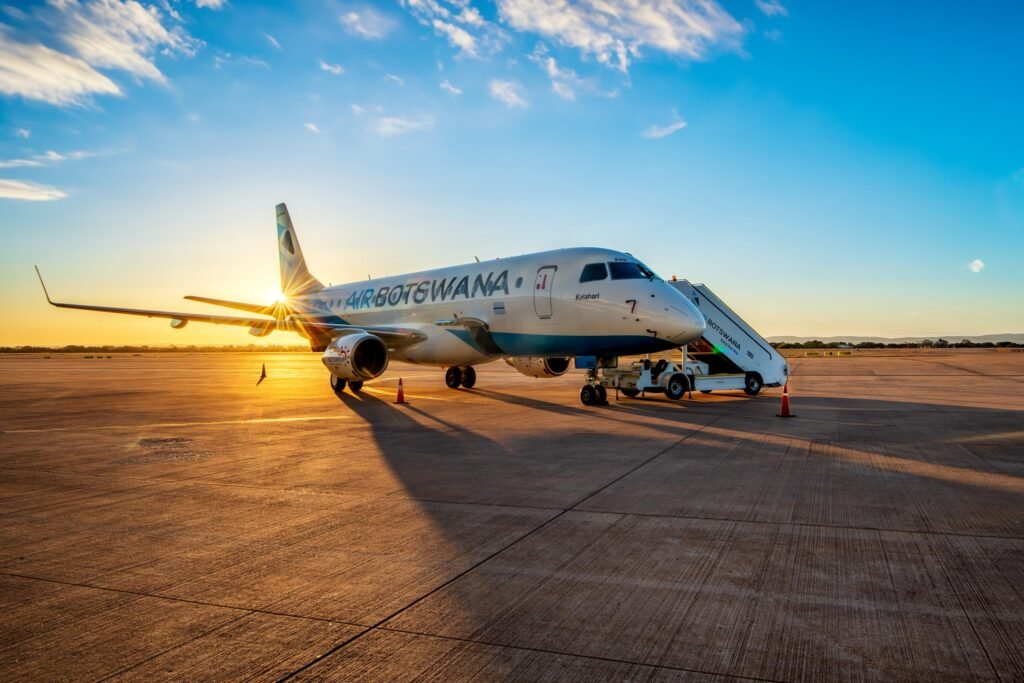
Air Botswana is executing a turnaround from a three-aircraft operational fleet supported by P127 million ($9.3M+) in government funding for FY2026/27, a completed C-check on its ATR72-600, two grounded Embraer ERJ145s awaiting return to service, and $67.6 million in annual revenue against a structural backdrop where Botswana's diamond-dependent economy needs functional aviation infrastructure more than the airline's balance sheet currently reflects.
Air Botswana's recovery plan addresses the aftermath of operational disruptions that grounded aircraft and forced regional route suspensions creating a connectivity gap in a Southern African market where the airline's routes are the primary air access for a tourism-dependent economy whose foreign exchange earnings are gated by how easily international visitors can arrive. Government support is not subsidy in the pejorative sense here. It is investment in infrastructure that the private sector has not stepped in to provide at the scale Botswana requires.
The aviation sector contributes between 2–3% of GDP across many African economies through tourism, trade facilitation, and connectivity and in Botswana, where tourism is a primary diversification pillar from diamond revenue dependency, the GDP contribution of functional aviation infrastructure is materially higher than the sector's direct financial weight suggests.
Sources: AfDB, IMF, Botswana Fiscal Data • Calculations & Modelling: Limitless Beliefs Consulting
Three Aircraft, Two Grounded, One C-Check The Fleet Arithmetic of Survival
The operational reality of Air Botswana in 2026 is defined by its fleet arithmetic: three ATR72-600s capable of flying, two ERJ145s grounded awaiting return to service, and a C-check on one aircraft in March 2026 that restored it to the active fleet. For a national carrier, fleet size determines route coverage, which determines revenue capacity, which determines whether the government subsidy can eventually be replaced by operating income. At three aircraft, Air Botswana can serve its core domestic and regional routes but the margin for disruption, additional maintenance grounding, or demand spikes is essentially zero.
The return of the two ERJ145s is therefore the most operationally consequential near-term milestone in the turnaround plan. Two additional aircraft do not simply add capacity proportionally they add redundancy that makes the three-aircraft fleet more commercially reliable, enable route expansion that the current fleet cannot service, and reduce the unit cost of operations by spreading fixed costs across more flying hours.
“Air Botswana is not competing with Ethiopian Airlines. It is competing with the absence of air connectivity in a tourism economy that needs it and on that basis, the turnaround case is stronger than the balance sheet suggests.”
Sources: IFC, AfDB Aviation Data • Calculations & Modelling: Limitless Beliefs Consulting
Charter Diversification Higher Margins, Lower Volume Risk
Air Botswana's strategic pivot toward charter operations reflects a commercially sound response to the constraints of operating a thin scheduled route network with a small fleet. Charter services particularly for tourism and corporate travel in a country with Botswana's wildlife destination profile offer higher per-seat margins, more flexible pricing structures, and revenue that is not dependent on the load factor economics that make thin-route scheduled operations financially marginal.
Botswana's tourism product Okavango Delta, Chobe National Park, Central Kalahari is premium and low-volume by design. The high-value, low-impact tourism model that Botswana has built creates precisely the demand profile that charter operations serve better than scheduled services: small groups, remote destinations, time-sensitive itineraries, and willingness to pay for direct access. Air Botswana's pivot to charter is not a retreat from scheduled aviation it is a recognition of where the airline's competitive advantage actually lies given its fleet size and market structure.
The airline's positioning is further supported by AviaDev Africa 2026 an aviation stakeholder event hosted in Botswana that provides a platform to attract route partnerships, investor interest, and regional integration opportunities that a carrier Air Botswana's size cannot generate through commercial outreach alone.
Sources: AfDB, World Bank, IMF • Calculations & Modelling: Limitless Beliefs Consulting
Sources: AfDB, IATA, IMF • Calculations & Modelling: Limitless Beliefs Consulting
Fuel Volatility, the African Cost Penalty, and Small Carrier Exposure
Jet fuel at 25–35% of total operating costs is the external risk variable that disproportionately affects small carriers operating without the hedging programmes and procurement scale that large airlines deploy. When global oil prices spike driven by Strait of Hormuz geopolitical tension or OPEC+ supply decisions Air Botswana absorbs the full cost increase per flying hour without the volume to negotiate better terms or the financial depth to absorb the margin compression without operational impact.
Afreximbank's documented 15–20% operating cost premium for African airlines compounds this exposure. Infrastructure limitations, currency volatility, and imported aviation input dependency are structural cost factors that Botswana's small domestic market cannot offset through scale economies. Air Botswana's turnaround strategy must account for these structural cost headwinds not as one-time challenges but as permanent features of the operating environment that the charter diversification and fleet optimisation strategies need to be designed around.
IFC benchmarks indicate that airlines in restructuring typically reduce workforce costs by 10–20% while gradually rehiring in technical and operational roles as capacity expands. For Air Botswana, the workforce dynamic is constrained by the small scale of the operation there are limited redundancies to cut without directly impairing flying operations, and the technical specialisations required for ATR and ERJ maintenance represent institutional knowledge that is expensive and time-consuming to rebuild once lost.
Air Botswana's turnaround is the most honest test case for what African national carrier viability actually requires. Small fleet, thin routes, government dependency, premium tourism market, structural cost disadvantage every constraint that makes African aviation difficult is present here simultaneously. The charter pivot is the right strategic move. The ERJ145 return to service is the right operational priority. The AviaDev platform is the right partnership signal. Whether it is enough depends on whether Botswana's government maintains the P127M commitment long enough for the revenue base to reach the scale where the airline can sustain itself and that is a political economy question as much as an aviation one.