
Desk: Uncategorized Desk
Published: September 10, 2026
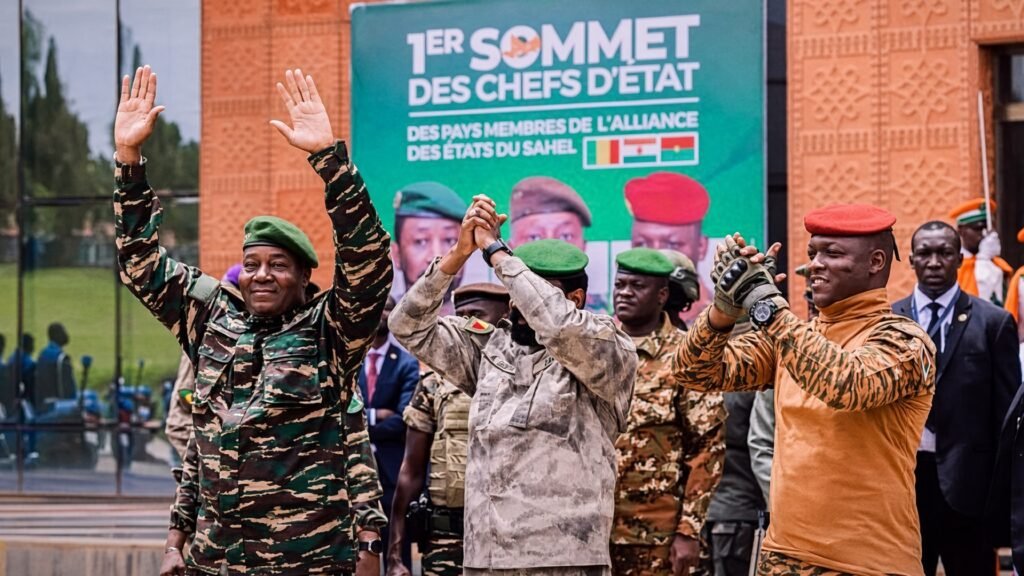
The Alliance of Sahel States is testing whether greater legal and political autonomy can translate into stronger economic sovereignty, deeper African ownership and a more independent policy environment. Burkina Faso, Mali and Niger have formally begun withdrawing from the International Criminal Court, completing a process that follows their departure from ECOWAS (effective January 2025) and the reshaping of their security architecture. The withdrawal from the ICC represents a significant change in the political architecture of the Sahel, but its economic impact will not be determined by the ICC decision alone. The larger story is institutional substitution attempting to replace external political and security frameworks with structures regarded as more sovereign and responsive to regional interests.
Burkina Faso deposited its ICC withdrawal notification on June 24, 2026, alongside Mali, while Niger deposited its notification on June 18. Under Article 127 of the Rome Statute, withdrawal takes effect one year after notification. The three therefore remain parties during the withdrawal period and do not immediately escape obligations arising from the period in which they were members. For Mali, this is particularly important because the ICC has had an active situation concerning Mali since 2013. The withdrawal therefore represents a change in the country’s future relationship with the Court rather than an automatic cancellation of the Court’s existing legal work.
Sources: International Criminal Court, ICC Assembly of States Parties • Calculations & Modeling: Limitless Beliefs Consulting
The Legal Break Is Significant, But It Is Not Immediate
The political argument behind the AES decision rests partly on the historical concentration of ICC investigations in Africa. For roughly the Court’s first fourteen years of investigations, the situations formally under investigation were African. Georgia became the first non-African investigation in 2016. That historical concentration does not by itself establish that the ICC deliberately discriminated against African states. The Court’s jurisdiction is constrained by the Rome Statute, referrals from member states and United Nations Security Council referrals. Nevertheless, the geographic concentration created a legitimacy problem that African governments and commentators have repeatedly raised. The controversy became more politically complicated as the ICC expanded its reach beyond Africa. Arrest warrants were issued for Russian President Vladimir Putin in 2023 and Israeli Prime Minister Benjamin Netanyahu and former Defence Minister Yoav Gallant in 2024.
“The central political question: Can an international justice system maintain legitimacy when the ability of the system to exercise jurisdiction varies substantially according to state membership, Security Council politics and the geopolitical position of the actors involved?”
AES Is Not Simply Leaving an Institution. It Is Building an Alternative Policy Architecture.
The ICC decision is part of a larger institutional strategy. Burkina Faso, Mali and Niger have already moved away from ECOWAS, with their withdrawal becoming effective in January 2025. They have also reduced the role of France in their security architecture and established the Alliance of Sahel States as a political and security framework. The broader strategy is based on a principle of greater autonomy. Instead of assuming that Western led or inherited regional institutions should remain the default framework, AES governments are attempting to construct mechanisms that they regard as more compatible with their sovereignty and political priorities. This creates both an opportunity and a major institutional test. Sovereignty can reduce external policy constraints. It does not automatically create stronger institutions.
Sources: IMF, World Bank • Calculations & Modeling: Limitless Beliefs Consulting
The Policy Environment Is Not Economically Stagnant
The economic data complicate the narrative that the AES countries are simply collapsing because of political isolation. Burkina Faso, Mali and Niger have all recorded positive real economic growth, although the composition and sustainability of that growth remain important concerns. Burkina Faso’s growth has been supported by agriculture, services and mining. Mali remains heavily connected to gold, agriculture, lithium and services. Niger’s growth outlook has been strongly influenced by oil exports and extractive activity, alongside agriculture. The important policy distinction is therefore between growth and economic transformation. An economy can grow quickly while remaining dependent on commodities, public expenditure, external financing and a narrow productive base.
The Biggest Economic Question Is Whether Sovereignty Produces Productive Capacity
If AES governments use greater policy autonomy to increase local processing, domestic procurement, energy capacity, infrastructure development, agricultural productivity and financial intermediation, political sovereignty could eventually produce measurable economic benefits. Mining policy is particularly important. Burkina Faso, Mali and Niger possess strategically important mineral and energy resources. Greater control over licensing, local content, processing requirements and state participation could allow more economic value to remain inside the region. However, aggressive localization can also raise costs if domestic suppliers are not yet competitive. The optimal policy is therefore not simply to exclude foreign companies. It is to use regulation to create domestic capabilities while maintaining enough competition and capital access to keep projects commercially viable.
Sources: AfDB, Afreximbank, IMF, World Bank, IFC • Calculations & Modeling: Limitless Beliefs Consulting
The Missing Ingredient Is Institutional Credibility
The greatest danger is not sovereignty itself. The greater danger is institutional substitution without institutional strengthening. If the ICC is rejected because it is considered externally imposed, the replacement justice mechanism must still provide predictable procedures. If foreign arbitration is rejected, domestic or regional arbitration must still be credible. If foreign capital is replaced with African, Gulf or Asian capital, investors will still demand contracts, security, transparency and mechanisms for resolving disputes. This produces a fundamental economic principle: Sovereignty can lower external political constraints, but predictability lowers the cost of capital. AES governments therefore face a strategic choice. They can use sovereignty to build stronger institutions, or sovereignty can become another layer of political uncertainty. The economic outcomes of the two paths are very different.
Sources: BCEAO • Calculations & Modeling: Limitless Beliefs Consulting
The Currency Question: Why Leaving the ICC Does Not Immediately Threaten the CFA Franc
The ICC decision should not be confused with monetary independence. Burkina Faso, Mali and Niger remain members of the West African Economic and Monetary Union and continue to operate within the CFA franc monetary framework administered through BCEAO. Leaving the ICC therefore does not itself cause an immediate currency break. The more important currency question would arise if AES countries eventually sought to leave WAEMU and establish a separate monetary arrangement. That would be an entirely different scale of policy change involving reserves, convertibility, exchange-rate management, banking supervision, monetary credibility and cross-border payments. In other words, political sovereignty and monetary sovereignty are separate projects.
The Cost of Sovereignty for Ease of Doing Business
Political autonomy can improve policy flexibility, but institutional fragmentation can increase transaction costs. Companies operating across West Africa could face additional compliance requirements if regulatory systems diverge. Customs procedures, licensing, taxation, capital controls, contract enforcement and cross-border payments can all affect the cost of doing business. The economic cost therefore depends less on whether AES governments reject an external institution and more on what they build afterward. If the AES transition results in stronger domestic procurement and regional supply chains, African companies could become major beneficiaries. Mining contractors, construction firms, engineering companies, agricultural processors, transport operators, telecom providers, banks, insurers, energy developers and technology firms could all gain from a larger role for domestic and African suppliers. But the reverse risk also exists. If regulatory uncertainty rises, multinational companies may demand higher returns before committing capital.
Sources: IMF, World Bank, AfDB • Calculations & Modeling: Limitless Beliefs Consulting
What Happens to Ordinary Citizens?
The ultimate test is not whether governments become more sovereign. It is whether households experience better economic outcomes. Potential benefits include more local employment, greater domestic ownership of natural resource value chains, improved energy supply, agricultural investment, infrastructure construction and stronger domestic businesses. The risk is that institutional uncertainty could raise the cost of imported goods, financing and investment. If capital becomes more expensive, private investment can slow even when government policy becomes more autonomous. Niger provides an important example of why growth and welfare should be measured together. World Bank projections indicate that the country’s strong growth outlook has been accompanied by a projected decline in extreme poverty, illustrating how expansion in oil and other productive activity can potentially translate into household gains when the benefits reach the wider economy.
The AES Economic Model Is Becoming a Test Case for Africa
The AES experiment matters beyond Burkina Faso, Mali and Niger because it raises a wider continental question: can African states increase sovereignty without sacrificing institutional credibility? Africa’s policy debate has often been framed as a choice between integration with international institutions and complete independence from them. The more useful framework is institutional performance. An African institution can be just as effective as an international institution if it provides independence, due process, enforceability and credibility. Conversely, an African institution can fail if it becomes politically controlled, unpredictable or inaccessible. This is why the proposed development of endogenous justice mechanisms will matter enormously. If AES countries create credible regional courts or arbitration institutions, their withdrawal could ultimately become an institutional transformation rather than simply an institutional rejection.
The Strategic Risk: Withdrawal Without Replacement
The strongest criticism of the AES approach is therefore not necessarily that the countries are seeking sovereignty. It is that withdrawing from external institutions creates a vacuum unless replacement institutions are stronger. The strategic equation is straightforward: Withdrawal + stronger institutions = greater sovereignty with potential economic upside. Withdrawal + weaker institutions = greater sovereignty with higher transaction costs. This distinction should shape how investors, African governments and policymakers evaluate the AES experiment.
- Withdrawal + stronger institutions = greater sovereignty with potential economic upside.
- Withdrawal + weaker institutions = greater sovereignty with higher transaction costs.
Bottom Line: The Alliance of Sahel States is asking a question that extends far beyond Burkina Faso, Mali and Niger: who writes the rules governing African states, who enforces those rules, and how can African countries build institutions that are both sovereign and credible? Burkina Faso, Mali and Niger have withdrawn from ECOWAS and the ICC, while maintaining WAEMU membership and CFA franc participation. Their economies continue to grow 5.3%, 5.0%, and 6.9% respectively but growth is not yet transformation. The greatest opportunity lies in building stronger regional institutions to replace those they have left: credible arbitration mechanisms, transparent regulatory frameworks, efficient customs systems, and investment grade dispute resolution. If sovereignty becomes stronger courts, better infrastructure, deeper African capital markets, greater resource value capture and more productive domestic companies, the AES experiment could become a significant model of African policy autonomy. If sovereignty instead produces regulatory fragmentation, higher risk premiums and weaker accountability, the economic gains could be limited. The real test is not whether the AES can leave international institutions. The real test is whether it can build institutions capable of replacing them.