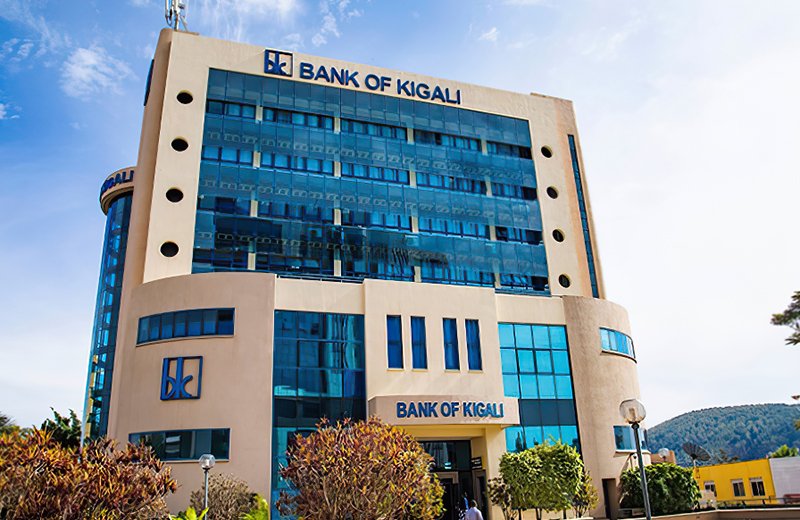
Rwanda’s banking sector has entered a phase of structured expansion, with Bank of Kigali its largest commercial bank by assets playing a central role in the country’s ambition to position itself as a regional financial services hub. The bank’s growth trajectory reflects broader macroeconomic stability and policy-driven efforts to deepen financial intermediation in a relatively small but rapidly formalizing economy.
According to the National Bank of Rwanda, total banking sector assets have continued to expand steadily, supported by consistent GDP growth and regulatory reforms. The International Monetary Fund (IMF) projects Rwanda’s medium-term growth to remain above 6%, reinforcing a stable macroeconomic backdrop for financial sector development.
Balance Sheet Expansion and Credit Allocation
Bank of Kigali has expanded its balance sheet through increased lending to key sectors, including real estate, trade, and services. The bank maintains capital adequacy ratios in line with Basel regulatory standards, reflecting prudent risk management within a growing credit environment.
However, the structure of credit allocation reveals a concentration risk. Lending activity remains skewed toward urban sectors, particularly construction and commercial services, which are more bankable but less diversified in terms of long-term economic transformation.
This concentration mirrors a broader trend identified by the World Bank, where African banking systems tend to prioritize low-risk, asset-backed lending over industrial or manufacturing finance.
Digital Banking and Financial Inclusion Gains
Digital transformation has been a key component of Bank of Kigali’s strategy. Mobile banking platforms and digital payment systems have expanded access to financial services, particularly among previously underserved populations.
According to the World Bank Global Findex database, Rwanda has made measurable progress in financial inclusion over the past decade, with increased account ownership and digital transaction usage.
However, inclusion at the account level does not necessarily translate into meaningful credit access. Many users remain outside the formal credit system due to lack of collateral, limited credit history, or income volatility.
Structural Constraints of a Small Market
Rwanda’s banking sector operates within the constraints of a relatively small domestic economy. While policy consistency and governance improvements have strengthened investor confidence, the scale of the market limits the depth of financial intermediation.
The IMF has noted that smaller economies often face challenges in achieving diversified credit growth, as sectoral concentration increases vulnerability to localized shocks.
For Bank of Kigali, this creates a structural tension: continued growth requires either deeper domestic penetration or expansion beyond national borders.
Regional Expansion and AfCFTA Alignment
Regional integration presents a potential pathway for growth. Rwanda’s participation in the East African Community (EAC) and the African Continental Free Trade Area (AfCFTA) provides a framework for cross-border banking expansion.
Financial institutions capable of operating across multiple jurisdictions are better positioned to facilitate trade flows, manage currency exposure, and support regional investment.
According to the African Development Bank, financial integration is a critical enabler of intra-African trade, which remains below 20% of total trade volumes.
Power Dynamics in Credit Allocation
Commercial banks play a central role in determining how capital is allocated within an economy. In Rwanda, Bank of Kigali’s position as the dominant financial institution gives it significant influence over which sectors receive funding.
This creates an implicit power structure within the economy, where access to credit is unevenly distributed. Large corporates and established businesses are more likely to secure financing, while small and medium-sized enterprises (SMEs) face higher barriers.
The World Bank has consistently identified SME financing gaps as a major constraint on economic development across Sub-Saharan Africa.
Structural Direction
Rwanda’s ambition to become a regional financial hub is supported by strong governance, policy consistency, and a stable macroeconomic environment. However, the long-term success of this strategy will depend on the ability to expand beyond a limited domestic base and support more diversified economic activity.
Bank of Kigali’s trajectory highlights a broader reality: financial sector growth in emerging markets is not constrained by ambition, but by the structural limits of market size, credit distribution, and economic diversification.