
Desk: Uncategorized Desk
Published: May 5, 2026
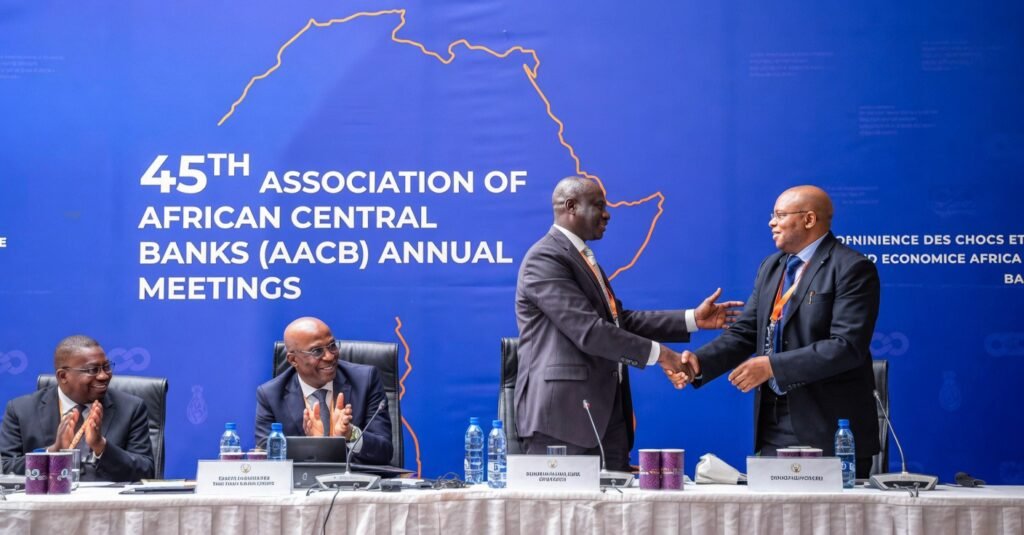
On May 7, 2026, central bank governors from across the continent will convene in Dakar at the headquarters of the Banque Centrale des Etats de l’Afrique de l’Ouest (BCEAO) for the African Association of Central Banks (AACB) Bureau meeting a critical policy forum shaping Africa’s monetary future. At stake is more than coordination. The discussions center on accelerating the African Monetary Cooperation Programme (AMCP), advancing the African Monetary Institute (AMI), and laying the groundwork for a future African Central Bank. The core question: can policy alignment unlock a $1 trillion intra-African economy by 2035? Or will fragmentation continue to cost the continent $50 billion annually in lost trade?
Africa currently operates with over 40+ currencies, creating friction across every dimension of economic activity. Intra-African trade remains stuck at approximately 15% of total trade—compared to 60%+ in Europe and 40%+ in Asia. Currency conversion costs consume up to 10% of transaction values for cross-border payments. Settlement delays of 2–5 days tie up working capital and increase counterparty risk. The cost of policy inefficiency is not abstract; it is deducted directly from the balance sheets of African businesses, reducing competitiveness and discouraging regional value chains.
Sources: AfDB, IMF, World Bank, UNCTAD • Analysis: Limitless Beliefs Consulting
The Core Question — Integration or Fragmentation?
The Dakar meeting represents a inflection point. The African Monetary Cooperation Programme (AMCP) has existed for decades, but implementation has lagged ambition. The African Monetary Institute (AMI) conceived as a precursor to a full African Central Bank—remains in design phase, not operation. The gap between policy intent and policy execution is where economic value is lost.
The table below summarizes the current state of African monetary integration across key dimensions:
| Dimension | Current Status | Target (2030) | Gap Analysis |
|---|---|---|---|
| Currency Convertibility | Limited; multiple bilateral agreements | Full convertibility across major corridors | Political will vs technical implementation mismatch |
| Payment Systems | Fragmented; PAPSS operational but underutilized | Pan-African real-time settlement | Adoption inertia from incumbent correspondent banking |
| Monetary Policy Coordination | Minimal; independent central bank mandates | Harmonized inflation and exchange rate frameworks | Sovereignty concerns vs integration benefits |
| Macroeconomic Convergence | Wide divergence; inflation 3%–30%+ | Convergence criteria (inflation, deficit, debt) | Fiscal discipline uneven across member states |
Sources: AfDB, IMF, World Bank • Analysis: Limitless Beliefs Consulting
“Africa does not lack capital. It does not lack talent. It lacks policy alignment and execution. The Dakar meeting is a test of whether coordination can overcome fragmentation.”
Where Policy Is Working Regional Bright Spots
The WAEMU (BCEAO) zone demonstrates the potential of monetary coordination. The shared CFA franc, despite political controversies over its governance, delivers tangible economic benefits: low inflation (typically 2–4% vs double-digit rates in non-currency-union peers), stable trade flows, and lower transaction costs within the union. The lesson is not that the CFA model is perfect—it is that monetary coordination, even imperfect, outperforms fragmentation.
Rwanda offers a different model: aggressive domestic policy reforms that have improved ease of doing business, attracted investment, and maintained relative currency stability despite external shocks. Kenya’s progressive fintech and payments regulation has enabled M-Pesa and a wave of digital innovation, demonstrating that policy clarity in specific domains (payments, digital finance) can unlock private sector activity even without full monetary integration.
The challenge is scaling these successes. What works in the WAEMU (a long established currency union with exogenous anchor) or Rwanda (a small, reform-driven economy) does not automatically translate to large, diverse economies like Nigeria, Egypt, or South Africa. The Dakar discussions must confront this heterogeneity directly.
Sources: AfDB, Afreximbank, IMF, World Bank • Analysis: Limitless Beliefs Consulting
Where Policy Is Failing The Fragmentation Penalty
The cost of policy inefficiency manifests across multiple channels. Currency volatility in large economies (Nigeria, Egypt, Ethiopia) creates hedging costs that are ultimately borne by importers and consumers. Inconsistent regulatory frameworks mean that a fintech licensed in one jurisdiction cannot operate seamlessly across borders—defeating the purpose of digital integration. Capital controls, implemented with varying intensity across the continent, restrict investment flows and increase the cost of capital by an estimated 20–30% compared to global averages.
The African Continental Free Trade Area (AfCFTA) was designed to address tariff barriers. But tariff barriers are no longer the primary constraint. The binding constraints are monetary currency convertibility, payment settlement, and regulatory harmonization. AfCFTA cannot deliver its promised $1 trillion in intra-African trade if businesses cannot pay each other efficiently across borders.
Sources: World Bank, UNCTAD, AfDB • Analysis: Limitless Beliefs Consulting
Monetary Integration Opportunity vs Risk
The AACB’s push toward deeper monetary integration offers major upside: reduced transaction costs, faster cross-border payments, increased trade and investment flows, and stronger collective bargaining power in global financial forums (IMF quota reforms, G20 representation, etc.). However, the risks are equally significant. Loss of monetary sovereignty is a genuine concern for economies with different inflation realities, fiscal trajectories, and political cycles. The eurozone’s sovereign debt crisis demonstrated that monetary union without fiscal union creates structural vulnerabilities.
For Africa, the path is likely partial rather than full: enhanced payment system integration (building on PAPSS), harmonized regulatory frameworks for cross-border finance, and graduated convergence criteria that respect different starting points. The African Monetary Institute (AMI) could play a coordination role without requiring full currency union. Incrementalism—not a single “African Central Bank” moment—is the more plausible trajectory.
Jobs, Upward Mobility, and Policy Design
The employment implications of policy alignment are substantial but indirect. Financial integration could enable 5–10 million new jobs by 2035 by: reducing the cost of capital for SMEs (the primary job creators across African economies), enabling regional value chains that distribute employment across borders, and improving access to trade finance for smaller enterprises. Improved payment systems directly benefit informal sector businesses—often 50–80% of employment—by reducing cash dependency and enabling digital record-keeping that can unlock formal credit.
The risk is that policy fragmentation creates a two-speed Africa: countries with stable monetary environments attract capital and grow, while those with volatility are left behind. The Dakar meeting’s success metric should not be the number of agreements signed, but whether the policy coordination mechanism reduces the dispersion in economic outcomes across member states.
Bottom Line: The Dakar AACB meeting arrives at a pivotal moment. Africa’s economic integration agenda—AfCFTA, PAPSS, AMI—has never been more ambitious. But ambition without execution delivers neither trade nor growth. Forty-plus currencies, 10% transaction costs, and $50 billion in annual lost trade are not immutable facts. They are policy choices. The choice is between coordination that unlocks a $1 trillion intra-African economy and fragmentation that continues to tax African businesses at rates no external tariff could match. The central bankers in Dakar cannot solve monetary fragmentation alone fiscal policy, political will, and private sector engagement are equally necessary. But they can set the architecture. And architecture, once set, is hard to undo. The question is not whether Africa can afford monetary integration. The question is whether it can afford continued fragmentation.