Africa’s technology narrative has long been dominated by startups, venture capital flows, and fintech valuations. Yet beneath this visible layer lies a more consequential question: who controls the infrastructure that enables the digital economy? According to the World Bank, a 10% increase in broadband penetration can raise GDP growth by up to 1.4% in developing economies, underscoring that connectivity infrastructure not applications is the true foundation of digital transformation.
This distinction is becoming increasingly important as African economies digitize. While startups capture headlines, it is fiber networks, data centers, and cloud infrastructure that ultimately determine scalability, cost structures, and control of data flows.
Infrastructure vs Innovation: A Misaligned Narrative
The dominant narrative across Africa’s tech ecosystem has emphasized innovation at the application layer payments, lending platforms, and consumer apps. However, this focus often obscures the structural dependency these businesses have on underlying infrastructure.
Companies operating at the application level remain constrained by:
• Limited broadband penetration
• High data costs
• Fragmented connectivity across markets
The African Development Bank has consistently identified infrastructure deficits particularly in ICT and energy as a primary constraint on economic productivity. Without reliable and affordable connectivity, even the most well-funded startups face scaling limitations.
This creates a structural imbalance: innovation is visible, but infrastructure determines outcomes.
Fiber Networks as Strategic Assets
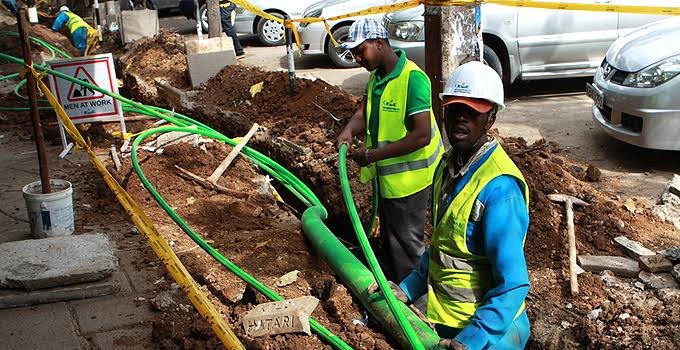
Fiber optic networks form the backbone of Africa’s digital economy, enabling data transmission across cities, countries, and continents. Unlike mobile towers or consumer-facing services, fiber infrastructure operates largely out of public view, yet its economic significance is substantial.
Operators such as Cassava Technologies, MainOne, and WIOCC have built extensive networks linking African markets to global internet exchange points.
These networks serve multiple functions:
• Enabling cross-border data flows
• Reducing latency for digital services
• Lowering the cost of bandwidth over time
Control over these assets translates directly into pricing power and influence over market access. In practical terms, companies that own fiber networks shape the economics of the entire digital ecosystem built on top of them.
Data Centers and the Localization Imperative
Alongside fiber networks, data centers represent another critical layer of infrastructure. Africa currently accounts for less than 1% of global data center capacity, according to the African Development Bank, despite rapid growth in internet usage and digital services.
This capacity gap has historically forced African data to be stored outside the continent, increasing costs and raising concerns about data sovereignty.
Infrastructure players including Cassava Technologies through its Africa Data Centres division are investing in localized facilities to address this imbalance.
The implications extend beyond efficiency:
• Governments gain greater regulatory control over data
• Enterprises reduce dependence on offshore infrastructure
• Local ecosystems become more competitive
However, global hyper scalers such as Microsoft and Amazon Web Services are simultaneously expanding their footprint, intensifying competition for control of this layer.
Power Dynamics: Infrastructure as Economic Leverage
The question of infrastructure ownership is increasingly tied to broader geopolitical and economic power dynamics. Digital infrastructure is no longer neutral it is a strategic asset.
Countries and companies that control networks and data storage effectively influence:
• Information flows
• Digital trade routes
• The cost of doing business online
This dynamic mirrors historical patterns in physical infrastructure, where control of ports, railways, and energy pipelines translated into economic dominance.
In Africa, this raises a critical question: will the continent’s digital backbone be controlled by local firms or external actors?
Constraint Layer: Capital and Fragmentation
Despite growing investment, infrastructure development in Africa faces persistent structural constraints.
The International Finance Corporation estimates that billions of dollars in additional investment are required to close the continent’s digital infrastructure gap. Fiber expansion, in particular, is capital-intensive and often challenged by regulatory fragmentation across multiple jurisdictions.
Key constraints include:
• High upfront capital requirements
• Regulatory inconsistency between countries
• Energy reliability issues affecting data centers
These factors slow deployment and create barriers to scaling infrastructure across the continent.
Strive Masiyiwa’s Infrastructure Thesis
Strive Masiyiwa’s strategy through Cassava Technologies reflects a long-term thesis: infrastructure ownership, not application-level innovation, will define Africa’s position in the global digital economy.
By building an integrated platform spanning fiber, data centers, and cloud services, Cassava is attempting to capture value across the entire digital stack.
This approach contrasts with the venture capital-driven startup ecosystem, which often prioritizes rapid growth over control of underlying infrastructure.
The implication is clear: startups may generate innovation, but infrastructure determines who captures the majority of economic value.
Structural Outlook
Africa’s digital economy is entering a phase where infrastructure constraints will become more visible. As demand for data, cloud services, and digital platforms accelerates, the underlying systems that support them will face increasing pressure.
The long-term trajectory of the continent’s tech sector will depend less on the number of startups and more on the scale and ownership of its infrastructure.
Fiber networks, data centers, and cloud platforms are not just enablers they are the core of economic participation in a digital world.
The emerging reality is that Africa’s tech future will not be decided in venture capital rounds, but in the quiet expansion of cables, servers, and networks that define who controls access, cost, and ultimately, power.