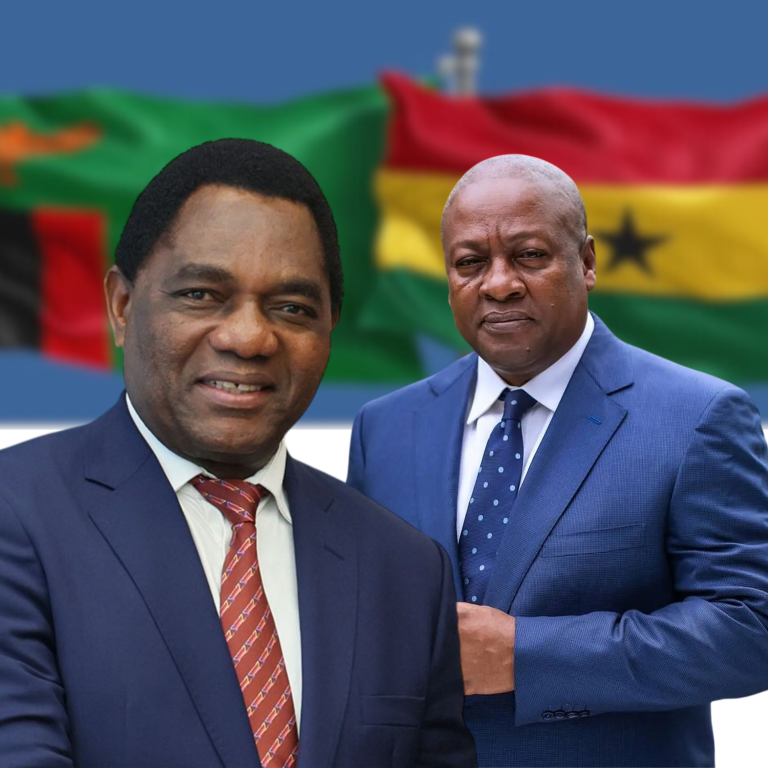
As global attention remains fixed on commodity prices and external financing flows, a quieter shift is taking place within Africa’s economic landscape. Zambia’s President Hakainde Hichilema is advancing a strategy centered not on aid dependency, but on intra-African trade, bilateral deal-making, and resource repositioning.
Through targeted engagement with Ghana’s leadership and a broader alignment with the African Continental Free Trade Area (AfCFTA), Zambia is attempting to redefine how African economies interact prioritizing regional exchange over external reliance.
The implications extend beyond individual agreements, pointing toward a potential restructuring of economic relationships across the continent.
Bilateral Momentum: Zambia–Ghana Alignment
At the core of this approach is an emerging partnership between Zambia and Ghana, led by President Hichilema and Ghanaian leadership under John Mahama. The focus of this alignment is not symbolic cooperation, but practical integration across sectors such as value-added production, investment flows, and industrial coordination.
Rather than exporting raw commodities and importing finished goods, both countries are exploring frameworks that emphasize processing, manufacturing, and intra-African supply chains.
This reflects a shift in emphasis:
• From commodity exports to value-added production
• From external markets to regional demand
• From aid-driven projects to trade-based partnerships
The alignment is being framed within the AfCFTA structure, using the agreement as a mechanism to reduce trade barriers and facilitate cross-border investment.
Lobito Corridor: Infrastructure as Strategy
Zambia’s trade repositioning is closely linked to infrastructure development, particularly the Lobito Corridor, which connects Zambia and the Democratic Republic of Congo to Angola’s Atlantic coast.
The corridor provides an alternative export route for critical minerals, reducing dependence on traditional pathways and enhancing logistical efficiency.
Supported by international partners, including development finance institutions, the corridor is designed to facilitate the movement of copper, cobalt, and other strategic resources.
However, its significance extends beyond transportation. By improving access to ports and markets, the corridor strengthens Zambia’s negotiating position in global supply chains.
It also creates opportunities for regional trade, enabling goods to move more efficiently between African economies.
Critical Minerals: From Extraction to Positioning
Zambia’s economic strategy increasingly revolves around its role in the global supply of critical minerals, particularly copper, which is essential for energy transition technologies.
Historically, these resources have been exported in raw or minimally processed form. The introduction of local-content rules, effective January 2026, signals an effort to change this dynamic.
These rules aim to increase domestic participation in mining value chains, encouraging processing, manufacturing, and service provision within Zambia.
At the same time, the government has been engaging a broader set of international partners, seeking to diversify relationships beyond traditional dominant players.
This reflects a strategic recalibration:
• Expanding the pool of investors and partners
• Increasing competition for access to resources
• Enhancing national leverage in negotiations
The approach does not exclude existing partners but introduces greater balance into the system.
Trade, Not Aid: A Leadership Signal
Hichilema’s emphasis on trade represents a broader shift in leadership philosophy. Rather than positioning Zambia primarily as a recipient of external assistance, the administration is framing the country as an active participant in regional and global markets.
This shift is particularly notable in the context of an election cycle, where economic performance and policy direction are under increased scrutiny.
By focusing on tangible trade outcomes, the government is attempting to demonstrate a model of engagement that prioritizes self-directed growth.
The Zambia–Ghana alignment serves as a practical example of this approach, illustrating how bilateral agreements can be structured around mutual economic benefit rather than dependency.
Geopolitical Implications: If Trade Comes First
The broader implications of this strategy extend beyond Zambia. If more African leaders prioritize trade agreements and economic integration, the structure of continental relationships could shift significantly.
Increased intra-African trade would reduce reliance on external markets, potentially altering global supply chains and redistributing economic influence.
It could also strengthen regional blocs, making them more cohesive and capable of negotiating with external partners on more balanced terms.
However, this transition is not without challenges. Differences in industrial capacity, infrastructure quality, and regulatory environments can limit the effectiveness of trade agreements.
The success of this model depends on the ability of participating countries to align policies and invest in complementary systems.
Constraints and Execution Risk
Despite the strategic clarity, several constraints remain. Infrastructure projects such as the Lobito Corridor require sustained investment and coordination across multiple countries.
Local-content policies, while potentially beneficial, must be implemented carefully to avoid deterring investment.
In addition, translating bilateral agreements into measurable trade flows requires operational capacity and institutional consistency.
The World Bank and African Development Bank have both emphasized that the effectiveness of trade integration depends on execution, not just policy design.
Structural Outlook: Rewriting the Playbook
Zambia’s current trajectory suggests a gradual shift in how African economies engage with one another and with external partners.
By prioritizing trade, infrastructure, and value addition, the country is attempting to move beyond traditional patterns of economic interaction.
The Zambia–Ghana alignment illustrates how bilateral partnerships can function within a broader continental framework, leveraging AfCFTA while addressing specific national priorities.
The question is whether this approach can scale. If replicated across multiple countries, it could lead to a more integrated and self-directed African economic system.
For now, the model remains in development. But its implications are clear: when trade becomes the primary focus, the dynamics of influence, negotiation, and growth begin to change.
And in that shift, a different version of Africa’s economic future starts to take shape.