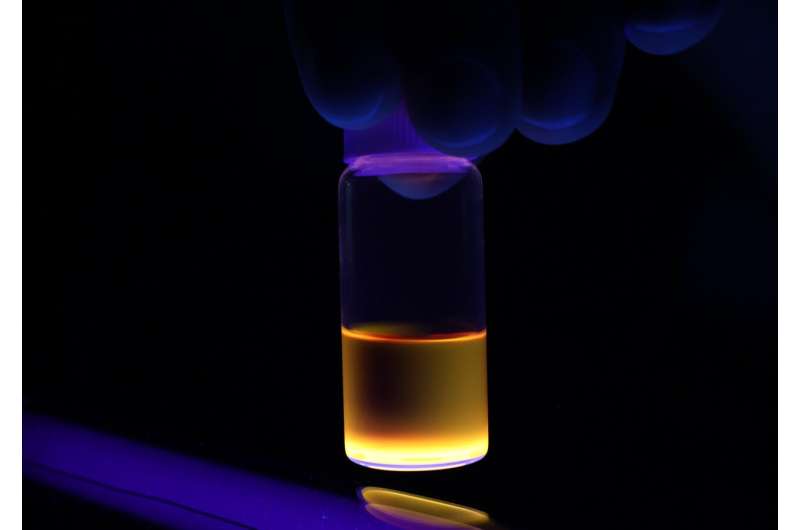
A team of researchers from the Instituto de Carboquímica of the Spanish National Research Council (CSIC) has made a remarkable step forward in the development of efficient and sustainable electronic devices. They have found a special combination of two extraordinary nanomaterials that successfully results in a new hybrid product capable of turning light into electricity, and vice-versa, faster than conventional materials.


The research is published in the journal Chemistry of Materials.
This new material consists of a one-dimensional conductive polymer called polythiophene, ingeniously integrated with a two-dimensional derivative of graphene known as graphene oxide. The unique features exhibited by this hybrid material hold incredible promise for improving the efficiency of optoelectronic devices, such as smart devices screens, and solar panels, among others.
Dr. Wolfgang Maser, the lead researcher on the project, explains, “Through our synthesis strategy, the polymer adopts a particular structure as water-dispersible nanoparticles, which favors an intimate contact with the graphene oxide sheets.” This contact, in turn, leads to electrical behavior modifications within the polymer, significantly increasing its electrical efficiency.
Dr. Ana Benito, co-lead researcher of the project, and leading alongside Dr. Maser of the Carbon Nanostructures and Nanotechnology group (G-CNN), says, “We were particularly intrigued by the advantageous optical, electric and electrochromic properties of polythiophene. While it generated electricity upon illumination, and emitted light when provided with electricity, its response was slow.”
“Having extensively studied graphene oxide—a nanomaterial derived from graphene that has unique properties, is aqueous dispersible, and easy to produce—the team hypothesized that combining the two materials would overcome the inherent electronic limitations of the polymer,” points out Dr. Maser.
“Our original concept was to modify the polythiophene, turning it into small nanospheres called nanoparticles, which could be easily combined with graphene oxide. Moreover, this methodology allowed us to work in aqueous dispersions, something extremely challenging with this type of polymers,” emphasizes Dr. Benito.
“Initially, we did not observe any changes in the electronic properties of the material. However, when we analyzed it in depth, we found that the new materials facilitated unusual rapid electron transport phenomena, so fast that we initially were not able to track it with the standard techniques.”
Collaborating with researchers from the Universities of Murcia, Cartagena and Zaragoza was key to confirm the relevance of their findings.
A technological revolution
This groundbreaking discovery holds significant implications for a wide variety of technological applications, including the fabrication of smart flexible screens, portable electronic devices, or highly efficient electronic paper.
Eduardo Colom, the lead author of the article who investigates the hybrid materials in his Ph.D. thesis, explains, “Devices built with this novel material would exhibit superior efficiency, reduced weight, enhanced flexibility, and greater sustainability, all thanks to the use of environmentally friendly materials with outstanding electrical properties.”
Furthermore, this breakthrough could also boost the efficiency of organic solar cells by capturing a greater quantity of light from the sun in a more efficient and cost-effective manner.
The authors further point out, “We may be able to make more energetically efficient electronic devices that consume less power while providing faster responses. These findings push us toward a future based on a more advanced and sustainable technology.”
A commitment to sustainability
The synthesis of this new hybrid material represents a significant step towards sustainability, as it relies on water as the solvent, avoiding the use of toxic chemicals usually employed in current methodologies. This holds the potential to reduce the environmental impact associated with electronic devices manufacturing.
Moreover, the synthesis strategy employed could be extended to other conductive polymers, thereby fostering important implications in technological applications. This finding represents an important achievement in the sustainable design of new architectures for high-performance optoelectronic devices.
The team of researchers of the G-CNN group has focused in recent times on creating highly functional and sustainable nanomaterials. These versatile nanomaterials find utility in a wide array of applications, ranging from the generation of clean energies, such as green hydrogen, to catalysis, energy storage or even heritage preservation, (bio)sensor development, and disease treatment.
More information:
Eduardo Colom et al, Graphene Oxide: Key to Efficient Charge Extraction and Suppression of Polaronic Transport in Hybrids with Poly (3-hexylthiophene) Nanoparticles, Chemistry of Materials (2023). DOI: 10.1021/acs.chemmater.3c00008
Provided by
Spanish National Research Council
Citation:
Researchers make progress toward a new environmentally friendly nanomaterial that could revolutionize electronic devices (2023, July 20)
retrieved 20 July 2023
from https://phys.org/news/2023-07-environmentally-friendly-nanomaterial-revolutionize-electronic.html
This document is subject to copyright. Apart from any fair dealing for the purpose of private study or research, no
part may be reproduced without the written permission. The content is provided for information purposes only.