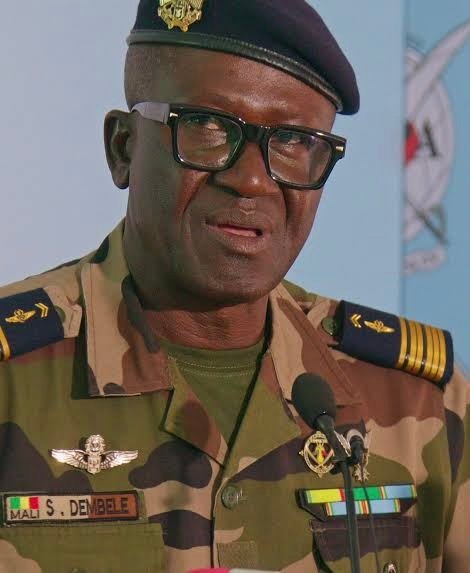
Malian authorities have formally rejected allegations that the country’s leadership engaged in negotiations involving the release of detained militants in exchange for fuel supplies, describing the claims as part of a broader wave of disinformation targeting the Sahel region. Colonel-Major Souleymane Dembélé, Director of Information and Public Relations for the Malian Armed Forces, characterized the narrative as strategically constructed to undermine state legitimacy and distort the country’s security posture.
The allegations, which circulated across regional and international media channels, suggested that Malian authorities had entered into informal arrangements with jihadist groups, specifically Jama'at Nasr al-Islam wal-Muslimin (JNIM), to secure logistical or energy related concessions. However, Malian officials argue that such claims lack evidentiary grounding and conflict with established intelligence assessments.
Contradictions Within Intelligence Assessments
A central element in Mali’s rebuttal is the inconsistency between the allegations and publicly acknowledged intelligence evaluations from Western agencies. Nicolas Lerner, head of France’s external intelligence service (DGSE), has previously indicated that available intelligence does not support the notion that JNIM possesses either the capacity or strategic coherence to assume control over the Malian state.
This assessment is critical. If JNIM lacks the organizational capability to govern or exert centralized territorial control, the premise that it could engage in structured, state-level negotiations over resources becomes significantly less credible.
From a security intelligence perspective, insurgent groups operating in fragmented networks typically prioritize localized influence rather than formalized bargaining with central governments. The operational structure of JNIM characterized by decentralized command and fluid alliances limits its ability to function as a unified negotiating counterpart.
Information Warfare in the Sahel
The emergence of such allegations highlights the increasing role of information warfare in the Sahel’s geopolitical landscape. Competing narratives often amplified through digital platforms have become a key component of strategic positioning among both regional actors and external powers.
This dynamic introduces a new layer of conflict:
• Military operations are accompanied by narrative competition
• Perceptions of legitimacy become strategic assets
• Disinformation can influence diplomatic and financial relationships
For Mali, the reputational impact of allegations involving collaboration with militant groups extends beyond domestic politics. It affects engagement with international partners, access to development financing, and the broader perception of state stability.
Energy Constraints and Narrative Construction
The specific framing of “terrorists-for-fuel” claims is notable, as it intersects with Mali’s broader economic constraints. Like many Sahelian economies, Mali faces structural challenges related to energy access, infrastructure limitations, and fiscal capacity.
These constraints create a context in which narratives linking resource scarcity to security compromises can gain traction. However, such narratives also risk oversimplifying complex economic and security dynamics.
From a structural standpoint, Mali’s energy challenges are primarily driven by:
• Limited domestic refining capacity
• Dependence on imported petroleum products
• Infrastructure bottlenecks in distribution networks
Linking these issues directly to alleged negotiations with insurgent groups introduces a narrative leap that is not supported by established economic or security data.
Power Dynamics: Narrative Control and External Influence
The contestation over these allegations reflects a broader power dynamic in which control over narratives becomes as significant as control over territory. External actors whether state or non-state can shape perceptions of legitimacy through the selective dissemination of information.
For Sahelian governments, this creates a dual challenge:
• Managing internal security threats
• Countering external narratives that may influence international engagement
The ability to contest disinformation effectively is increasingly tied to diplomatic leverage and access to financial resources. Negative perceptions can translate into reduced investor confidence, stricter lending conditions, or conditionality in international support.
In this context, information becomes a strategic variable within the broader geopolitical equation.
Constraint Layer: Credibility and Institutional Trust
Despite rejecting the allegations, Malian authorities face structural constraints related to institutional credibility. Political transitions, changes in security partnerships, and evolving governance frameworks have created an environment in which competing narratives can gain traction.
For international observers, the challenge lies in distinguishing between substantiated intelligence and politically motivated claims.
This underscores a broader issue within global security discourse:
• Information asymmetry complicates verification processes
• Conflicting intelligence assessments create ambiguity
• Narrative competition can obscure underlying realities
As a result, even unsubstantiated claims can have tangible effects if they align with existing perceptions or geopolitical interests.
Structural Implications
The rejection of “terrorists-for-fuel” allegations by Malian authorities highlights the evolving nature of conflict in the Sahel, where information and perception are increasingly intertwined with security and economic dynamics.
The reference to intelligence assessments from actors such as France’s DGSE introduces a critical dimension: not all narratives are supported by the underlying intelligence landscape.
For policymakers and analysts, this reinforces the importance of distinguishing between verified information and strategically constructed narratives.
As geopolitical competition intensifies across the Sahel, the ability to navigate this information environment will become a key determinant of both domestic stability and international engagement.
In this context, the contest is no longer confined to territory it extends to the interpretation of reality itself.