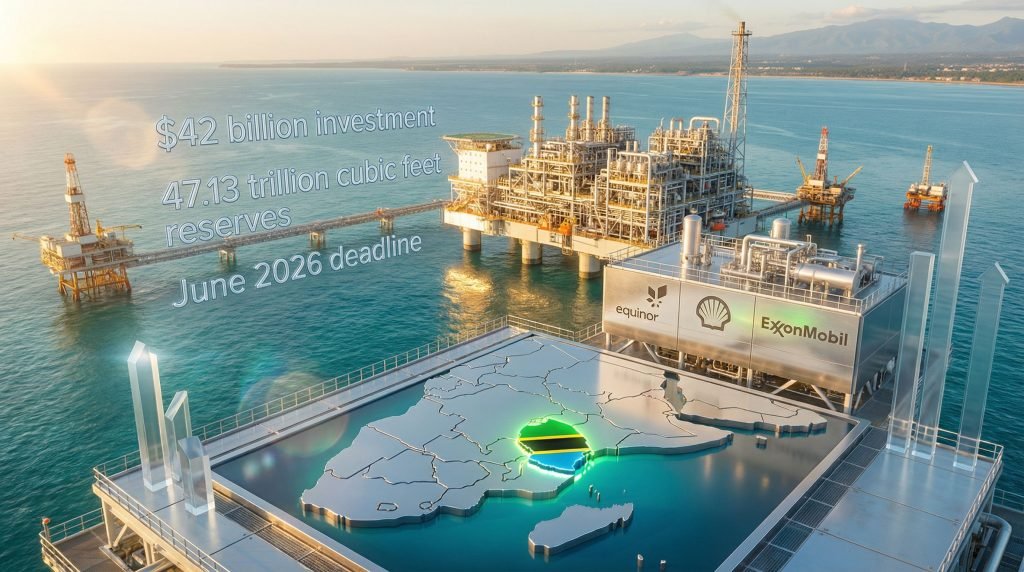
Tanzania holds some of East Africa's largest proven natural gas reserves, with offshore deepwater fields containing over 57 trillion cubic feet of recoverable gas according to industry estimates. The planned liquefied natural gas export terminal anchored by Shell, Equinor, and TotalEnergies has been in development for over a decade without reaching final investment decision. The cost of that delay is not abstract. It is measured in foregone revenue, unrealised infrastructure development, and the compounding uncertainty cost embedded in Tanzania's broader investment climate.
Why the Decision Has Not Been Made
The obstacles to Tanzania's LNG final investment decision are layered. Contract frameworks negotiated under the Magufuli administration introduced production sharing terms that international operators found commercially challenging. Community land rights and resettlement frameworks for the Lindi coastal zone have not been fully resolved. Financing structures for an investment of this scale potentially exceeding $30 billion require a level of fiscal and legal certainty that has not yet been established.
Each year of delay adds cost to the pre-development expenditure already sunk by the operator consortium, reduces Tanzania's competitive position relative to Mozambique and other regional LNG developments, and defers the fiscal revenue that the government has incorporated into long-term development planning.
The Mozambique Reference Point
Mozambique's LNG projects similarly delayed by security disruption in Cabo Delgado illustrate both the transformative potential and the complex risk profile of large-scale African LNG development. TotalEnergies' force majeure declaration at its Mozambique project reinforced how security and community risk can derail investments that have already passed financial close.
For Tanzania, the Mozambique experience is both a cautionary tale and a competitive opportunity if the LNG project can be moved to execution while Mozambique's timeline remains uncertain, Tanzania could capture a share of the long-term Asian LNG demand that East African gas is positioned to serve.
Community Rights and Resource Governance
The fishing and coastal communities of Lindi and Mtwara the regions adjacent to the proposed LNG terminal site have legitimate land, livelihood, and compensation interests that have not been resolved to international standard. Unresolved community frameworks are not merely a social license issue; they are a project execution risk that financiers and operators must account for in their investment decisions.
What Resolution Requires
Moving Tanzania's LNG project from perpetual delay to execution requires a government willing to negotiate commercial terms that are acceptable to international capital, a community engagement framework that meets lender requirements, and a security architecture that protects the construction and operational phases. These are achievable conditions but achieving them requires political prioritisation that has been inconsistent.