In today’s digital era, connectivity underpins global growth, innovation, and cross-border collaboration. From everyday devices like smartphones and laptops to IoT technologies, cloud platforms, and enterprise systems, we now operate within an ecosystem where everything is interconnected.
However, this constant connectivity also exposes organizations to greater security risks. Traditional “castle-and-moat” models, where insiders were automatically trusted once inside the network perimeter, are no longer sufficient. To safeguard data and infrastructure in this expansive, borderless environment, many organizations are adopting zero-trust security as the new benchmark.
According to Chris Butler, Head of Vodafone MEA Account, Cloud and Network Services at Nokia, “Identifying threats is only the first step. True cyber resilience demands more. It requires a shift to zero-trust models, where every user, device, and application interaction is continuously authenticated to eliminate assumptions of trust.”
The End of Perimeter-Based Security
For decades, cybersecurity was built around firewalls, intrusion detection tools, and gateways, keeping outsiders at bay while allowing insiders to move freely. This setup was effective when most assets were housed within corporate networks.
However, the digital landscape has evolved. With the growth of remote work, widespread cloud adoption, and bring-your-own-device (BYOD) practices, traditional network boundaries have all but disappeared. Employees now access corporate systems from home networks, public spaces, and mobile devices, while supply chains and external partners increasingly require privileged access.
Each additional connection expands the attack surface, creating new vulnerabilities.
Once intruders breach the perimeter, they can move laterally, often undetected, with devastating consequences. Organizations need a security approach that assumes threats may already be inside, and that’s where zero trust comes in.
Discover More: Proactive Cybersecurity: A Cost-Effective Alternative to Reactive Solutions
Understanding Zero Trust
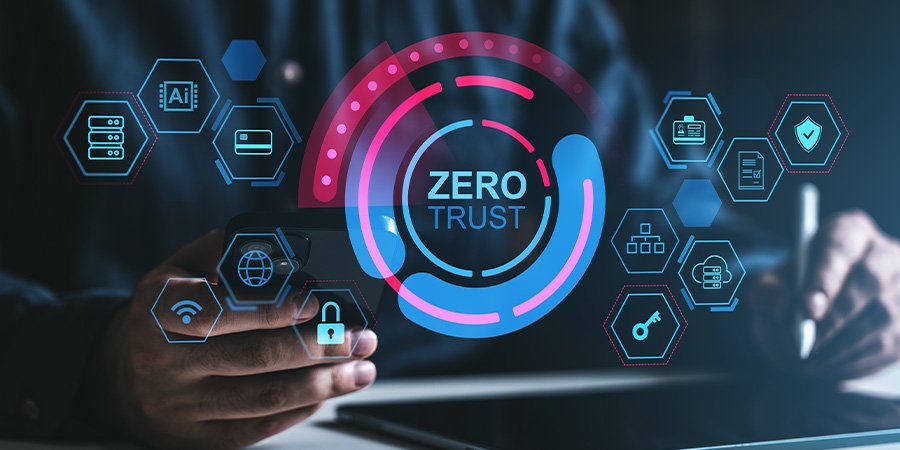
Zero trust is not a single tool but a strategic framework. Its foundation is simple: never trust, always verify. Every user, device, and application, whether inside or outside the network, must continually prove its legitimacy before gaining access.
This framework is built on several core principles:
- Ongoing Validation: Authentication isn’t a one-time check. Users and devices must verify continuously.
- Scarce Privilege: Access rights are limited to what is strictly necessary, minimizing potential damage from compromised accounts.
- Segmentation: Networks are divided into smaller, isolated zones to prevent attackers from moving laterally.
- Identity and Device Assurance: Both users and their devices must meet strict compliance and authentication checks.
- Active Monitoring: Real-time analytics and anomaly detection should spot unusual behavior quickly.
By shifting security from the perimeter to the data and identity layer, zero trust ensures protection no matter where information is stored or accessed, whether it be on-premises, in the cloud, or on mobile endpoints.
Zero Trust in an Always-On World
The hyperconnected era magnifies the need for zero trust. Billions of IoT devices, edge platforms, and digital services expand the attack surface daily. Industries handling sensitive or mission-critical data are especially at risk. The telecom sector, underpinning all connectivity for both cyberattacks and cyber prevention must maintain vast, distributed infrastructures to achieve always-on connectivity.
Backed by this connectivity, the healthcare, finance, manufacturing industries, and more, rely on zero-trust frameworks to ensure that every transaction, device, and identity is validated in real time, reducing the likelihood of catastrophic breaches.
Backing this notion up, recently, Mplify (formerly MEF), warned that the USD 10.5-trillion cybercrime economy, weaponized AI, and escalating global conflicts are creating unprecedented risks to IT systems and critical infrastructure. In response, its Enterprise Leadership Council (ELC) has issued a manifesto calling for mandatory SASE certification across all products, services, and solutions under the Mplify framework. The “SASE certification is not a checkbox; it is a catalyst for trust, innovation, and resilience,” according to the manifesto, and serves as a blueprint for similar implementation in Africa’s cybersecurity sector.
Innovative Solutions:
Cloud Security Protecting Digital Infrastructure’s Future
Securing the Future with Advanced M2M Authentication
The Roadblocks to Adoption
Despite its advantages, zero trust is not a plug-and-play solution. Organizations often face hurdles such as:
- Legacy Infrastructure: Outdated systems may not integrate easily with modern security frameworks.
- Implementation Complexity: Rolling out segmentation and constant monitoring across large networks requires careful planning.
- User Pushback: Employees sometimes see stricter access policies as disruptive.
- Budget Concerns: Transitioning to zero trust demands upfront investment.
Yet, the cost of not adopting it can be far greater. A single breach can lead to massive financial losses, reputational damage, and legal consequences. Most recently, in Morocco, the National Social Security Fund suffered a breach affecting up to 4 million employees, equating to financial and identity theft consequences.
As digital transformation accelerates, zero trust will become the cornerstone of modern cybersecurity strategies. Governments are already pushing organizations to adopt stronger models, while advancements in AI and automation are making zero-trust frameworks more intelligent and responsive. In an exclusive interview with Telecom Review Africa, Roland Abi Najem, CEO of Revotips, reiterated the importance of this, noting that, “Currently, there are no rules or regulations to govern all aspects of AI since governments are still struggling to find the proper rules to control cyber-attacks before AI; now, things are becoming more complicated with AI.”
In a hyperconnected world where trust can no longer be assumed, zero trust provides the guardrails for safe innovation. It allows businesses, governments, and individuals to harness the full potential of connectivity, without compromising security.
Read More: Addressing Network Security Threats in Africa’s Expanding Telecom Ecosystem