

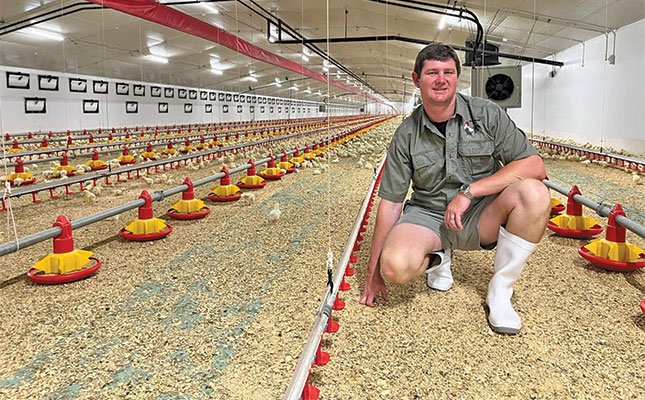
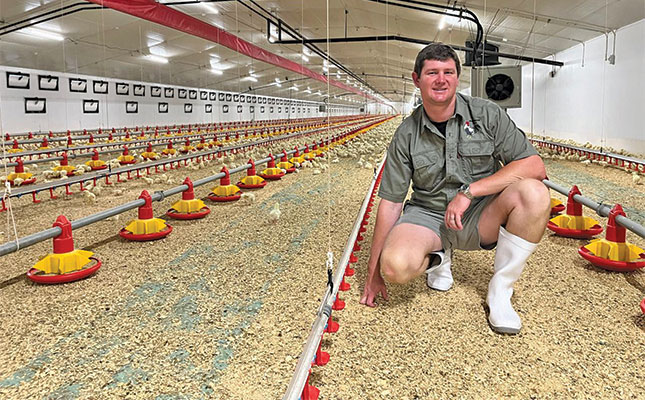
Attention to detail and work ethic have earned Gerrit Maritz the title of AgriCulture Gauteng’s Young Farmer of the Year 2025. He runs a poultry operation producing 4,5 million broilers per year in Magaliesberg, Gauteng. He shared his lessons on keeping margins favourable with Lindi Botha.
– ADVERTISEMENT –
Gerrit Maritz, owner of Brandvlei Chickens in Magaliesberg, Gauteng, did not let the lack of opportunity get in his way to becoming a farmer.
While his father was a part-time farmer, Maritz could not take this operation on full-time and was given the choice to either pursue a tertiary education or find a job after high school in 2007.
With farming being the only career in mind, he found a job working for a chicken farmer, absorbing all the knowledge he could. For several years he worked on different farms, gaining experience in different production systems.
He eventually moved on to become a consultant in the industry, helping farmers to improve production.
His acumen was soon noticed by a businessman looking for a partner to run a broiler operation that could supply chickens to Sangiro Chickens, a processor in Broederstroom.
“I was quite taken aback when I received that phone call. Who just phones someone and offers to be their silent partner to set up a farm?” says Maritz with a laugh.
He shrugged off the offer, but when it was made again, he accepted the request for a meeting.
“They needed someone reliable who could produce a large amount of broilers on a commercial level. It was a huge honour that they saw my value, without me even having to approach them for investment. It goes to show that action speaks louder than words,” says Maritz.
In 2020, Maritz and his silent partner started producing 300 000 broilers every 47-day cycle. During the first year he already proved his worth, earning the title of Sangiro Chickens’ Grower of the Year. Today production has doubled, equating to 4,5 million broilers per year.
Managing climate for optimal growth
Eagles Pride is contracted by Sangiro Chickens to provide their contract growers with day-old chicks. Maritz therefore farms the breed he receives and does not have a particular preference. Breeds are generally Arbor Acres, Ross 308, Cobb, or Indian River.
He averages a mortality rate of 5%, which is on par with the industry average.
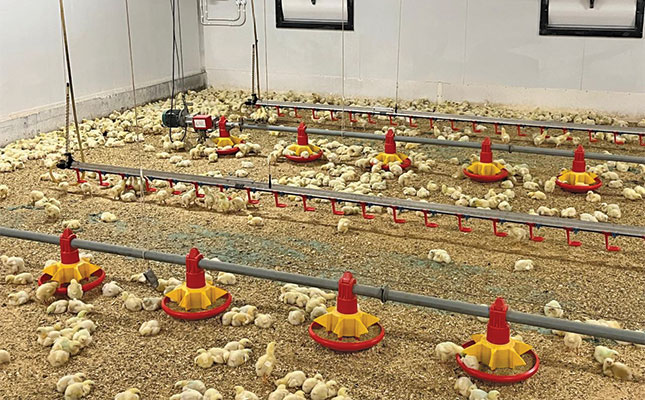
Maritz notes that the biggest factor influencing mortality is the climate inside the broiler houses. Climate control is therefore automated in his 12 broiler houses to ensure precision across temperature, ventilation, and humidity.
Day-old chicks require a temperature of 32°C, and those close to slaughter between 18°C and 22°C.
“Because chickens give off body heat, it is tricky to maintain the ideal temperature in the houses. Real-feel must also be taken into account. If there is a breeze through the house, then the chickens will feel cooler than what the thermometer says.”
With the external climate being out of farmers’ control, temperature management requires even more scrutiny. Maritz says that the ample rain this summer has played havoc with humidity levels.
“We need to operate at around 60% humidity, which is difficult when the air you are drawing in from outside is at 100% humidity when it is raining constantly.”
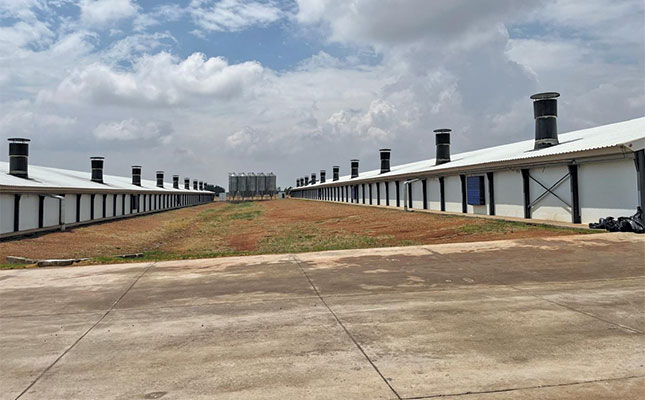
Ventilation is a key focus for Maritz. The houses have been designed to allow for ventilation across the width of the houses, not down the length, as this would create a tunnel effect and increase wind speed.
“Chickens like a breeze, not an August wind. It’s important to find the right balance to ensure the chickens have fresh air and that cold wind does not sink down onto the bedding, causing it to get wet. So the wind needs to move at just the right speed.
“I’ve found that this is easier to achieve when the ventilation only crosses a distance of 16,5m across the house, instead of 130m, where wind will pick up speed too quickly.”
Box fans on the sides of the houses aid in cross-ventilation. All fans have variable speed so that they switch on and off gradually. This aids in energy reduction and also ensures that chickens do not face sudden changes in climate.
The houses also contain sensors that measure carbon dioxide so that ventilation can automatically be increased if the levels are too high.
Other changes in design that Maritz implemented to aid production are chimney fans that draw air up and out of the houses through the roof to ensure that stale air escapes.
Keeping the bedding dry is crucial to keep the chickens healthy. From Day seven to Day 28, the litter is manually lifted with a fork to aerate it.
“This process ceases on Day 28 because we don’t want too much movement in the houses. At this stage the chickens are already quite big and will start jumping on top of one other.
“Their sharp nails scratch the other chickens’ backs, leading to septic wounds. This negatively influences meat quality, which reduces income,” says Maritz.
In winter, the houses are heated by using a boiler. This is left on standby mode so that when temperatures drop suddenly and heat is required, the water does not first have be heated from scratch.
With load-shedding providing a constant challenge, solar power was erected on the farm in 2023 to ensure consistent energy supply, and reduce the high costs of having a backup generator. The solar energy provides all the electricity during the day, which has reduced Brandvlei’s Eskom account.
Attention to detail saves costs
Feed is the biggest expense on the farm and Maritz is therefore meticulous about feed management.
“Feed that is properly formulated is important to ensure a good growth rate. But good- quality feed does not come cheap. Every gram that was bought but has not gone through a chicken is money down the drain,” he says.
The feeding system is automated to supply feed when the feeding pans in the houses run empty. Feed delivered to each house is measured to keep track of how many tons are being consumed per cycle of chickens. He averages a feed conversion rate of 1kg meat produced for every 1,36kg feed provided.
Maritz points out that the settings on the feed pans are important to master to prevent chickens from scratching feed out of the pans and wasting.
“The better you manage the feed, the better your result and margin.”
Care is taken to ensure that the feed pans are not filled to the brim as this results in selective eating, with bigger pieces consumed and smaller pieces or that which has become powder being left.
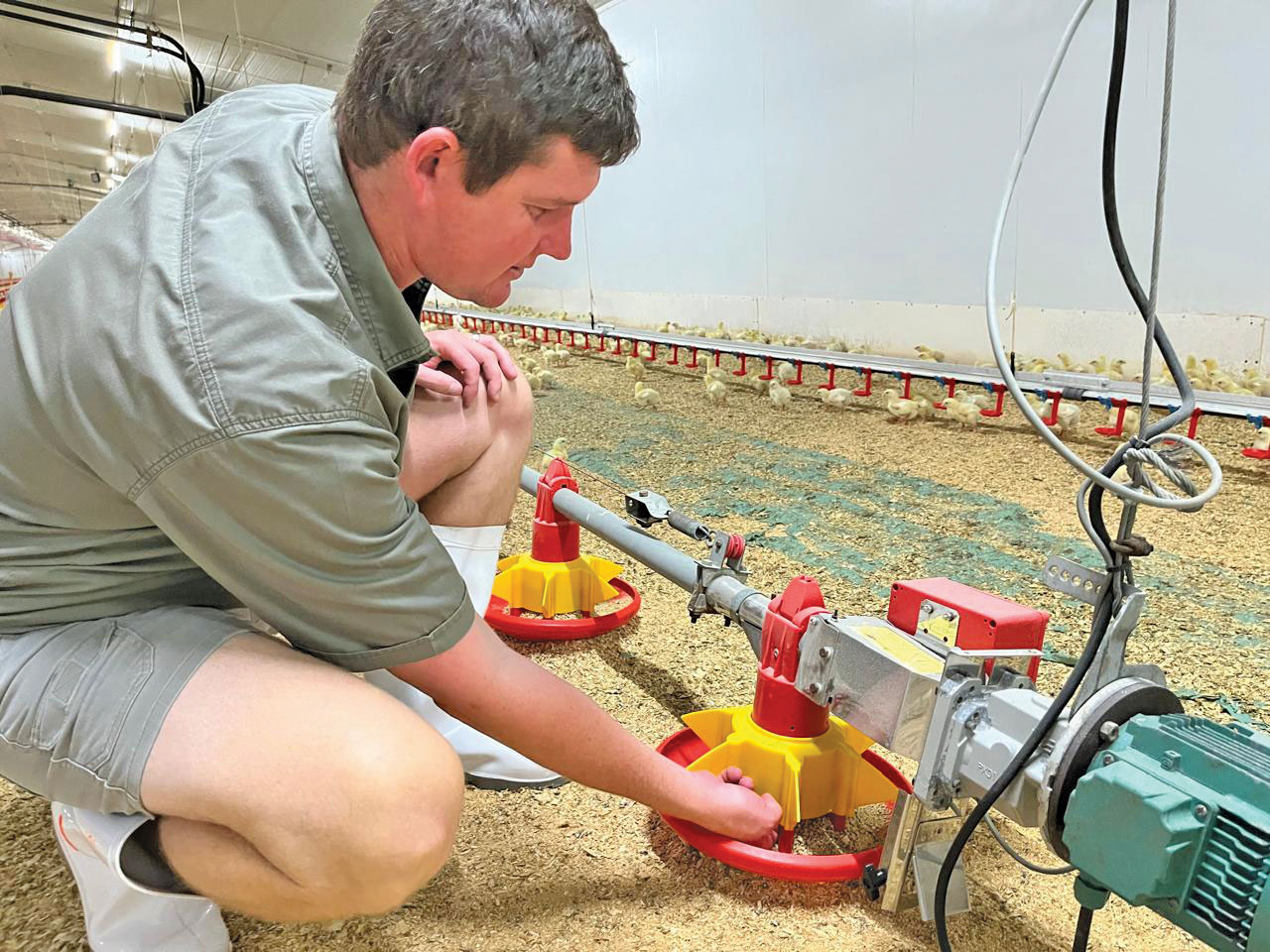
“We try to force the chickens to eat everything that is there. Feed is not supplied in a constant flow, but rather limited to certain feeding times. The feeding lines are switched on when food is being supplied, and these conditions ensure the chickens move to the troughs to eat,” adds Maritz.
“The pans are never empty, but we take care not to oversupply. It’s a finicky process to figure out. Every farmer has their preference and it’s important to figure out what works on your farm.”
Maritz’s attention to detail extends to his workforce of 18, where he takes up much time to properly train his staff. Since skilled workers are scarce, and often poached by other farmers, Maritz rewards workers who excel.
On-the-job training is done to ensure each worker understands what needs to be done, and why. “One makes the mistake of thinking staff know why things need to be done like they are, but they don’t. It’s therefore important to not just give orders, but give reasons too. I don’t micro manage, but I’m hands-on. If staff struggle, I am there to help.
“Rewarding good work is important, otherwise you risk staff leaving. My staff know that the harder they work, the better the business will do, and the more they will be rewarded.”
A large part of managing costs is preventing problems from escalating. Maritz’s ‘tomorrow is too late’ attitude means that any issues identified are addressed as soon as possible.
“If a motor is making a strange sound it must be looked at immediately. Waiting could mean a far bigger breakdown that not only costs more to fix, but impacts production, having a ripple effect on the whole farm.”
Maritz relates that the judges for the AgriCulture Gauteng Young Farmer of the Year award were particularly impressed with how neat his premises are.
“There was a quip about even the hosepipes being all neatly rolled up. But this farm is my investment. If I don’t look after it, and everything in it, it will go backwards. This is a business that must do well, pay the bills and grow,” says Maritz.
Contract farming
Marketing his chickens is one aspect Maritz does not have to focus much attention on. Being a contract grower for Sangiro Chickens means that all his birds are sold to this processor.
“Marketing 600 000 chickens at once is no easy feat if you don’t have a lot of contacts in the market, which can take years to build. So being a contract grower has a lot of benefits because I can focus on farming, not marketing.”
The farm is relatively close to the abattoir – 65km – which means transport costs are not excessive. Regardless of the marketing model, Maritz laments that farmers are price takers and there is little wiggling room to negotiate prices.
“My focus is therefore to do the best I can and keep improving,” says Maritz.
In this regard, taking part in the AgriCulture Gauteng Young Farmer of the Year competition has helped Maritz to see his farm in a different light. Now, a larger focus is placed on the financial side of the business.
“During the adjudication process I realised there were questions that I couldn’t answer. So now I speak to my accountants more, asking questions about the numbers and the story they tell. I’m also looking at bringing in more experts to improve specific sections of the business.”
It’s clear that Maritz’s plans for the future know no bounds, fuelled by optimism over the broiler industry.
His dream is to produce three million birds per cycle, equating to 23 million per year.
“Chicken is the most eaten protein in the world and there is a lot of opportunity for growth.
“Last year, Astral grew their production by 400 000 chickens per week – that says something about the enormous demand for chicken,” concludes Maritz.
For more information email Gerrit Maritz at [email protected].


