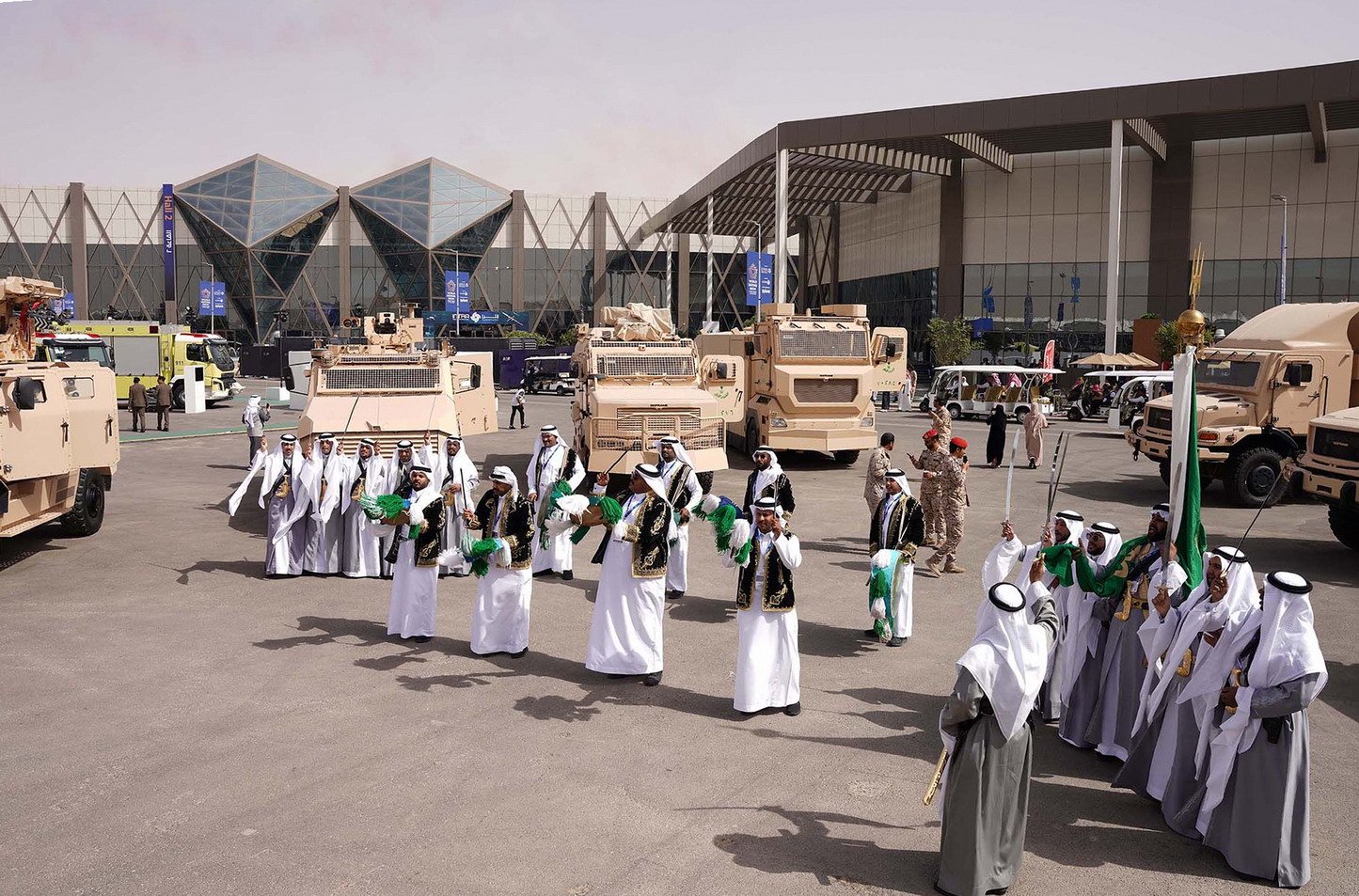

From 8 to 12 February, Riyadh hosted the third edition of the World Defence Show (WDS), Saudi Arabia’s bid to host the largest defence exhibition in the Middle East, and rival the IDEX show held every two years in the UAE.
For this new edition which was themed “The Future of Defence Integration”, a brand new hall was introduced, the “Future Defence Lab”, as well as new exterior presentation spaces, notably a “naval zone”.
For a long period, Saudi Arabia has been designated as a country where defence business was not endorsed and has been subject to export control bans by Northern Europe countries in particular. Regardless, commercial relationship are now normalising as Saudi Arabia is among the biggest spenders in the Middle East with a defence budget that exceeded $78 bn in 2025, only outdistanced by Ukraine (whose spending is justified by war necessity), India and Qatar in the 2024 ranking of arms importers. It was therefore to be expected that a significant number of companies were present at the show. However, despite the signing of several contracts, only a small number of these were large-scale.
Saudi Arabia’s nascent defence industry
In pursuit of greater autonomy, Saudi Arabia has made significant progress in localising the production of some of its systems. As part of the Kingdom’s Vision 2030 roadmap, the General Authority for Military Industries (GAMI), aims to achieve 50% of localized production, and has celebrated the milestone of 25% achieved in 2024. Numerous Saudi defence companies were present at the show and were able to introduce new products. In alignment with the government’s priorities, Saudi exhibitors placed a particular emphasis on unmanned and counter-unmanned capabilities. Serb Advanced Industries displayed a model of the “Jaser” loitering munition, described as having entered mass production, while Intra Defence Technologies showcased its Shalfa precision munition intended for tactical UAVs. On the counter-drone side, Airshield unveiled its BARQ anti-drone system, designed to be deployable from ground launchers, naval platforms or airborne platforms, and which reportedly integrate AI technologies. Wakeb introduced its “baby-raptor” interceptor drone.
Concurrently, Saudi manufacturer introduced several new land systems. Saudi Arabia Military Industries (SAMI), which recently created a Land division, launched its HEET indigenous armoured vehicle programme, unveiling a new 8×8 Fire Support Vehicle armed with a 105 mm gun, alongside a 4×4 MRAP with a 12.7mm remote turret and a 6×6 vehicle that was not showcased. ERAF introduced its Tares III MRAP family, but also announced a partnership with Lockheed-Martin to jointly develop an unmanned turret for future land combat vehicles.
To achieve a high-level of localisation, Saudi Arabia is indeed pursuing international partnerships and transfers of technology. SAMI, through its joint venture with the Spanish shipbuilding company Navantia, is now in a position to propose “in-house” solutions for maritime C4I systems as well as a “lite” version of the Hazem combat management system. Following that trend, the Saudi National Centre for Industrial Development signed during WDS 2026 a MoU with Airbus to lay the foundation for the assembly of rotorcraft in the Kingdom, while Saudi company Pioneers Technical Systems signed a technical partnership with Lockheed Martin to test and repair critical components of Patriot PAC-3 launchers locally. Similarly, Saudi Arabia is in talks with US based Shield AI, having shown interest for its V-Bat and X-Bat vertical take-off reconnaissance UAVs and UCAVs, for which it could possibly request a level of localised production.
Saudi Arabia’s strategic objectives encompass not only the domestic production of new equipment, but also the ambitious expansion of its R&D activities in cutting-edge technologies. As part of a five year roadmap, the prioritised fields for investment include: semiconductors, sensors, advanced materials, space technologies, artificial intelligence, control of the electromagnetic spectrum, digital sustainment, human-machine teaming, autonomous systems, rocket technologies and directed energy weapons.
Clear Skies, Clear Waters
As demonstrated at WDS 2026, the Kingdom of Saudi Arabia has been identified as a nation with considerable and diverse requirements across all domains. This has attracted the interest from companies on a global scale. For instance, a number of air defence systems were shown at the exhibition, including the Pantsir S1 which Saudi Arabia ordered for $2.2bn, the European IRIS-T and SAMP/T-NG or various Turkish systems made by Aselsan or Roketsan. China was also present at the show, proposing the LY-70 mid-range surface to air missile system and its LW-30 Laser Weapon System, offering this system for the Gulf anti-drone needs.
Ballistic missile defence (BMD) appears to be a sought-after capability in the Royal Saudi Naval Forces’ 5 frigate programme. Indeed, Spain’s Navantia presented its F-110 in an “IAMD” (Integrated Anti-Missile Defence) configuration at WDS 2026.
Meanwhile, Hyundai Heavy Industries emphasized that its HDF-6000 frigate is also offering BMD capabilities as well as ‘Europeanized’ armaments and localised production through the International Maritime Industries (IMI) project. Other competitors are France’s Naval Group proposing the FDI frigate or Turkey proposing the Istanbul class frigate.
Finally, Fincantieri, which announced the signing of a contract worth €200 mn to supply Saudi Arabia with MU90 Lightweight Torpedoes, confirmed to The Bulletin that it is targeting this market with the FREMM Evo frigate which recently caught the eye of Portugal. The Italian company is leveraging the work done by its local subsidiary, established two years ago, to develop commercial partnerships and opportunities in the Kingdom.
To address maritime surveillance and combat needs, Saudi Arabia has prioritised the development of USV. Some local option are already available, like the Prince Sultan Defence Studies & Research Centre (PSDSARC)’s USV jointly designed with ERAF. However, foreign suppliers also see a potential interest for UUVs to carry critical infrastructure protection, like BAE Systems with its XLUUV Herne, South Korean company LIG or Turkish company STM showcasing its NETA 300 UUV.
A mock-up of Lockheed Martin’s F-35 could be spotted at WDS 2026, while General Atomics presented its Gambit collaborative combat aircraft family and its MQ-9B Sky Guardian. On the other hand, China showcased its J-10CE and J-35A fighter jets. Garnering Saudi’s interest, Turkish Aerospace Industries displayed a model of its Kaan fighter aircraft and presented the Anka III drone in a collaborative combat configuration. Nonetheless, and despite Turkish President Recep Tayyip Erdogan hints that Saudi Arabia was on the verge of becoming a partner on the Kaan programme, no major deal was announced with the Saudi Air Force with no collaboration announced for fixed wing aircraft and no development either on the prospect of Saudi Arabia’s participation in the GCAP initiative.
As written earlier, WDS did not see many high-number contracts, and one of the most important contracts came in fact after show ended, with Saudi Arabia ordering four C-27J Spartan transports in their maritime patrol configuration from Leonardo, on 16 February.
Even more than weapons, WDS 2026 displayed Saudi’s growing appetite for locally produced systems. In the midst of all the strategic autonomy rhetoric, it seems that even traditional importers might look at their own industry to fulfil its needs. Traditional arms exporters will increasingly compete with newcomers, and all will see a shrinking market as more and more countries try to build their own solutions. Perhaps then, is it time to investigate new promising importers?
Written by ADIT – The Bulletin and republished with permission.