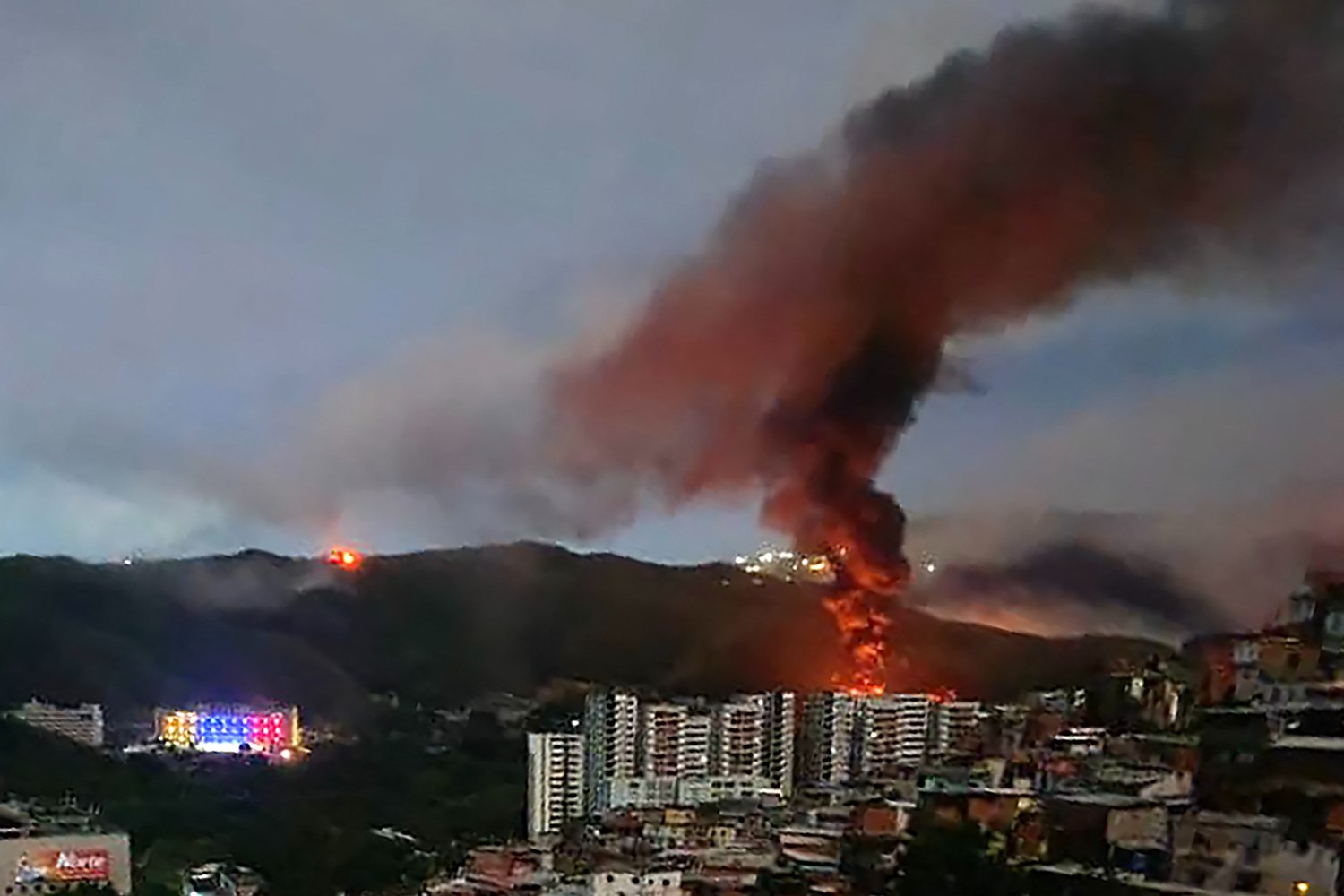

Every year, FP runs an essay titled “10 Conflicts to Watch” in partnership with the International Crisis Group, an independent body that raises the alarm about war. This year’s article lists many of the usual hot spots, including Israel and Palestine, Ukraine, Sudan, and a few lesser-known conflicts such as the ones in Burkina Faso, Ethiopia and Eritrea, and Myanmar.
On the latest episode of FP Live, I spoke with one of the essay’s co-authors, Comfort Ero, the CEO and president of the Crisis Group. We began by discussing the fast-moving developments in Venezuela after the United States captured President Nicolás Maduro and his wife on Jan. 3 and brought them to New York, raising questions not only about the future of Venezuela but also about the legality of the operation and the future of international law. Subscribers can watch the full discussion on the video box atop this page. What follows here is a lightly edited transcript.
Ravi Agrawal: We have to start with Venezuela. Nicolás Maduro is gone. His vice president, Delcy Rodríguez, is now interim president. What’s your reading of how stable the situation is in Caracas?
Comfort Ero: First, it was quite a dramatic, clinical snatch-and-grab extraction to bring him to the United States to face various charges that the government has set against him. Right now, it’s a Maduro-less Chavista government still in Caracas, so it’s not a full regime change. And it was also a deliberate choice of language by the U.S. government to show that they were dealing with an illegitimate leader who they didn’t believe won the elections in 2024. I think everybody agrees with that.
But we’ve also seen repression and a state of emergency in the country. Of course, Venezuelans are still feeling their way through this change. It’s also important to acknowledge that an overall majority of Venezuelans are happy to see the decline of Maduro. Whether they wanted it this way, to have your leader to be extracted by night in this manner, the jury is still out. But most of them have been frustrated by the backsliding of democracy, and a number of other countries also felt that pressure as well.
There are still lots of questions to ask. When [U.S. President Donald] Trump says we’re “going to run” the country, is he looking for a pliant, obedient government run by Rodríguez? And what should we expect from the rest of the regime behind her?
RA: Well put. There are certainly more questions than answers at this stage. For all the critiques of how and why this was done, it is hard to disagree that Maduro was an awful leader. He ruined Venezuela’s economy. He was incredibly repressive. But, of course, there are many such leaders in many countries around the world. And Trump, in his televised remarks on Saturday, didn’t even mention Edmundo González, the actual winner of the 2024 election. What happens in the longer term to democracy in Venezuela?
CE: For the opposition, who to a certain extent threw their lot behind the idea of external assistance to remove Maduro, it’s now a point of reflection. “What does this mean for us as the opposition? What does it mean for democracy?” And clearly the opposition sees they are not on the same page of the agenda that they thought that they shared with Trump.
RA: Let’s jump for a moment to a bigger-picture question. I looked back at previous iterations of “10 Conflicts.” For the 2022 edition, for example, you wrote that “the number of major wars has also descended from a recent peak.” You also said that “states rarely go to war with one another.” These were all true statements as written in December 2021. No one could have disagreed with those facts. And then right after that, Russia invaded Ukraine. Then we had Oct. 7. Sudan got much worse. And it feels like now, Comfort, we’re in one of the bloodiest periods in recent memory. If you had to dig at the underlying reason for why conflicts suddenly seem so common, what is the answer you’re getting at?
CE: It’s not a single narrative. I think one issue is that the systems that would normally act as safeguards—the [United Nations] Security Council itself—were losing currency. A number of major powers themselves were losing their own legitimacy or clout. A few months before we released “10 Conflicts to Watch in 2022,” the major international incident was the United States’ embarrassment in Afghanistan. Did that send a message to other powers, particularly Russia, that this might be their moment to strike? At the same time, we were seeing a number of rising powers with regional clout gain some game-changing effects beyond their regions. I’m thinking of Turkey, the Gulf countries, playing outsize roles. The United States was no longer the only sheriff in town. There were others who wanted to be part of shaping security in their region. But I think the key for me is that the guardrails that would often curb such behaviors—sanctions, peacekeeping, the United Nations Security Council—were highly dysfunctional and no longer trusted.
RA: That answer brings us back to Trump and Venezuela, because in the wake of the United States capturing Maduro, there have been all these questions about international law. What happens to rules and norms? And there are two ways of looking at it. One is that the United States has a long history of belligerence, especially in Latin America, and often does pick and choose rules it wants to follow. International law was already shaky. The other is that there’s something exceptional about Trump, who truly prizes a world in which might is right. Given the events of the last few days, how challenged is the status of international law?
CE: Stephen Miller, in his CNN interview this week with Jake Tapper, said that “international niceties” have no role and no bearing on the United States; that force, raw power, brute power is back in vogue. You talked about the exceptionalism of Trump. The United States generally has been exceptional in its international foreign policy. It has often seen itself as a stand-alone actor. It crafted a number of international rules and is choosing right now to say, “We’re going to set those aside. They go against our core interests.”
I was reading the Trump administration’s National Security Strategy again, Ravi, and it’s near script-like, especially in relation to the Western Hemisphere and Venezuela. It’s about our economy, it’s about America First, it’s about migration, it’s dealing with the war on drugs. But it’s also about making sure that we take control of our backyard. As we said in the 10 conflicts article, the sphere of influence then becomes indifferent to international law. Because if it’s about controlling, shaping, cajoling—using all different kinds of instruments to bend countries to your will for the sake of your own national security strategy—there is no room for international norms. There is no room for international cooperation. It is the 21st-century version of the Monroe Doctrine, and they said it very articulately, very clearly, in the National Security Strategy. So no surprise there. It’s a moment to pause to ask what this means, not just in the Western Hemisphere, but in other places where the United States has interests as well.
RA: One of the things I struggle with as a journalist, Comfort, is just how broad the interpretation of documents and comments like that can be. For example, that interview by Stephen Miller that you described. He can call international law “international niceties” and make the case on TV that the United States should invade Greenland. But then simultaneously, a message emerges from the White House that this is really just a negotiating tactic for rights to mine critical minerals in Greenland. So you have this wide spectrum of possibilities that various factions put out within the White House, which are very difficult to interpret as an observer. I’m curious how you read something like the so-called Donroe Doctrine. And how are other countries thinking about how to react to the way the United States is talking about hemispheric influence?
CE: Nobody can say they’ve got a very clear reading, because at the end of the day, the center of gravity is Donald Trump, and whatever he says goes. But he’s also very prone to being captured. The last person who puts a compelling argument in front of him that shows him in a strong light and reinforces his own image wins. You saw the full cast of characters around Trump tussling over Venezuela. So first it was migration and the hostages and dealing with the drugs. And then suddenly it switched to regime change. And then, suddenly, it switched to something else as well. One has to pay attention.
Now, in terms of how the rest of the world is reading this, I can imagine [Russian President Vladimir] Putin is probably sitting there thinking, “Why can’t I have done that in 2022?” Both Putin and [Chinese President] Xi Jinping will read into this that “we want control over our backyard, and this fits into our own narrative, into our foreign policy, how we want to shape and determine affairs in our own backyard as well.”
This is a nightmare scenario for Europe, who are trying to negotiate carefully on Ukraine. How then should they read what is happening on Greenland? Do they suck it up and say, “For the sake of Ukraine, we have to do this”? It’s been interesting to listen to the narratives from a number of European countries. Some have been lukewarm, some have been unclear, some haven’t been reassuring. But at the same time, they came up with this interesting statement of declaration on Ukraine.
This doesn’t look good if you’re sitting in any of the European capitals. It raises a number of questions about the reliability of NATO, about the future of the alliance, but also about whether you can keep the U.S. onside in terms of the future of European security architecture.
RA: Let’s jump to some other arenas now. Sudan is the world’s worst humanitarian disaster. Millions are displaced, nearly half the country is facing food insecurity. It doesn’t get enough coverage in the West. What is your sense, Comfort, of the trend line on the conflict there?
CE: I’ve said this several times: If you wanted the poster child of the bloodiest humanitarian catastrophe beyond Ukraine and Gaza, then Sudan is it. Everything has gone from bad to worse since the outbreak of the new conflict in April 2023. You’ll remember that in 2019, there was a lot of excitement with the revolution. That went in the wrong direction. The key forces that were instrumental in getting rid of [former President Omar al-]Bashir are now in this heavy contest. On top of that, you’ve got clear external actors who are shaping facts on the ground because they’re supplying both sides of the conflict.
To your point about Sudan not getting the necessary attention that it deserves, I would have thought that the horrific, violent incident that happened in El Fasher would have been the turning point in terms of international engagement. But if you want further indication that the West does not have the bandwidth, that Europe is so focused on its own neighborhood (no criticism there, I think it’s important), that the system of crisis management is itself in crisis, that the principles that shape international relations are all collapsing, then Sudan is it. And it is not just a civil war; it’s a proxy war as well, because there are a number of key external actors who have clear interests in what happens in Darfur.
RA: I want to ask you about that. It’s fairly widely reported that the UAE [United Arab Emirates] supplies arms to the RSF [Rapid Support Forces], which the UAE denies, of course. Saudi Arabia, Egypt, Turkey, and maybe even Iran are selling arms to the military on the other side of this conflict. Why is it so hard to get these other players, these proxies, to hash it out at a table instead of at the cost of Sudanese lives?
CE: Because there’s a bigger war at stake, because there’s bigger tensions. Sudan, in a sense, has become a stomping ground for wider regional and geopolitical tensions within the Gulf countries. When Saudi Crown Prince [Mohammed bin Salman] went to Washington recently, one of the big pushes that Crisis Group made was to suggest that there was a way to put Sudan on the table in which Trump would be engaged. The question there was not just picking up the phone to UAE and saying, stop arming the RSF. Neither side trusts the other. Neither side believes that a peace process will end the fighting. Sudan has become more fragmented, more partitioned, more arms are going in there, and the bigger issue—the rivalry between the UAE and Saudi Arabia—is not only just playing out in Sudan, but now you’ve seen an uptick in conflict in Yemen as well.
The stability of Sudan hinges on working out what the strategic interests are and the rivalry between a number of Gulf and Arab countries. So we said, take that out of the picture. It could be easier, but there’s still complicated politics in the country. There is a tussle between the old guard, Islamist, pro-Bashir and other Sudanese political forces. And the region itself has its own complicated politics vis-à-vis Sudan. We said to bring in Donald Trump in the hope that he could find a through line with the UAE and Saudi Arabia, but I think this is one that the region needs to work out.
RA: Some of the conflicts you’ve listed are obvious. We can see them around the world. But I was surprised to see Syria on the list, given that the civil war ended there about a year ago with the victory of now-President [Ahmed] al-Sharaa. He’s joined the fight against [the Islamic State]. Syria today faces fewer sanctions. Why is Syria still an area of concern in 2026?
CE: Because you mention your surprise about Syria, I should explain how we make the decision around the conflicts on the list. It’s not necessarily that we’re going to see an uptick in violence. It’s also because we see opportunities and so are warning that if you don’t keep an eye on a particular conflict or if you don’t provide the necessary political and economic investment to safeguard it, it can go off the rails. That’s partly why Syria is on the list. It’s a reminder that while the international standing of President al-Sharaa has been good, while he’s had a great honeymoon, and while we’re seeing important issues around sanctions and investments being made, Syria does have strong domestic security challenges and issues about governance and inclusion. How you deal with various forces, such as the Druze and the Alawites, the Syrian Democratic Forces and that tension on the border with Israel. So it looks great internationally, but if you don’t win the peace at home, that starts to crumble.
RA: Let’s cross that border to Israel. Obviously, you listed the conflict in Gaza. There was a cease-fire signed in October, which is still holding. But as you write, “Gaza remains in limbo.” How does the coming year look for Palestinians?
CE: Pretty bleak, to put it quite frankly. The status hasn’t changed, the horrible situation and deepening occupation. It’s worrying that we haven’t been able to move forward in any meaningful way beyond phase one since the Gaza summit in Sharm el-Sheikh. Let’s at least acknowledge that, even with the cease-fire, we’ve also seen an increasing number of deaths continue. What we’re seeing is the status quo likely to hold; the difficulties of getting to phase two around governance; the Board of Peace that President Trump announced; getting the Palestinian technocratic committee off the ground and beginning to think very seriously about how you administer governance in Gaza. These look stuck for now, and it’s hard to see how we’re going to turn that around. Meanwhile, you’re seeing annexation occurring off the charts in the West Bank.
The situation unfortunately suits Israel. With the U.S. very focused now on Venezuela and all the noise around Greenland, the question is whether the United States loses attention or will continue to play that central role that we thought that Trump was going to pursue. It was so important that we got the cease-fire, but now the question is about converting that cease-fire into something more sustainable.
RA: I feel like we have to end with Trump; he just looms large across all of these conflicts we’ve been discussing. What is your latest assessment of his disposition? He, of course, came to power as someone who has criticized the war in Iraq. And yet it’s quite clear from the last few months—Iran and also Venezuela now—that Trump likes the trappings of power. He likes to be able to use lethal force. You could see that from the way he was announcing Maduro’s capture on Saturday in front of the cameras. Yet he also fashions himself as a peacemaker. What is your sense for which way Trump is headed in 2026, when it comes to these kinds of wars?
CE: There’s so many choice adjectives to use. Let’s answer the question through Venezuela. The question that we were certainly asking is, “Why deploy all those assets into the Caribbean if you weren’t going to do something?” He needed to do something. For a president that says that he wants to limit adventurism and pull the United States back from forever wars, my own sense is that he will only entertain something that he believes he can win. The question will always be, what does a win look like? Of course, he likes big, beautiful outcomes—the 24-hour cycle around Maduro, taking him from the ship, to the prison, to the courts. That’s the kind of big, beautiful outcome that Donald Trump likes.
Trump wants to be a president of peace. And I think we should take him at his word on that. The question is the conversion rate around those peace deals. Can he turn the cease-fire and truces, which are important because they help stop the conflict, into something that’s long-term? Because right now it’s about deals. He gets impatient very quickly, and mediation requires patience, listening, and cajoling and bringing people along.
But it’s also clear to us, Ravi, that behind Trump, you’ve got to be there ready to fill in the vacuum. There is an experience deficit around using envoys that are more focused on property estates as opposed to mediation. What worries me is that for somebody who wants to leave behind a legacy, the question is at what cost to others? Do other world leaders trust Trump? Europe certainly now is asking whether they treat the United States as an ally or whether Trump’s an adversary as well. These are big questions for 2026.