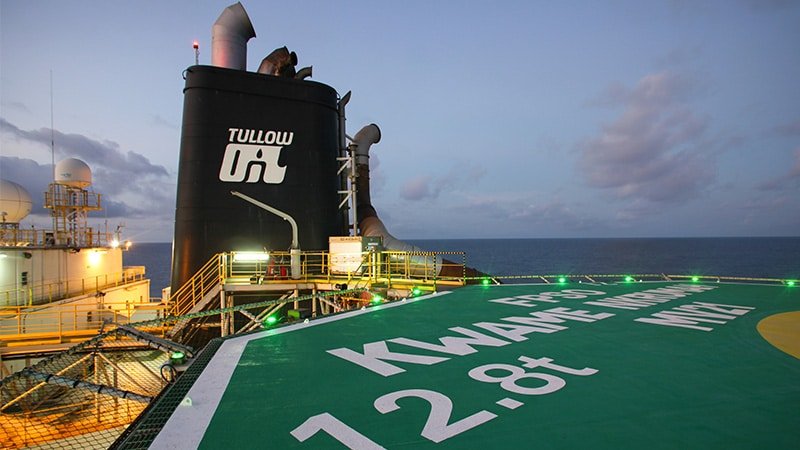
Tullow Oil is placing its biggest bet yet on Ghana’s oil fields. The Irish energy company says the West African nation is the linchpin of its financial recovery and long-term growth strategy.
After years of battling heavy debt and scaling back operations elsewhere in Africa, the London-listed independent is leaning on the reliable output and cost competitiveness of its Jubilee and TEN fields

For Tullow, focusing on these assets will more than help stabilise cash flow and strengthen its balance sheet; it can also help rebuild investor confidence.
The Africa-focussed company has in recent years lost the trust of many investors who once took pride in their early days in West Africa.
The company and other partners in 2007 drilled Ghana’s first commercial oil well at Jubilee field. By the following year, it had become the operator of the field that would lead Ghana to achieve its first oil in late 2010.
Many years later, Tullow’s operated producing fields in Ghana have witnessed a decline in output.
However, the company hopes to turn the page by maximising returns from these assets through strategic investments and renewed focus on operational efficiency.
“In the year ahead, our priorities are to progress our refinancing plan” and “optimize our production activities at Jubilee and TEN”, Tullow said in a statement in March.
Tullow’s debt trap and rescue strategy
Tullow Oil has grappled with a mounting debt burden that has shaped its strategic direction and operational decisions for over a decade.
By the end of 2016, debt had surged to $4.8 billion, the result of years of aggressive exploration and asset acquisitions across Africa.
When oil prices slumped, this leverage left the company exposed to severe refinancing risks and rising cost pressures.
In response, Tullow pivoted to consolidation, selling non-core assets and raising around $700 million from divestments in Uganda, Equatorial Guinea, and Gabon, while also putting its Kenyan portfolio up for sale.
These moves have gradually placed the company’s debt on a downward trajectory.
By the end of 2023, net debt had fallen to $1.6 billion from $1.86 billion in 2022, supported by production gains, tighter cost controls, and asset disposal proceeds.
Even though the company recorded a $110 million loss in 2023 due to significant impairments (mainly from Ghana’s TEN field), it still generated $170 million in free cash flow that aided debt repayment.
The momentum continued into 2024, with net debt reduced to $1.45 billion and liquidity headroom maintained at about $715 million.
However, as of the first half of 2025, net debt edged back up to around $1.6 billion, with a smaller liquidity buffer of $200 million.
Moreover, former CEO Rahul Dhir played a pivotal role in the debt-reduction drive, cutting net debt from a peak of $2.4 billion in 2020 to about $1.6 billion by early 2024.
Following board pressure and criticism, Dhir stepped down, passing leadership to CFO Richard Miller.
Tullow said it remains determined to push debt below $1 billion by year-end.
“In the second half of the year, we are focused on refinancing our capital structure, production optimization activities and continuing to manage our cost base,” Miller said.
Tullow’s divestment spree
Over the past six years, Tullow Oil has embarked on an aggressive divestment programme, offloading several non-core assets across Africa as part of a broader refinancing strategy to strengthen its capital base.
The company has exited operations in Kenya, Uganda, and Gabon:
- Kenya: Tullow sold its assets to Gulf Energy in a $120 million deal, structured in three equal installments of $40 million each. The final payment will be made over five years, starting in Q3 2028.
- Gabon: In July 2025, the company sold its entire portfolio for $307 million.
- Uganda: In 2020, Tullow exited the Lake Albert project, selling its stake to TotalEnergies for $575 million.
Before these African exits, Tullow had already decommissioned its UK North Sea assets, ceasing production in 2018.
A full decommissioning programme is underway and expected to conclude by 2028.
Despite its pullback from certain regions, Tullow has retained exploration and appraisal interests elsewhere.
In Argentina, the company holds licences for three blocks in the Malvinas West Basin.
This includes an operated 40% stake in Areas 114 and 119, and a 100% stake in Area 122, formally ratified in October 2019.
Tullow also maintains non-operated stakes in Côte d’Ivoire.
The Ivorian assets include two exploration licences, which it views as low-risk projects with the potential for rapid commercialisation, high returns, and quick payback.
Why Ghana is Tullow’s last bet
Ghana sits at the heart of Tullow Oil’s global strategy.
The country’s operations account for more than 80% of Tullow’s worldwide output and revenue, underscoring its role as the company’s most critical market.
In 2022 alone, Ghana contributed over 85% of Tullow’s revenue; approximately $1.78 billion.
Since entering the market in 2010, Tullow and its partners have invested close to $19 billion in Ghana, generating about $6 billion in revenue for the government.
A recent milestone was the Jubilee South-East project, which boosted the Jubilee field’s production capacity from 70,000 to 100,000 barrels per day in 2024, again proving the company’s operational commitment.
“Over the years, we have contributed significantly to Ghana’s economic growth, supported the communities in which we operate and made dreams come true for many in the country,” said Tullow Ghana Managing Director Wissam Al-Monthiry at the Ghana Stock Exchange.
“We see great potential in our existing assets and, with timely support from key stakeholders, we can deliver even greater benefit to the people of Ghana.”
Beyond oil, Tullow has deeply integrated into Ghana’s socio-economic fabric.
It has awarded $220 million in local contracts and $317 million to joint-venture firms, with Ghanaians making up over 75% of the workforce at Jubilee and TEN. The company aims to push this above 90%.
Tullow is also moving into gas commercialization. According to S&P Global, Jubilee and TEN could hold up to 2 trillion cubic feet (TCF) of gas reserves.
The company has begun harnessing this potential via the Jubilee FPSO, supplying significant daily volumes to Ghana’s Atuabo Gas Processing Plant.
Is Ghana’s regulatory landscape good enough?
Ghana’s oil and gas regulatory framework is widely regarded as one of the most stable, transparent, and investor-friendly in sub-Saharan Africa.
However, despite its generally predictable nature, operators have occasionally raised concerns over tax disputes and delayed VAT refunds that have weighed on operational performance.
Tullow, in particular, has faced several high-profile tax disputes with Ghana’s revenue authorities over the years.
A major breakthrough came in January when the International Chamber of Commerce (ICC) ruled in Tullow’s favour in a $320 million Branch Profit Remittance Tax (BPRT) arbitration case.
The decision eased a significant financial overhang, with Colin Grant, an analyst at Davy, saying:
“Tullow is expected to move this year to refinance a $1.4 billion bond due to mature in May 2026 … the removal of the BPRT contingent liability has improved its ability to do this.”
Following the ruling, Tullow and its partners signed a new agreement in June to extend the West Cape Three Points (WCTP) and Deep Water Tano (DWT) oil licenses until 2040.
The deal could unlock up to 20 new wells and attract as much as $2 billion in additional investment over the licenses’ lifespan.
Still, the risk of fiscal disputes remains.
Tullow is currently embroiled in two unresolved cases with the Ghana Revenue Authority (GRA) involving hundreds of millions of dollars in disputed loan interest deductions dating back to 2010–2020.
A separate $400 million BPRT-related case is also under arbitration.
Another challenge lies in meeting Ghana’s local content requirements.
While these policies strengthen domestic participation in the sector, they can also increase operating costs for international companies like Tullow, despite its strong commitment to local development.
Ghana in Tullow’s operational outlook
Ghana is home to Tullow’s flagship producing assets; the Jubilee and TEN fields. Together, these fields contribute more than 85% of Ghana’s daily oil output.
However, recent operational data indicates that both mature fields are beginning to show signs of decline.
Lower-than-expected production from Jubilee and TEN in 2024 weighed heavily on Tullow’s earnings, leaving annual profit at less than a quarter of analysts’ projections.
Ghana’s oil output has been falling at an average annual rate of 7.4% since 2019, with production from the TEN field peaking in 2018 and forecast to reach its economic limit by 2033.
According to the Public Interest and Accountability Committee (PIAC), national oil production has dropped sharply from 71.44 million barrels in 2019 to 48.25 million barrels in 2024.
Despite these setbacks, Ghana still holds more than 2 billion barrels of oil equivalent in proven reserves.
To tap into this potential, Tullow has launched an ambitious drilling program for 2025.
Two new wells are planned for Jubilee in the second half of the year.
The first, drilled in July using the Noble Venturer drillship, delivered better-than-expected net pay and is already onstream.
“We have recommenced drilling and have successfully completed and brought on stream the first of two planned 2025 production wells at Jubilee, with better than expected net pay during drilling,” said Interim CEO Richard Miller in Tullow’s Half-Year Results.
The second well is expected to be completed before year-end, with four additional wells scheduled for 2026.
The bottom line
It’s no exaggeration to say Ghana’s Jubilee and TEN fields are the backbone of Tullow’s operations.
These two assets generate the bulk of the company’s revenue and underpin its long-term growth strategy.
That significance is echoed in the words of Richard Miller, Tullow’s Interim CEO, who said:
“We have absolute confidence in the Jubilee field to deliver material cash flows and provide the business with optionality for returns and growth, once our net debt target of below $1.0 billion is reached.”
In many ways, Ghana could hold the blueprint for reviving Tullow’s market value, which has plunged from over $18 billion at its peak to under $2 billion today.
Whether that turnaround materializes remains uncertain, especially as the company’s 2025 half-year results have already fallen short of expectations.