- Africa could provide the majority of the world’s new workers within the next 30 years, so quality, equity and accessibility of education on the continent is of importance globally.
- Supporting and developing the teaching profession in Africa is the most important factor, but this must also be combined with new technology.
- More attention and investment in Africa’s education system – and international support from governments, NGOs and other organizations – will help fuel innovation and prosperity around the world.
Within a decade, one in three entrants to the global workforce will be from Africa. Over the next 30 years, the majority of the world’s new workers may well be on the continent. What they learn in the classroom and how they learn it is a vital question of our time.
But Africa’s future success in education is not yet guaranteed. Basic literacy skills have declined in four out of ten African countries over the last three decades. Even as participation grows, children still face low primary education completion rates – about 63%, compared to a worldwide average of 87%. Those rates are worse for girls. Around 50 million children remain out of school across Africa. These challenges are especially acute in sub-Saharan Africa.
There are also not enough teachers or classrooms for a continent where 60% of the population is under 25 years old. Africa needs at least 9 million new classrooms and 9.5 million additional teachers by 2050, according to UNESCO. And that’s only to meet the needs of school-age children and adolescents, it doesn’t address surging demand for higher education.
Progress in two areas could make a significant difference: teacher training and education technology. It would be short-sighted to pursue one without the other, and Africa has immense potential in both domains. Investment in teacher training, alongside measured technology deployment, must be supported by international collaboration, however. How this is achieved really matters.
Supporting Africa’s teachers
As African education curricula, policies, expertise and technology develop, the standards and status of the teaching profession must also rise. We can learn from missteps, including from shortsighted efforts to lower standards through lower pay, standardization and homogenization. A race to the bottom will end in failure.
One important sustainable way to build up capacity is to invest in teacher training and empower teachers with technology, rather than using technology to displace their work. We have to raise quality as we scale-up.
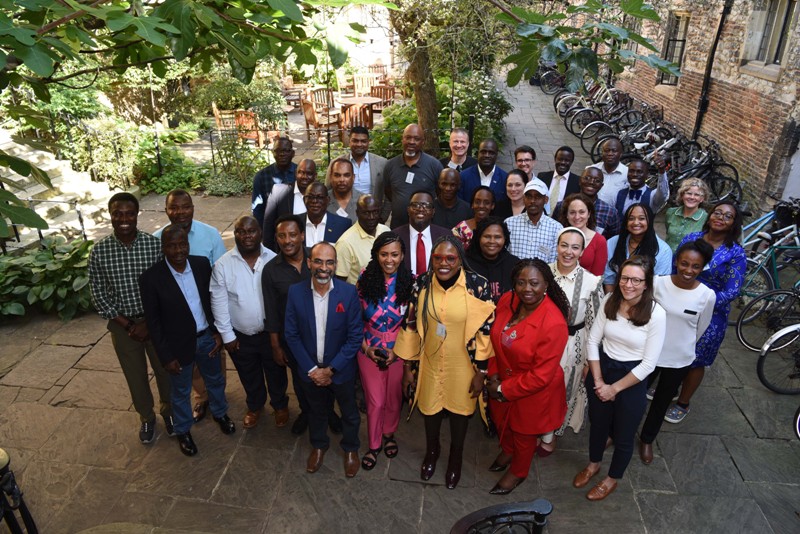
When Bella Rwigamba, the chief digital officer for Rwanda’s Ministry of Education, came to the University of Cambridge for an EdTech Fellowship recently, she epitomized this effort to use technology to raise quality. Her work involves leading digital transformation for around 4,900 schools with 3.9 million students across Rwanda. This collaboration – seeded at Cambridge, but flourishing online – with other African leaders and international academic and curriculum experts is helping nurture digital skills among teachers and students. Her team is raising the bar by developing better and more practical infrastructure and teaching devices for Rwandan classrooms.
Throughout Africa, digital literacy is becoming a core part of curricula and education policies, alongside fundamental literacy. It has to – governments in Botswana, Mauritius and South Africa have all placed digital competency at the heart of their education policies.
Empowering Africa’s teachers
So, when we look for the next wave of innovation in education, the most exciting places may not be Silicon Valley, Shenzhen or even my own highly inventive backyard of Cambridge, England. They may be in Africa.
Indeed, when African teachers are empowered with technology – even relatively simple kit such as laptops and projectors, along with enduring essentials like textbooks – the expansion of networks and sharing of best practice is inspirational.
We saw this when COVID-19 forced the closure of schools in Eswatini, a southern African country, in March 2020. Students needed more than apps to continue their education, even as the national telecoms provider allowed free and subsidised internet access for online teaching. Education leaders also had to address the digital divide in a country where nearly 70% of the population lives below the poverty line. Printing presses were redeployed so exercise booklets could be distributed with newspapers. Lessons were broadcast on TV and radio.
It was a simple, smart and scalable strategy. Most importantly, it worked. Many wealthy nations could learn something from Eswatini’s frugal innovation in the face of adversity. Similarly, when Senegal gave all children high-quality textbooks, it saw significant improvements in early-grade literacy performance.
National plans like these work when they have clearly defined standards, targets and means of monitoring outcomes. Investment in teacher training is also fundamental: raising the status of teachers, providing training and support mechanisms, and opportunities for a community of practice and collaboration. At Cambridge, we have our own experience with communities of practice – we have the largest and most diverse international school community in the world.
International support for education in Africa
International collaboration and investment will be critical in realizing Africa’s potential – the African Union has highlighted this as we enter its Year of Education. So, those of us involved in global education, along with governments, NGOs, philanthropists and investors, need to take education in Africa seriously. We have to think bigger.
In April, the UK Prime Minister, Rishi Sunak, will host 25 heads of state and government at the UK-African Investment Summit 2024. The aim will be to strengthen UK-African partnerships to create jobs and growth, support talent in sectors like finance and technology, and promote women entrepreneurs. All of these objectives rely on quality fundamental education, as well as exploiting technological advances. Education in Africa must be central to this summit.
The world is entering an era where educational progress depends on both the fundamentals and the leading-edge. That’s as true in Boston, Birmingham and Beijing as it is in Benin City and Bangui. The African continent is exciting as a source of new ideas and approaches in education policy and practice. If mass education can catch up with the demographics, the opportunity will become even bigger.
As workforces in other parts of the world age, Africa’s population will remain young and increasingly dynamic. That’s why an investment in education in Africa is an investment in innovation and prosperity for the whole world.
This story was originally sourced from World Economic Forum