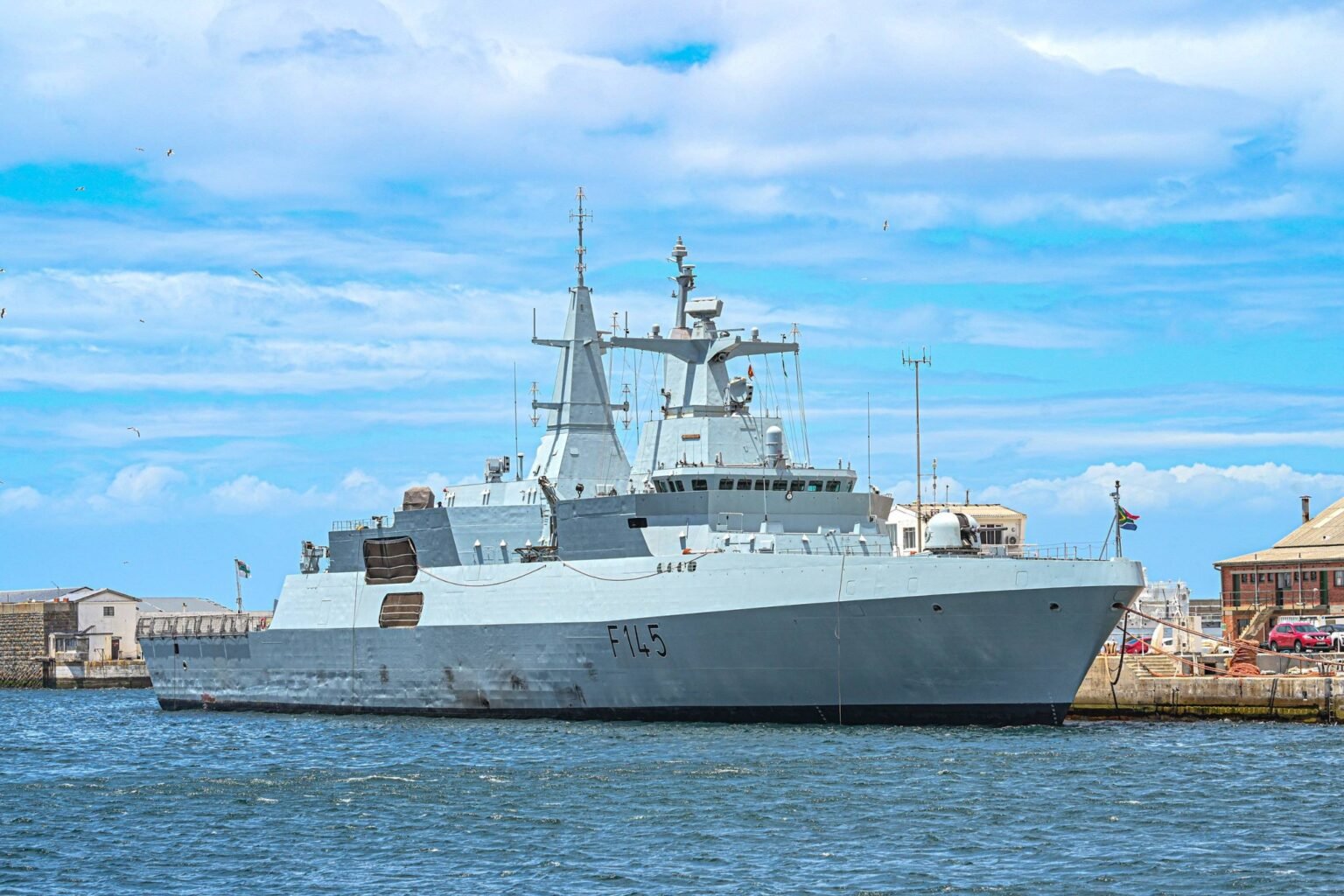

In mid-February I was among a group of 28 international defence journalists invited to India to observe a series of exercises hosted by the country’s armed forces. The first was Exercise Milan, a multinational naval exercise that culminated in the International Fleet Review, where dozens of warships assembled in formation to be reviewed by India’s president, Droupadi Murmu, alongside numerous international delegations.
From the deck of INS Sukanya, an offshore patrol vessel assigned to carry observers, the scale of the event was immediately apparent. Over seventy warships lined up in the waters off Visakhapatnam, their crews standing in ceremonial formation while aircraft passed overhead and naval bands echoed across the harbour. It was a vivid demonstration of contemporary naval diplomacy, part spectacle, part strategy.
Delegations from more than seventy countries were present, with eighteen sending ships to partake. Among the assembled ships was the South African Navy frigate SAS Amatola. In numerical terms her presence was modest. Strategically, it mattered far more than it might appear.
In early 2026 the South African Navy managed something that has become increasingly difficult, it deployed a modern surface combatant across the Indian Ocean, in a single trip, and kept it operational long enough to participate in two significant multinational engagements, the International Fleet Review and Exercise Milan. For a navy operating under persistent financial and maintenance constraints, that achievement should not be overlooked.
The deployment highlighted two realities simultaneously. The first is the fragile condition of South Africa’s naval capability. The second is the continuing importance of naval diplomacy in preserving the country’s strategic relevance at sea.
A navy under pressure
The South African Navy currently operates under sustained institutional pressure. Years of constrained defence spending, delayed maintenance cycles and declining operational tempo have reduced the fleet’s ability to deploy consistently.
Several major platforms have spent extended periods alongside awaiting maintenance or refit funding. Sea time for sailors has declined, and with it the operational exposure required to maintain professional proficiency. The navy retains capable ships and well-trained personnel, but opportunities to employ them at sea have become increasingly limited.
These challenges are not unique to South Africa. Many middle-power navies face similar pressures as defence budgets compete with domestic priorities. What distinguishes effective maritime states is not simply the size of their fleets, but their ability to maintain strategic engagement despite such constraints.
Naval power is not measured only in hull numbers. Presence, partnerships and professional credibility matter just as much.
Why presence still matters
That is why the voyage of Amatola to India carried significance beyond the mechanics of a routine deployment. Her arrival in Visakhapatnam placed South Africa visibly within a global gathering of maritime powers.
Fleet reviews remain steeped in naval tradition. Warships assemble for inspection while dignitaries observe from shore or reviewing vessels. Yet beneath the ceremony lies a practical purpose.
These events bring together naval leaders, operational commanders and crews from dozens of countries. They create a space where relationships can be strengthened, perspectives exchanged and future cooperation quietly arranged.
Walking the quayside in Visakhapatnam, one could see how these interactions unfold. Officers move easily between ships, conversations continue long after formal sessions conclude and professional networks expand almost organically. Naval diplomacy rarely produces dramatic headlines. Its value lies in the relationships it builds over time.
For South Africa, the symbolism of Amatola’s presence was therefore significant. At a time when domestic discussion often focuses on the navy’s operational and financial constraints, the ability to send a frigate across the Indian Ocean demonstrated that the service retains a measure of operational credibility.
Naval diplomacy as strategy
Naval diplomacy has long been one of the most flexible instruments of defence engagement. Warships operate in the international commons and can visit foreign ports without the political sensitivities associated with permanent land deployments.
For middle powers this flexibility is invaluable. South Africa sits at the intersection of the Atlantic and Indian oceans, overlooking the Cape sea route through which a substantial portion of global maritime trade passes.
Maintaining engagement in the wider Indian Ocean security environment is therefore not optional. It is a strategic necessity. Even limited naval deployments reinforce South Africa’s position as a maritime stakeholder while sustaining professional relationships with partner navies. Each exercise, port visit and leadership meeting contributes to a network of cooperation that becomes essential when maritime crises arise.
The diplomatic dimension of the deployment extended well beyond the ship itself. Vice Admiral Monde Lobese, chief of the South African Navy, travelled to India to meet counterparts from across the region.
Speaking during the visit, Lobese expressed appreciation for the scale and organisation of the event. “I would like to take this opportunity to thank the Indian Navy for hosting us for this exercise,” he said. “I’m very excited to be here in India. It’s a first time for me to witness the international fleet review. It’s been a wonderful experience and exposure for the South African Navy and for the entire Global South.”
He described the exercise as “well hosted, well organised”, noting that the participation of so many countries illustrated the unifying role of the maritime domain. “Among the number of nations participating here, it shows that the sea is actually a uniting force,” he observed. “The Indian Ocean, to be specific, is a bridge that unites all nations.”
Lobese also highlighted the broader purpose of such engagements. “We are here to build friendship and make sure that we defend and protect the interest of all nations that trade through the Indian Ocean,” he said.
Among the gatherings he attended was the Conclave of Chiefs of the Indian Ocean Naval Symposium, which brought together naval leadership from across the Indian Ocean region. The forum addresses practical challenges facing maritime forces, including maritime domain awareness, disaster response and the fight against non-traditional threats such as piracy, trafficking and illegal fishing.
South Africa’s Defence Attaché in India, Brigadier General Kevin Moonsamy, congratulated the Indian Navy on what he described as the “outstanding and undisputed success” of Milan and IFR-26, he noted that the exercises demonstrated the service’s “exceptionally high professional standards in all its facets”.
Moonsamy also highlighted the broader coordination behind the event, praising the “remarkable joint effort” of Indian government institutions, including the ministries of defence, home affairs and tourism, alongside the Indian Air Force and Coast Guard. The organisation of such a large international gathering, he said, reflected a “whole-of-nation approach” and “impressive national coordination capacity”.
From ceremony to operations
While senior officers met ashore, SAS Amatola moved from ceremony to operations. After the fleet review the frigate joined Exercise Milan 2026, a multinational naval exercise hosted by the Indian Navy.
Milan has grown steadily in scope and participation over the years, drawing navies from across the Indian Ocean and the broader Indo-Pacific. The programme combines harbour discussions with manoeuvres at sea designed to improve interoperability between participating fleets.
Amatola took part in the sea phase of the exercise, conducting manoeuvres and communications drills alongside warships from several countries. For the South African crew the experience offered valuable operational exposure.
With limited opportunities for extended deployments at home, multinational exercises provide rare chances for sailors to practise complex manoeuvres and observe how other navies approach similar tasks. They also strengthen the informal professional relationships between officers that often prove critical when real maritime incidents occur.
Beyond exercises and port visits, cooperation between the South African and Indian navies increasingly includes technical collaboration.
South African submariners and naval technicians have attended courses at Indian naval training establishments in areas such as submarine operations, engineering support and underwater safety. India’s investment in naval training infrastructure has created facilities that partner navies can use to develop specialised expertise.
One of the most significant developments has been cooperation in submarine rescue. In September 2024 the two navies signed a Submarine Rescue and Cooperation Implementation Agreement allowing the Indian Navy to assist South African submarines in distress.
Under the arrangement India can deploy its Deep Submergence Rescue Vehicles, specialised systems capable of operating at depths of roughly 650 metres. These vehicles can be transported rapidly by air or deployed from support vessels to reach a disabled submarine.
Implementation of the agreement has already begun. In 2025 an Indian Navy team conducted a rescue-seat certification for the South African submarine SAS Manthatisi in Simon’s Town, ensuring compatibility between the submarine’s escape interface and the Indian rescue system. It marked the first time India had conducted such certification for a foreign navy.
During the harbour phase of Exercise Milan 2026 the Indian Navy also demonstrated its submarine rescue capability to visiting delegations, illustrating the operational readiness of the system and the potential for cooperative response in the event of a submarine emergency.
Technical cooperation of this kind rarely attracts the attention given to multinational manoeuvres or fleet reviews. Yet it often represents the most substantive form of defence partnership.
Remaining relevant at sea
The voyage of SAS Amatola illustrates a broader lesson in maritime strategy. Even a navy facing financial constraints can retain strategic relevance if it remains engaged internationally. South Africa’s naval challenges are real. Sustaining the existing fleet will require long-term investment in maintenance, logistics and training. Without it operational capacity will continue to erode.
Yet diplomacy at sea offers a means of preserving strategic visibility while those structural problems are addressed.
The current deployment, first to India, then off to China, Singapore, Malaysia, Kenya and Tanzania, represents more than a routine operational task. It demonstrates how a constrained fleet can still contribute to regional maritime security through active diplomacy and professional engagement.
In the vast expanse of the Indian Ocean, such engagement remains an important instrument of national influence.
Written by Ricardo Teixeira for The Daily Friend and republished with permission. The original article can be found here.