


In the world of investing, the pursuit of alpha—the risk-adjusted excess return on an investment relative to a benchmark index—has long been the holy grail for financial advisors and portfolio managers. However, in today’s rapidly evolving financial landscape, generating consistent alpha has become increasingly challenging. Financial advisors are navigating a confluence of factors, including heightened market efficiency, macroeconomic uncertainty, high market concentration, and the growing influence of technology. This article explores the difficulties of generating alpha in the current investment environment and offers insights into how financial advisors can adapt to these challenges.
The Elusive Nature of Alpha
Alpha, by definition, represents the risk-adjusted added value an active manager adds to a portfolio above and beyond the passive benchmark. It is a measure of skill, insight, and strategy. However, the pursuit of alpha is inherently difficult because markets have become more efficient. The more efficient a market becomes, the harder it is to identify mispriced assets or exploit inefficiencies.
The recent difficulty in generating alpha is evidenced by the below graph, which is sourced by Zephyr. Figure 1 shows that the number of U.S. large growth mutual funds producing positive alpha since 2019 has shrunk. In fact, only 5% of U.S. large growth mutual funds produced positive alpha during the past six years. It’s also easy to see that the number of U.S. large growth mutual funds who have produced negative alpha has spiked.
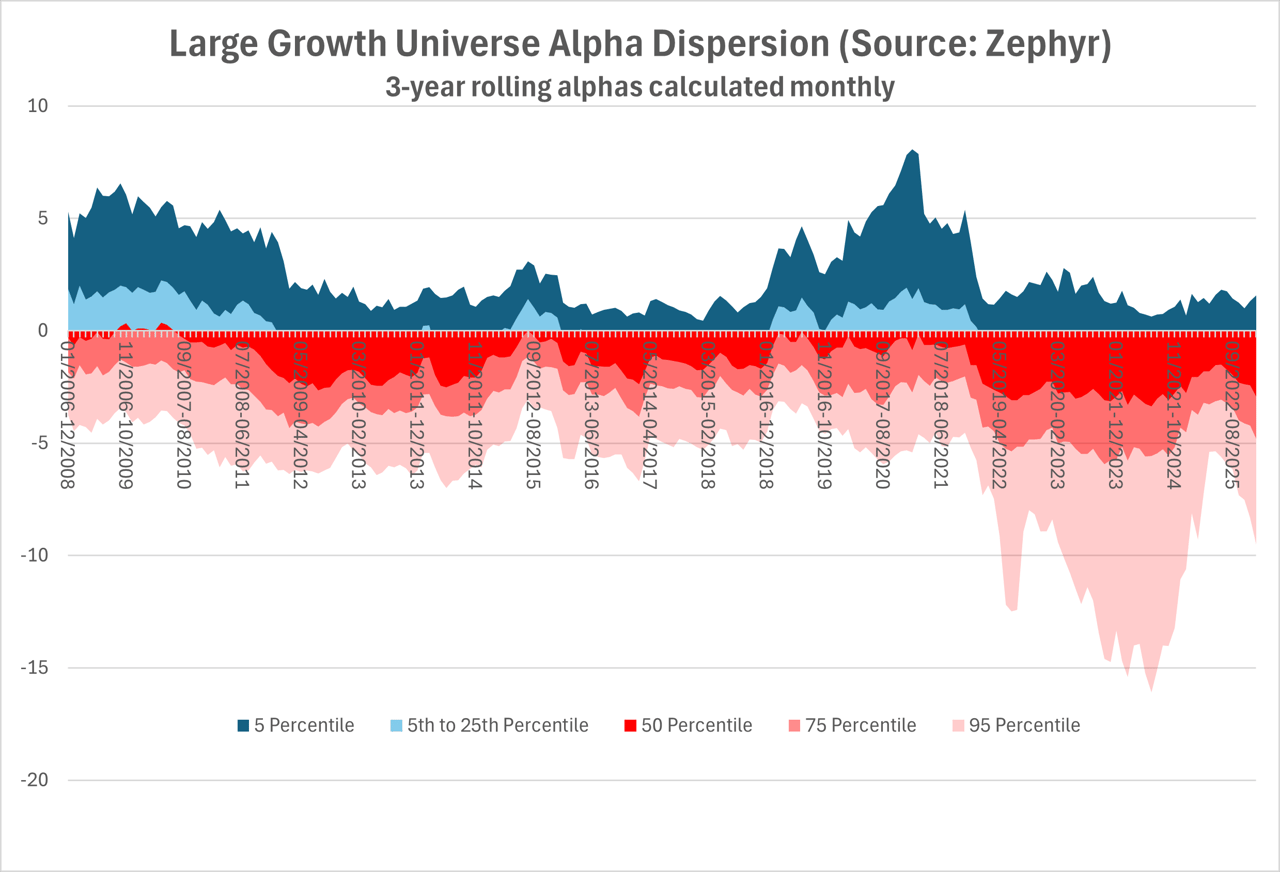
Figure 1: Source – Zephyr

To learn more about alpha and other investment analytics, check out Zephyr’s StatFACTS.
In today’s environment, the quest for alpha is further complicated by several factors:
-
Highly Concentration: The top ten holdings of the S&P 500 index, which are made up of primarily technology names, make up 40% of the index, which smashes the Dot-Com record of 29%. So, what does the high concentration mean for advisors looking for alpha generating investments? When a small number of companies or sectors dominate the market, the breadth of opportunities for active managers to generate alpha diminishes. In a highly concentrated market:
-
Benchmark Dependence: Indices become heavily weighted toward a few dominant stocks or sectors. This makes it difficult for active managers to outperform benchmarks without taking significant positions in these dominant stocks.
-
Limited Diversification: High concentration reduces the diversity of investment opportunities, as a large portion of market returns is driven by a handful of companies. This limits the ability of active managers to find mispriced assets in less-followed areas of the market.
-
-
Market Efficiency: Advances in technology, the proliferation of data, and the rise of algorithmic trading have made markets more efficient than ever. Information is disseminated almost instantaneously, leaving little room for traditional active managers to gain an informational edge.
-
Fee Compression: Investors are increasingly aware of the cost of active management and are demanding lower fees. This puts pressure on financial advisors and portfolio managers to deliver alpha while operating within tighter cost constraints.
-
The Rise of Passive Investing: The shift from active to passive investing has been one of the most significant trends in the financial industry over the past two decades. While this trend has benefited investors by reducing costs and improving transparency, it has also made it harder for active managers to generate alpha.
-
Crowded Trades: As more investors flock to passive strategies, certain sectors and stocks become crowded, leading to inflated valuations. This can create challenges for active managers who are trying to identify undervalued opportunities.
-
Market Dynamics: The dominance of passive investing can also exacerbate market volatility during periods of stress, as index-based strategies may lead to indiscriminate buying or selling of securities.
-
-
Technological Disruption: Technology has transformed the investment landscape, creating both opportunities and challenges for financial advisors. On one hand, advancements in data analytics, artificial intelligence (AI), and machine learning have enabled more sophisticated investment strategies. On the other hand, these same technologies have leveled the playing field, making it harder for any single manager to maintain a competitive edge.
Strategies for Financial Advisors to Overcome These Challenges
Despite the difficulties, financial advisors can take proactive steps to navigate today’s investment environment and enhance their ability to generate alpha. Here are some strategies to consider:
-
Embrace Technology: Rather than viewing technology as a threat, financial advisors should leverage it to their advantage. Tools such as AI-driven analytics, portfolio optimization software, and risk management platforms can help advisors identify opportunities, manage risks, and improve efficiency.
-
Diversify Beyond Traditional Asset Classes: In a world where correlations between traditional equity and fixed-income markets are increasing, diversification is more important than ever. Financial advisors should consider incorporating alternative asset classes, such as private equity, real estate, infrastructure, and commodities, into client portfolios to enhance portfolio diversification and reduce overall risk. Furthermore, alternative investments like real estate and commodities can serve as effective hedges against inflation, providing a source of alpha in a rising-rate environment.
-
Adopt a Multi-Factor Approach: Single-factor strategies, such as focusing solely on value or growth, may no longer be sufficient in today’s complex market environment. A multi-factor approach that combines factors such as value, momentum, quality, and low volatility can improve the likelihood of generating alpha.
-
Prioritize Client-Centric Solutions: Ultimately, the success of a financial advisor depends on their ability to meet the unique needs of their clients. By prioritizing client-centric solutions, advisors can build trust, strengthen relationships, and deliver value beyond investment performance.
-
Personalization: Tailor investment strategies to align with clients’ individual goals, risk tolerance, and time horizons.
-
Transparency: Provide clear and transparent communication about fees, performance, and the rationale behind investment decisions.
-
-
Opportunities in Underfollowed Areas: While high market concentration creates challenges, it also presents opportunities for active managers who are willing to look beyond the dominant stocks:
-
Small- and Mid-Cap Stocks: In a concentrated market, smaller companies often receive less attention from investors and analysts. This can create opportunities for active managers to uncover mispriced assets and generate alpha in less-followed areas of the market.
-
Sector Rotation: Active managers can capitalize on sector rotation by identifying undervalued sectors that are poised for a rebound. This requires a deep understanding of macroeconomic trends and sector-specific dynamics.
-
Contrarian Strategies: High market concentration often leads to crowded trades in the dominant stocks. Active managers who take a contrarian approach and invest in overlooked or out-of-favor areas of the market may be able to generate alpha by going against the consensus.
-
Conclusion
The pursuit of alpha has always been a challenging endeavor, but today’s investment environment presents an unprecedented set of obstacles. From macroeconomic uncertainty and the rise of passive investing to technological disruption and regulatory pressures, financial advisors must navigate a complex and rapidly changing landscape.
While the challenges are significant, they are not insurmountable. By embracing technology, focusing on behavioral coaching, diversifying portfolios, adopting multi-factor strategies, and prioritizing client-centric solutions, financial advisors can position themselves for success in the quest for alpha. In doing so, they can not only deliver value to their clients but also differentiate themselves in an increasingly competitive industry.
Zephyr, is an award-winning asset and wealth management software that offers portfolio construction, proposal generation, advanced analytics, asset allocation, manager screening, risk analysis, portfolio performance and more, transforming multifaceted data into digestible intel.


