

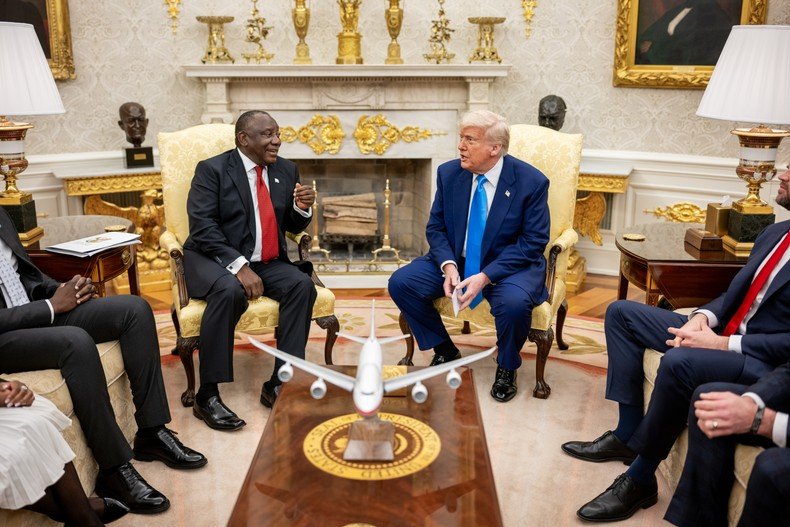
The U.S. president has been very consistent and proactive in aiding farmers of European descent in South Africa, considered disenfranchised and classified as refugees.
This came to light after President Trump and Elon Musk publicly criticized South Africa’s land reform laws, which they branded as racist.
As a result, Trump imposed strict sanctions against the South African government following the introduction of what he considered unfair laws.
Later in October, Donald Trump announced a drastic reduction in refugee admissions, cutting the annual cap from 125,000 to just 7,500 while giving priority to white South Africans.
Given these recent moves, Mercury Public Affairs LLC, a US lobbying group with connections to Trump, has pledged to advocate for the farmers before American officials without charging a fee, according to a previously undisclosed Foreign Agents Registration Act statement filed last month.
Mercury is taking on the job of convincing the US government to support Zimbabwe’s debt clearance process and the creation of new financial arrangements that could “generate the funds necessary to satisfy” the duties of the government to reimburse farmers, according to the letter.
Dror Besserglik, managing director of Johannesburg-based OB Projects Management, described the extent of Mercury’s engagement in a letter dated December 2 that was part of the FARA filing, as seen on Bloomberg.
“The services you will provide include contacting appropriate officials in the current administration and Congress to promote paying the Zimbabwean farmers,” Besserglik relayed.
Mercury Public Affairs LLC has represented the Zimbabwean government in Washington from 2019 to 2021, during which the country reportedly paid a monthly retainer of US$90,000 to campaign against US sanctions.
Zimbabwe’s recent history with white farmers
In May 2024, around 1,300 Zimbabwean farmers in the Southern African country, whose land was seized in the early 2000s, were promised compensation.
“We now have to go through the process of vetting them and confirming the amounts that they are owed,” Andrew Bvumbe, head of debt management in the Ministry of Finance, said in an interview at the time.
“With these 1,300, we want to move as quickly as possible. Maybe by the end of the third quarter of this year, we want to get this out of the way,” he added.
The Zimbabwean government, under Emmerson Mnangagwa, pledged to compensate 4,000 White farmers whose land was taken by state-backed militants under a 2020 agreement, but it has consistently missed payment deadlines.
Late Zimbabwean president, Robert Mugabe, started the Fast-Track Land Reform Program (FTLRP) in 2000, intending to seize commercial farms owned by whites.
State-backed militias frequently used force or intimidation to seize land.
Approximately 4,000 commercial farms were impacted, significantly lowering Zimbabwe’s commercial agricultural output.
Following Mugabe’s removal in 2017, the Mnangagwa administration was under pressure to resolve longstanding land conflicts.
In 2020, the Zimbabwean government agreed to pay 4,000 white farmers, committing $3.5 billion over ten years.
Payment delays were common due to economic restrictions and debt pressures.


