

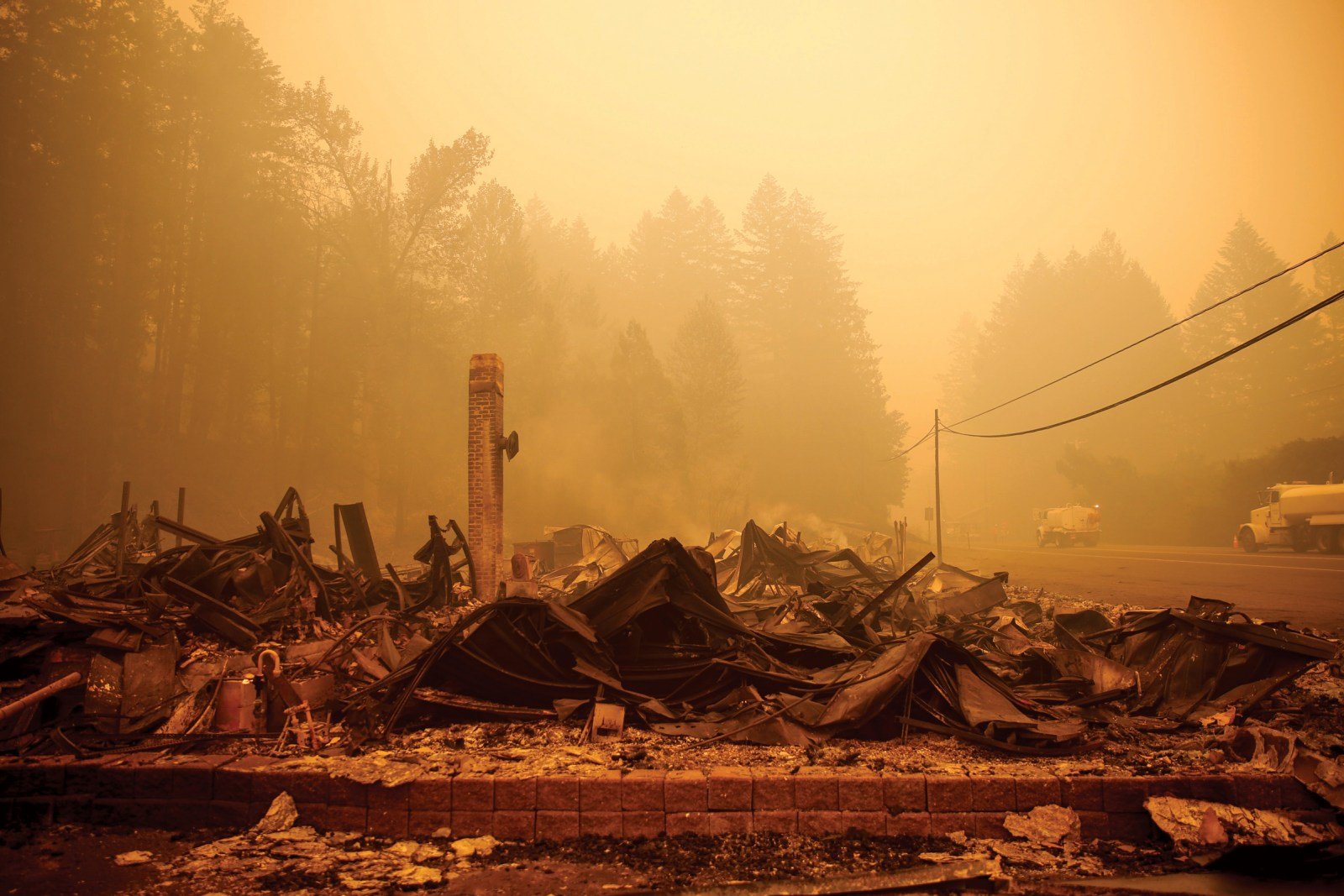
When the Santiam Fire ripped through Gates, Oregon, on Labor Day 2020, Sam Drevo escaped with his life, his puppy, Eddy, and not much else. The house he and his mother lived in, a triplex and the restored historic building that housed his kayak school and rafting business all burned to the ground. Drevo, a photographer and river guide, lost 15,000 slides representing decades of work; his mother, a weaver, lost all her looms and textiles. Facing that much loss after fleeing flames just a quarter mile away was traumatic.
As rumors spread throughout the neighborhood that the fire was sparked by downed power lines, Drevo wanted to know what caused the destruction, and who was responsible. So he joined a class action lawsuit against the utility company PacifiCorp.
The Santiam Fire was, in fact, started by active power lines that hot and windy weekend, and a jury found the utility fully responsible. That fire and several others — likely also started by the utility but still in pending litigation — killed 11 people and burned almost 2,000 square miles, destroying more than 5,000 homes and other structures. Juries have since found PacifiCorp liable for billions of dollars in damages. Altogether, the plaintiffs in Drevo’s lawsuit won more than $73 million — between $3 million and $5.5 million each for physical damages and emotional distress. The U.S. government is also threatening to sue PacifiCorp for almost $1 billion in damages, plus firefighting and cleanup costs, and dozens of local wineries and vineyards whose grapes were damaged by smoke are suing for over $100 million. The company’s mandatory commercial insurance policy has increased by $96 million.
The Santiam Fire and several others killed 11 people and burned almost 2,000 square miles, destroying more than 5,000 homes and other structures.
In the face of mounting expenses, PacifiCorp and its divisions Rocky Mountain Power (Wyoming, Idaho, Utah) and Pacific Power (Washington, Oregon, California) are looking for ways to reduce future wildfire costs and liabilities. Recently passed legislation in Utah will enable one utility company, PacifiCorp division Rocky Mountain Power, to create a “fire fund” — paid for by its customers — that covers claims above and beyond what the utility’s insurance covers. In several other states, PacifiCorp is trying other ways to reduce its liability, but failing.
Drevo believes that PacifiCorp is trying to evade the consequences of its own negligence. “Shirking responsibility is not an answer when their actions kill people and devastated lives,” he said.

COMPANIES CAN DO A LOT to lessen the chance of starting a wildfire. They can minimize vegetation under and near power lines, or bury power lines underground. They can also preemptively shut off power during high winds. But Utah’s new law allowing PacifiCorp division Rocky Mountain Power to raise customer rates for a “fire fund” has spurred concerns that the utility will no longer have incentives to complete this kind of risk-reducing work.


New rates, including the surcharge for the fire fund, must first be approved by Utah’s public utility commission. If approved, Rocky Mountain Power, the largest utility in the state, could collect customer surcharges over 10 years, totaling up to $1 billion.
Utah is not the only state with such a fund; California also has one, which consumers and three utilities pay into. Utah’s new bill, like California’s, places stipulations on using the fund’s money to pay out claims: The utility will have to pay out millions as a deductible prior to accessing the fund, and companies are required to have wildfire management plans. But unlike California, Utah allows the company to use fire funds even if it’s found negligent in starting or contributing to a fire. “That’s a counter-incentive for Rocky Mountain Power or PacifiCorp to maintain wildfire safety, because they’re not on the hook if they’re found negligent,” said Lindsay Beebe, a state lobbying and advocacy representative with the Sierra Club in Salt Lake City. State consumer advocates for residential and small commercial customers take issue with the company avoiding responsibility. “Customers should pay for the costs incurred in electric service,” said Michele Beck, director of Utah’s Office of Consumer Services. “But customers should not have to pay for gross negligence or poor management.”
PacifiCorp spokesperson Jona Whitesides told HCN that the company would not be able to access the fund if it is found in noncompliance with its own wildfire management plan. Whitesides also spoke of the increasing costs of providing electricity.
The new legislation also, for the first time, puts a limit on the amount of certain damages Utahns can recover from the utility. Under the bill, parties who sustained physical injury can ask for a maximum of $450,000 in “non-economic damages,” including emotional distress, but parties with no physical injury will be limited to $100,000 in non-economic damages.
Utah’s legislation could provide a blueprint for other Western states, where utility companies are already being ordered to open their wallets for wildfires. Costs from the deadly Camp Fire and other California wildfires caused Pacific Gas & Electric to file for bankruptcy in 2019. Xcel Energy is looking at massive liability for the 2021 Marshall Fire in Colorado, and Hawaiian Electric is facing at least a dozen lawsuits over the 2023 Maui wildfire that killed 101 people. These utilities largely burn fossil fuels, which contribute to climate change, which, in turn, increases wildfire frequency and severity. Now, at least in Rocky Mountain Power’s case, they’re asking their customers to pay for the consequences. “This is really climate inaction coming home to roost,” said Rose Monahan, a staff attorney at the Sierra Club.
“Customers should pay for the costs incurred in electric service. But customers should not have to pay for gross negligence or poor management.”
PACIFICORP IS ALSO SEEKING to limit what it can be held accountable for in other states. Proposed liability waivers, filed with the Wyoming, Washington, Oregon, California and Idaho public utility commissions in October, would, if approved, drastically reduce the type and scope of liabilities the company is responsible for.
When survivors file suit, most claim compensation for “actual” damages — legalese for direct monetary damage, such as a burned-down home, resulting from a company’s actions. They can also pursue compensation for indirect damages like lost wages, non-economic damages like emotional distress, and punitive damages. But these waivers would allow only wildfire victims who are also PacifiCorp customers to recover costs, and only from “actual” damages.
PacifiCorp would be able to dodge hundreds of millions of dollars of potential payouts. According to a brief submitted to the Oregon Public Utilities Commission by PacifiCorp, payments for indirect and non-economic damages can vastly exceed the costs of “actual” damage by tenfold or more. A jury in the Labor Day fires case ordered the company to pay $62 million to nine plaintiffs; only $6.3 million of this was for “actual” damages.
As of early June, some state commissions have rejected the requests. Idaho’s Public Utilities Commission staff determined the waivers were neither in the public interest nor enforceable under Idaho law. Oregon’s Public Utilities Commission turned down PacifiCorp’s proposal as well, writing, in its response, that “Oregon needs to find appropriate policy and regulatory solutions to the serious problems wildfire liability creates for … all utilities and their customers.”
Meanwhile, survivors of the 2020 Labor Day wildfires are not pleased with PacifiCorp’s proposed changes. “It’s super unfortunate that they are now wielding their power to try to further limit their responsibility when it comes to keeping communities safe,” Drevo said. “They’re basically saying that people don’t matter; the only thing that matters is what burns.”
We welcome reader letters. Email High Country News at editor@hcn.org or submit a letter to the editor. See our letters to the editor policy.
This article appeared in the July 2024 print edition of the magazine with the headline “Electric utilities don’t want to get burned.”



