

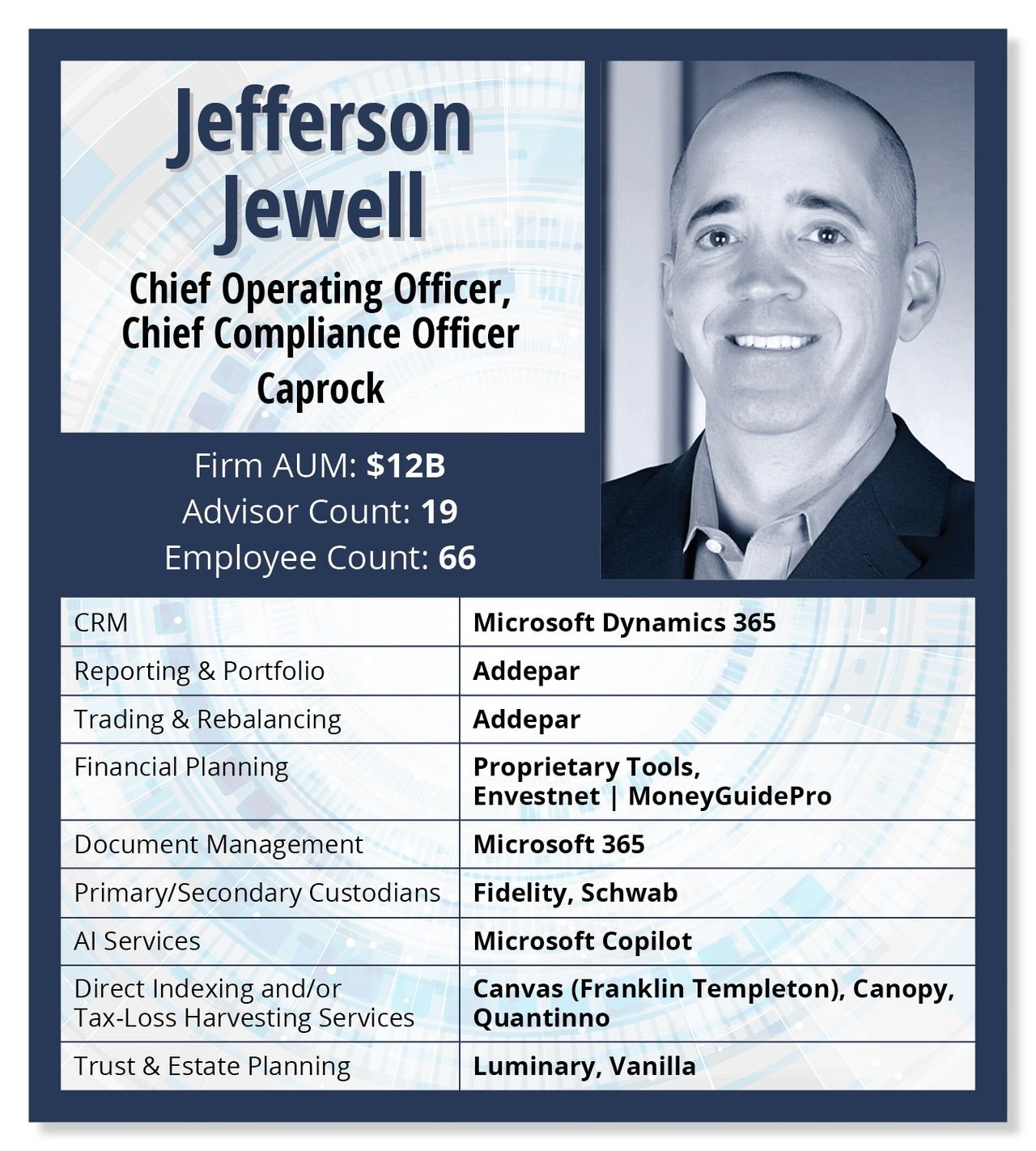
The most important thing about how we think about our technology stack is that we orient toward the advisor. It’s true that the person whose capital we are managing is the client, but the primary audience and most important user in my world is the advisor. They are part of why the client is here, and they are the force multiplier for the business.
We need to help create leverage for those advisors so that they can do what they do best for the client. There aren’t many people on earth who can stand in front of a family with $100 million in assets and get them to trust them with all of it. We’re making sure those people can spend as much time doing that work to give the best advice they can while feeling great about the tools they are using to do it.
CRM: Microsoft Dynamics 365
We use Microsoft Dynamics because it syncs with all our systems. We use it to help manage new business development, but have evolved our thinking when it comes to CRM.
In the past, a CRM used to be a lot more about the client record, name, birth dates, mailing address and all that. Then it became a tool for marketing automation, meeting notes and document storage. When it came to working with the client, the CRM was always an extra step: after a meeting, you had to stop and enter notes so they could be appended to the record.
Now, these features and functions are being used by various AI tools and agents. Instead of putting data into the CRM, it’s more automated. Because of AI, our entire Microsoft 365 tenant replaces a dedicated CRM system. It’s scraping Outlook, Teams messages, emails, meeting transcripts and client documents. It interacts with our Office 365 tools to gather all information about the client relationship, and then AI surfaces the next best steps or tasks for the advisor to evaluate.
Reporting & Portfolio Management: Addepar
Addepar is still very much the category leader. That’s particularly true for alternatives and private investing.
It’s not inexpensive. And I’m a little surprised they have not built in some simple commodity functionality, such as a document library or vault for client documents. When it comes to alternative investments data management, Addepar is also expensive. But when you look at some of the other platforms in that category, the pricing model consistently makes it difficult for a multi-family office because they charge per position rather than per fund. Platforms like Canoe, Arch and others assume you are working as a single-family office. Though I do think with the help of AI, that it will get sorted out over time and they’ll evolve their pricing to where it makes more sense.
Trading & Rebalancing: Addepar
It’s still relatively early in the product life for trading and rebalancing with Addepar, but things are going well so far, and it means one less provider for us, and the integration is valuable.
Financial Planning: Proprietary Tools, Envestnet | MoneyGuidePro
We have built our own financial planning tools and have had various iterations over time. We also give advisors the option to use MoneyGuidePro. We’ve been trying to move away from our own proprietary tools, but most of what’s in this category is focused on retirement planning, which is not our primary use case.
We’ve looked at other options, but it’s just not the right fit yet. The Venn diagram is just a bit off for us in terms of the functions we need. Some parts we really like, and some just aren’t a fit. The biggest thing for us tends to be serving the UHNW clients with their life events. That’s not necessarily about saving for retirement, but more about managing 25% to 30% of the portfolio being in private investments. There are unique business logistics you need for that, especially around liquidity management, that are not built into those [other] financial planning tools.
Document Management: Microsoft 365
Copilot continues to evolve and help us leverage what we have in our Microsoft environment.
Primary/Secondary Custodians: Fidelity, Schwab
We are not pleased by recent changes that Fidelity made when it comes to long-short SMA strategies. Fortunately, we have options.
.jpg?width=1280&auto=webp&quality=80&disable=upscale "jefferson-jewell-card_(1).jpg")
AI Services: Microsoft Copilot
We are using Copilot because it fits with our system. But we are very interested in Anthropic/Claude and their financial services offering, and what they are doing there. We’re also interested in the note-taking category. We love the functionality of Jump, Firefly and those other notetakers. But the gap between what already exists and what Microsoft is offering seems small, particularly as Microsoft is constantly rolling out new functionality. This is also a highly regulated industry, so we want to be comfortable about where the data is going to live. We are reluctant to add a new platform and a new place where data lives.
Direct Indexing and/or Tax-loss harvesting services: Canvas, Canopy, Quantinno
We’ve been using Quantinno for a little over two years, and it’s incredibly useful. The biggest obstacle is how it interacts with our custodians to build the portfolio. Caprock was an early adopter in this category and we were disappointed when Fidelity changed its policy. The tools are great and unlock useful strategies we continue to use for Caprock clients. We’re just doing it elsewhere.
Trust & Estate Planning: Luminary, Vanilla
We are using estate planning more and more with overall financial planning. The next layer for each client is not just what you own and the performance, but how you own it. Understanding the relationship (what is in the portfolio and what is in the trust, or the marital trust, and how to think about gifting) is critical. We love Luminary and so do our clients. The lines are starting to blur between what an estate planning tool is versus a financial planning tool.
As told to senior reporter Alex Ortolani and edited for length and clarity. The views and opinions are not representative of the views of Wealth Management.
Want to tell us what’s in your wealthstack? Contact Alex Ortolani at [email protected].


