


Welcome to Foreign Policy’s Africa Brief.
The highlights this week: Africa braces for the economic and political ripple effects of the war on Iran, newly released files show that Jeffrey Epstein had ties with African political elites, and a U.S.-Zimbabwe health deal crumbles.
As the U.S.-Israeli war on Iran escalates, Africa is bracing for the ripple effects of a wide-ranging regional conflict.
Analysts are paying particular attention to the Sahel, where Iran has positioned itself as a security partner to junta-led nations including Burkina Faso, Mali, and Niger in their fight against jihadist groups.
The current conflict, however, is likely to distract Western attention away from the Sahel, where the United States recently resumed counterterrorism support, and force Tehran to prioritize retaining its weaponry for domestic survival. This may lead to an uptick in Islamist violence in the region, as well as Sahelian states increasingly turning to Russia or Turkey for drones and other military equipment.
“There’s also potential for Iranian-supported groups to carry out violence against Israeli, American, or allied persons and assets,” said Ladd Serwat, a senior analyst for Africa at the Armed Conflict Location and Event Data Project. “Most likely are going to be Egypt, Djibouti, and Somalia,” where Iran has ties to the al-Shabab terrorist group.
The possible activation of Iranian networks or a spillover of conflict in the Middle East could worsen internal security challenges throughout Africa. Even before the war, Chadian security officials said last December that they dismantled two criminal networks linked to Iran.
“Iran’s ‘axis of resistance’ is facing its most serious test, and for African countries with significant Shia minorities, including Nigeria, the risk of proxy activity increases as Tehran seeks new pressure vectors,” Nigerian risk analysis firm SBM Intelligence wrote on Monday.
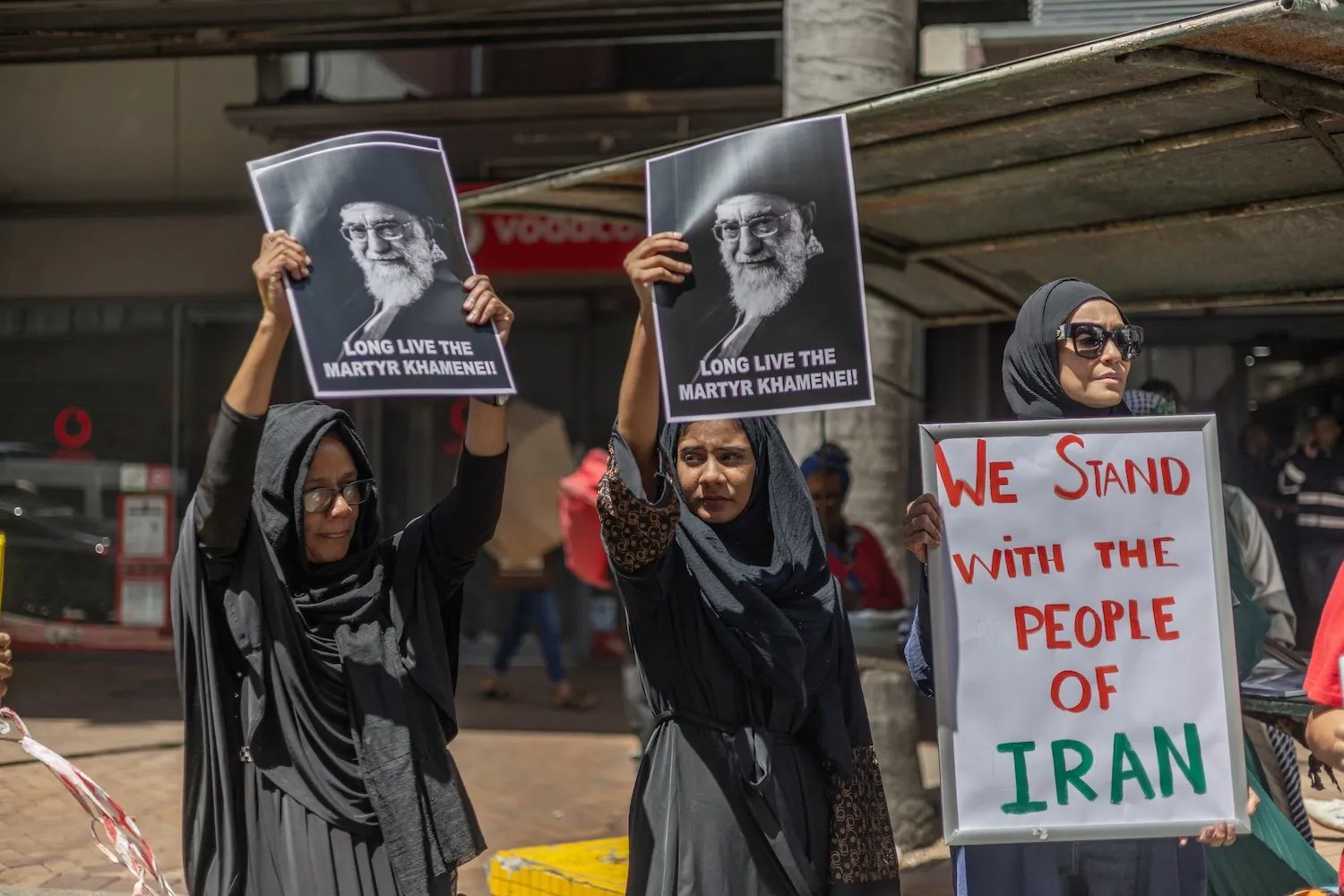
Thousands of Shiite Muslims in Nigeria have held nationwide protests organized by the Islamic Movement in Nigeria against the attacks on Iran, a Shiite-majority nation. These demonstrations prompted the U.S. Embassy in Nigeria to issue a security alert on Tuesday in the capital of Abuja.
The protests are largely peaceful, but experts warn that the conflict in Iran could make U.S. military personnel and assets in Nigeria a target for militant groups that are sympathetic to Iran. The war on Iran could be used for recruitment propaganda as evidence of aggression against Muslims by groups such as the Islamic State-West Africa Province and Jama’at Nusrat al-Islam wal-Muslimin, further destabilizing northern Nigeria’s volatile security situation.
Islamist violence is increasing in Nigeria, though it makes up a tiny fraction of overall insecurity in the country, where civilians of all faiths face rising attacks. “The state’s security forces have been much more focused on banditry and trying to protect various areas from armed bandit groups. That has limited their capacity to also deal with Islamist armed groups moving into the region,” Serwat told Foreign Policy.
More broadly, the economic impact of the war is expected to hit African economies hard—particularly with the closure of the Strait of Hormuz, a vital oil channel bordering Iran that connects the Persian Gulf to the Gulf of Oman. This has already led to global energy price hikes, forcing African consumers to pay more for everyday necessities.
Egyptian President Abdel Fattah al-Sisi has warned that a prolonged Middle East war threatens his country’s economic lifeline—the Suez Canal—after Egypt already lost an estimated $10 billion in revenue due to a reduction in shipping traffic after Israel’s 2023 invasion of Gaza.
The Suez is a critical shortcut from the Red Sea to the Mediterranean Sea, saving weeks of travel time in shipping cargo between Asia, Europe, and the United States. Many ships were rerouted after Iran-backed Houthi rebels launched attacks from late 2023 to late 2025 on boats in response to the war in Gaza.
“We are very cautious about the continuation of the war because of developments … in the Strait of Hormuz and its impact … on navigation in the Suez Canal,” Sisi said in a state broadcast on Sunday.
Thursday, March 5: The U.S. Senate Committee on Foreign Relations holds a nominee hearing on Frank Garcia as assistant secretary of state for African affairs.
The Africa Energy Indaba conference concludes in Cape Town, South Africa.
Saturday, March 7, to Sunday, March 15: Nairobi Design Week is held in Kenya.
Chagos controversy. U.S. President Donald Trump has doubled down on his criticisms of the United Kingdom’s approach to the Chagos Islands, an island chain in the Indian Ocean that hosts a joint U.K.-U.S. military base.
“The U.K. has been very, very uncooperative with that stupid island that they have,” Trump said on Tuesday, after British Prime Minister Keir Starmer initially denied Washington access to the base in Diego Garcia to launch the U.S. attacks on Iran.
Diego Garcia is the largest island in the Chagos Archipelago, which Britain detached from Mauritius three years before the latter’s independence in 1968, governing it as the British Indian Ocean Territory. Britain forcibly removed thousands of Chagossians, and the International Court of Justice advised in 2019 that the separation from Mauritius broke international law.
A bill to hand back the Chagos Islands to Mauritius and keep the military base through a 99-year lease is facing pushback by opposition parliamentarians in the United Kingdom following Trump’s criticisms of the plan in January.
Pretoria’s Iran problem. South Africa is struggling to distance itself from fellow BRICS member Iran as it seeks to mend trade ties with the United States.
Last month, Pretoria launched a probe into how Tehran came to participate in BRICS+ naval exercises off the coast of Cape Town, with an investigative panel reporting directly to President Cyril Ramaphosa, according to a statement released last Thursday.
Ramaphosa’s special advisor on investments, Alistair Ruiters, is in Washington this week to continue trade negotiations after Trump’s global tariffs were struck down by the U.S. Supreme Court. Trump had imposed a 30 percent tariff on South Africa.
U.S.-Zimbabwe deal crumbles. Zimbabwe rejected a U.S. deal last week that would have provided $367 million in health funding over five years due to data and sovereignty concerns. Zimbabwean officials described the deal as “lop-sided” and said that the Trump administration was demanding direct access to pathogen samples for commercial gain while refusing to agree to share the benefits of vaccines and treatments developed as a result.
As I’ve covered in past newsletters, African civil society groups and politicians have increasingly pushed back on health deals with the United States. Washington has now signed agreements with at least 17 African nations—and they have legitimate reasons to be wary.
The deals seek in part to replace the aid formerly provided by the now-dissolved U.S. Agency for International Development (USAID). But unlike USAID, they require African countries to directly report data to the U.S. government instead of multilateral organizations, such as the World Health Organization, without any guarantees of access to resulting vaccines.
During the COVID-19 pandemic, global distribution of vaccines was extremely unequal, and many people in Africa received vaccines long after those in Western countries. South Africa paid more than double the European Union price for vaccine doses. Since then, Africans have pushed for more transparency and equity in vaccine deals.
Epstein’s African connections. The latest documents released by the U.S. Department of Justice show convicted sex offender Jeffrey Epstein had close ties with some African political elites, including relatives of Ivorian President Alassane Ouattara.
The files reveal that Ouattara’s son, Dramane, and niece, Nina Keita—who is currently deputy general director of an Ivorian petroleum stocks company—met with Epstein several times. Emails suggest that Keita introduced a number of young women to Epstein on multiple occasions, including when he traveled to Ivory Coast’s capital of Abidjan in 2012. Neither Keita nor the Ivorian government has commented on the exchanges.
Emails show that Epstein later introduced Ehud Barak, a former Israeli prime minister, to Ouattara’s chief of staff. Barak allegedly proposed a security defense plan to Ouattara, including military training, that was ultimately rejected. Barak denies the claims. Epstein also formed close ties with Karim Wade, the son of former Senegalese President Abdoulaye Wade.
Ghana renamed its main airport the Accra International Airport a day before the 60th anniversary of the Feb. 24, 1966, coup d’état that overthrew the country’s first president, Kwame Nkrumah.
The airport was originally called the Accra International Airport, but in 1969, Ghana’s then-military government changed its name to honor Emmanuel Kwasi Kotoka, one of the putschists, after he was killed at the airport in a failed counter-coup two years earlier.


The recent decision to restore the original name has stirred some controversy: Kotoka’s family said that the name change erases his legacy and service to the country, but Ghana’s government maintains that the move is in line with the country’s democratic values.
Malawi’s carbon deal. Malawi has leased almost 6 percent of its land to Portuguese construction giant Mota-Engil in a 40-year carbon credit deal worth $100 million, Collins Mtika reports for the Center for Investigative Journalism Malawi.
The agreement covers 14 forest reserves, which would be used to generate carbon credits sold through Singapore-based commodity trader Trafigura.
“For a country that has earned only about $150 000 from carbon trading so far, the potential upside is seductive,” Mtika writes. But “[c]ritics argue Malawi is binding future governments, and communities living in and around the reserves, without first putting legal guardrails in place.”
Secretive gig work. Somali gig workers in Kenya may have been unknowingly helping the U.S. military in recent years, report Niamh McIntyre, Edwin Okoth, and Cam Wilson for the Bureau of Investigative Journalism.
The workers were hired by Australian tech company Appen to transcribe Somali telephone conversations used to build speech recognition systems—a project mentioned in a contract between Appen and the U.S. military.
“For now, gig workers in Kenya remain in the dark about the projects they take on, building datasets which could be sold to top-secret military clients, a private sector tech company, or both,” the authors write.


