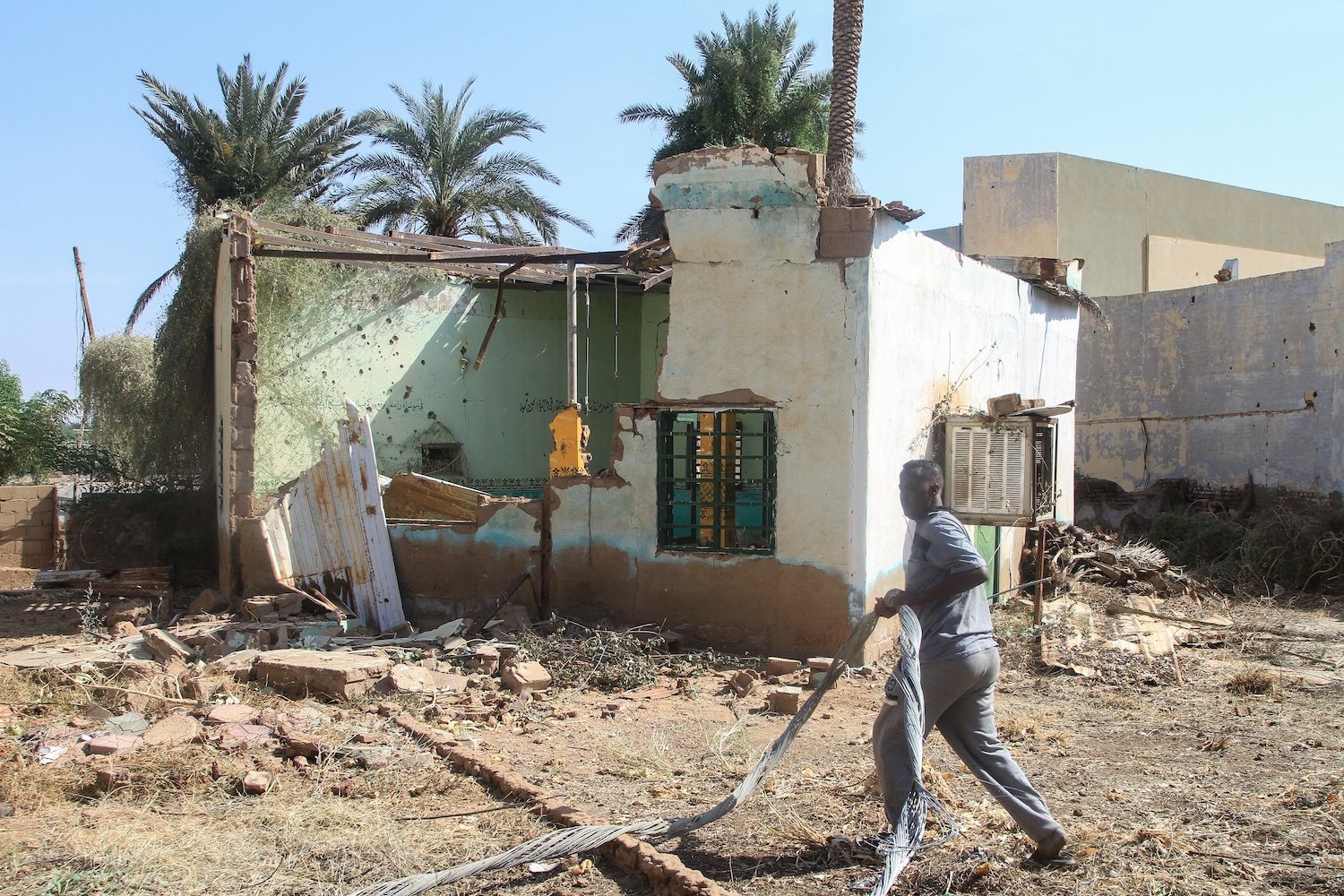

After more than 1,000 days of fighting, Sudan’s civil war looks to be entering a new and even more deadly chapter. This escalation could fully erase the borders that have nominally contained this conflict and unleash new violence across the wider Horn of Africa region and beyond. Sudan is already de facto partitioned between the paramilitary Rapid Support Forces (RSF) and the Sudanese Armed Forces (SAF), which split the country between west and east, respectively. However, with the conflict now a single-front war centered in the central Kordofan region, the RSF’s main backer, the United Arab Emirates (UAE), may be preparing to open a new front through Ethiopia. Doing so would further regionalize the conflict, creating another flash point in the ongoing battle for influence between Saudi Arabia and the UAE and threatening to pull in Egypt and Eritrea more directly.
Washington recognizes that a regional war would be disastrous for its Red Sea policy and would undermine U.S. interests in counterterrorism, maritime security, and containing Iran. That’s one reason it agreed to help bring Sudan’s war to an end and recently dispatched Deputy Secretary of State Christopher Landau to visit the Horn of Africa. But to achieve this, the Trump administration now needs to draw its own red lines with the UAE to ensure that the region’s newest power doesn’t recklessly widen the war.
After more than 1,000 days of fighting, Sudan’s civil war looks to be entering a new and even more deadly chapter. This escalation could fully erase the borders that have nominally contained this conflict and unleash new violence across the wider Horn of Africa region and beyond. Sudan is already de facto partitioned between the paramilitary Rapid Support Forces (RSF) and the Sudanese Armed Forces (SAF), which split the country between west and east, respectively. However, with the conflict now a single-front war centered in the central Kordofan region, the RSF’s main backer, the United Arab Emirates (UAE), may be preparing to open a new front through Ethiopia. Doing so would further regionalize the conflict, creating another flash point in the ongoing battle for influence between Saudi Arabia and the UAE and threatening to pull in Egypt and Eritrea more directly.
Washington recognizes that a regional war would be disastrous for its Red Sea policy and would undermine U.S. interests in counterterrorism, maritime security, and containing Iran. That’s one reason it agreed to help bring Sudan’s war to an end and recently dispatched Deputy Secretary of State Christopher Landau to visit the Horn of Africa. But to achieve this, the Trump administration now needs to draw its own red lines with the UAE to ensure that the region’s newest power doesn’t recklessly widen the war.
The partition in Sudan is a result of foreign backing as much as it is the tactical gains of the Sudanese belligerents. In this regard, there has been no greater force than the UAE. Whether motivated by the geostrategic advantages of controlling a Sudanese client state or under the misguided belief that defeating Sudan’s Islamists is best achieved by supporting a genocidal militia group, the UAE has emerged as the chief sponsor of the RSF. Crucial to the UAE’s support has been a constant effort to diversify supply lines. In the early days of the war, unwanted publicity caused the UAE to scale back efforts to send arms to the RSF through a remote base in Amdjarass, Chad. Instead, it pivoted to its other allies in the region. Soon, supply lines were humming from eastern Libya, South Sudan, and Bossaso in Somalia’s Puntland region.
Now, the RSF’s Emirati backers may be helping the RSF open a new base in the Benishangul-Gumuz region of Ethiopia. This region sits on Sudan’s eastern border and, more critically, is home to the country’s Grand Ethiopian Renaissance Dam (GERD). Since last November, there has been a surge in suspected Emirati-linked weapons shipments and possible mercenary deployments to Ethiopia. Open-source intelligence tracked at least one of these shipments to the Ethiopian border with Sudan. SAF officials began raising alarm bells in December, accusing Ethiopia of hosting, arming, and providing intelligence support for the RSF and aligned forces. And since the beginning of January, the SAF conducted airstrikes near the Ethiopian border against RSF-aligned militias and repelled an attempted RSF incursion into the same area from South Sudan. This new front would open a second path for the RSF to threaten the Sudanese capital, where fighting ended less than a year ago and reconstruction is just beginning.
Even more concerning, Ethiopia’s involvement in the civil war threatens to ignite already simmering tensions with neighboring Eritrea and Egypt in ways that could engulf the region and rapidly spread across the Red Sea. Ethiopia’s entry could be just the pretext Eritrea’s Machiavellian strongman, Isaias Afwerki, needs to restart conflict with his former ally and longtime rival, Ethiopian Prime Minister Abiy Ahmed. Isaias sees Sudan as a proxy battlefield for his unresolved tensions with Ethiopia and has already capitalized on the war to deepen his ties to Sudan. In addition to training Sudanese militias, Eritrea agreed to strengthen security cooperation with Sudan as part of a strategic alliance that recently included providing territory to Sudan’s military to house its military aircraft out of reach of RSF drone attacks. The next step in this escalatory ladder could see Isaias increase indirect support or even directly embed Eritrean forces in eastern Sudan in response to a flow of RSF weapons or troops entering Sudan from Ethiopia.
The SAF might then retaliate against Ethiopian involvement by renewing its cooperation with Eritrean-aligned opposition rebels in Ethiopia. The SAF provided arms and logistic support to the Tigray People’s Liberation Front (TPLF) during the Tigray war. The 2022 peace deal between the TPLF and the Ethiopian federal government, which Isaias viewed as a betrayal to his anti-TPLF alliance with Abiy, has been at a standstill since March 2025. Isaias has capitalized on the growing tensions to cultivate a partnership of convenience with his former TPLF enemies and Amhara ethno-nationalist insurgents, with Amhara militia, Eritrean, and TPLF officials allegedly meeting late last year on Sudanese soil.
This escalation could also reverberate across the Red Sea. Egypt has adopted a more aggressive stance against the RSF since the militia consolidated control over western Sudan after capturing El Fasher in October last year. Cairo fears that the RSF’s control of all Darfur would only add to instability along Egypt’s shared border and grow the 1.5 million Sudanese refugees already in Egypt. Egypt began coordinating air and drone strikes with Turkey against RSF supply lines near Egypt’s tri-border area with Libya after el Fasher fell. Egyptian officials have since repeatedly stated that Egypt will not accept anything other than a unitary Sudanese state that includes the SAF and dismantles the RSF. Egypt also took separate steps to pressure Ethiopia to reopen negotiations on the GERD—which Egypt views as an existential threat—through new naval agreements with Djibouti and Eritrea in late 2025. Now, Sudan’s role as a proxy theater will only intensify should Ethiopia become involved.
Growing Gulf state competition in Sudan and beyond has been fanning the flames of a full-blown regional crisis across the Red Sea. Last November, Saudi Arabian Crown Prince Mohammed bin Salman asked U.S. President Donald Trump to pressure the UAE to cut its support for the RSF and help achieve a lasting solution to Sudan’s ongoing war. The UAE seemingly responded by backing an ill-fated power grab by its Yemeni proxies against Saudi Arabia’s proxies in southern Yemen in December. Adding to its pressure campaign, the UAE then reportedly helped broker Israel’s recognition of the breakaway Somaliland region—two Emirati allies—around the same period, heightening regional concerns that Israel and the UAE were maneuvering to control the southern entrance to the Red Sea.
Saudi Arabia is no longer a passive observer to events in its backyard. In late December, Riyadh conducted airstrikes on Emirati targets in Yemen and effectively unraveled Emirati influence in the country over the next two weeks, forcing Abu Dhabi’s withdrawal. Saudi Arabia has also reportedly been working quietly to arrange a $1.5 billion weapons deal for Sudan’s army to purchase from Pakistan much-needed aircraft and anti-air systems to turn the tide in the war. Further pressing its position, Riyadh is now attempting to disrupt Emirati air supply lines to the RSF by refusing overflight permission for Emirati cargo and military flights and pressing its regional partners to do the same. Pressure from both Riyadh and Egypt on Libyan strongman Khalifa Haftar likely contributed to his announcement of a monthlong “maintenance” closure of the Kufrah air base in southeastern Libya, which in recent months had received more than 100 Emirati cargo flights and emerged as the largest single RSF support node in the war.
The international community, led by Washington, should do all it can to prevent the emergence of a new Ethiopia-UAE axis in Sudan’s war. The UAE successfully pressured the RSF to call off an assault in western Sudan in 2024 following a U.N. resolution demanding a cease-fire, showing that neither is immune to diplomatic pressure. However, rampant impunity in the months since has emboldened the UAE. Now, much like Saudi Arabia has done in Yemen, the international community must draw a line.
First, the Trump administration should heed the call of congressional Republicans and designate the RSF as a terrorist organization. Designating the RSF as a foreign terrorist organization or specially designated global terrorist organization would enable U.S. officials to investigate, prosecute, and sanction any third parties providing material support to the RSF—a substantial warning to the UAE.
However, punitive actions alone could be counterproductive and are unlikely to end Emirati involvement. U.S. officials should therefore also engage the UAE on a compromise that acknowledges Emirati interests in Sudan. The United States should continue to apply pressure on the SAF to diminish the influence of its Islamist factions. U.S. mediators can also try to negotiate a mutually beneficial deal with the UAE and SAF that would acknowledge peaceful relations are in both countries’ long-term interests.
Turning to Ethiopia, the international community should condition greater support for Ethiopian debt relief, financing, and search for reliable maritime access on Ethiopia staying out of Sudan. Abiy has been the perfect target for Emirati “bailout diplomacy” given his ambitious domestic development agenda and Ethiopia’s unsustainable debt levels. The UAE has also been the main partner trying to help Abiy achieve greater sea access through the Emirati-owned port in Berbera, Somaliland. However, this partnership is transactional, and Abiy can be swayed. Cooperation with international institutions like the G-20 and International Monetary Fund have been essential to ongoing debt restructuring efforts. As U.S. officials seek to increase commercial engagement with Ethiopia, they should explore potential investment options to develop Red Sea ports in Djibouti, Eritrea, and Somalia, build infrastructure to link these ports to Ethiopia’s market, and negotiate preferential Ethiopian access to them.
Looking beyond the Sudanese civil war, the Trump administration can use these same tools in its renewed effort at mediating a lasting deal over the governance of the GERD. Egypt has once again sought out Trump’s involvement, and Ethiopian military officials are wary about an Egyptian attack on the GERD. Washington needs to understand that any GERD talks cannot be advanced in a vacuum separate from the exceedingly complicated dynamics in Sudan.
As U.S. mediators seek to deescalate tensions in Sudan and across the Horn of Africa, they should consider adding Turkey and Qatar to Quad negotiations and other mediation efforts. Both countries are notable SAF backers, sending drones and aircraft at various points in the war. Including these countries in the Quad will help expand regional mediation efforts beyond Sudan. Turkey has ties with both Saudi Arabia and the UAE and has successfully mediated other sensitive issues with Ethiopia in Somaliland. Qatar also has a history of mediation efforts in partnership with the United States and in the Horn of Africa.
In Washington, successive administrations, eager to advance higher-priority goals in the Middle East, have chosen not to acknowledge the complicating role that competing Gulf state ambitions are having in the Horn of Africa. But any further delays in confronting these crosscurrents could cause the U.S. strategic harm well beyond Sudan. To avoid this scenario, the Trump administration should take a more comprehensive approach to the region than it has and designate a Senate-confirmed presidential special envoy for the Horn of Africa and Red Sea.
The Red Sea region has already become one of the most hotly contested areas on Earth in recent months and years. If Ethiopia emerges as a new front in Sudan’s civil war, this would exacerbate the world’s largest humanitarian and refugee crisis. It would also threaten international commerce and would create opportunities for a host of malign actors, ranging from Russia and Iran to al Qaeda, the Islamic State, and the Houthis. The Trump administration should do everything in its power to prevent this.