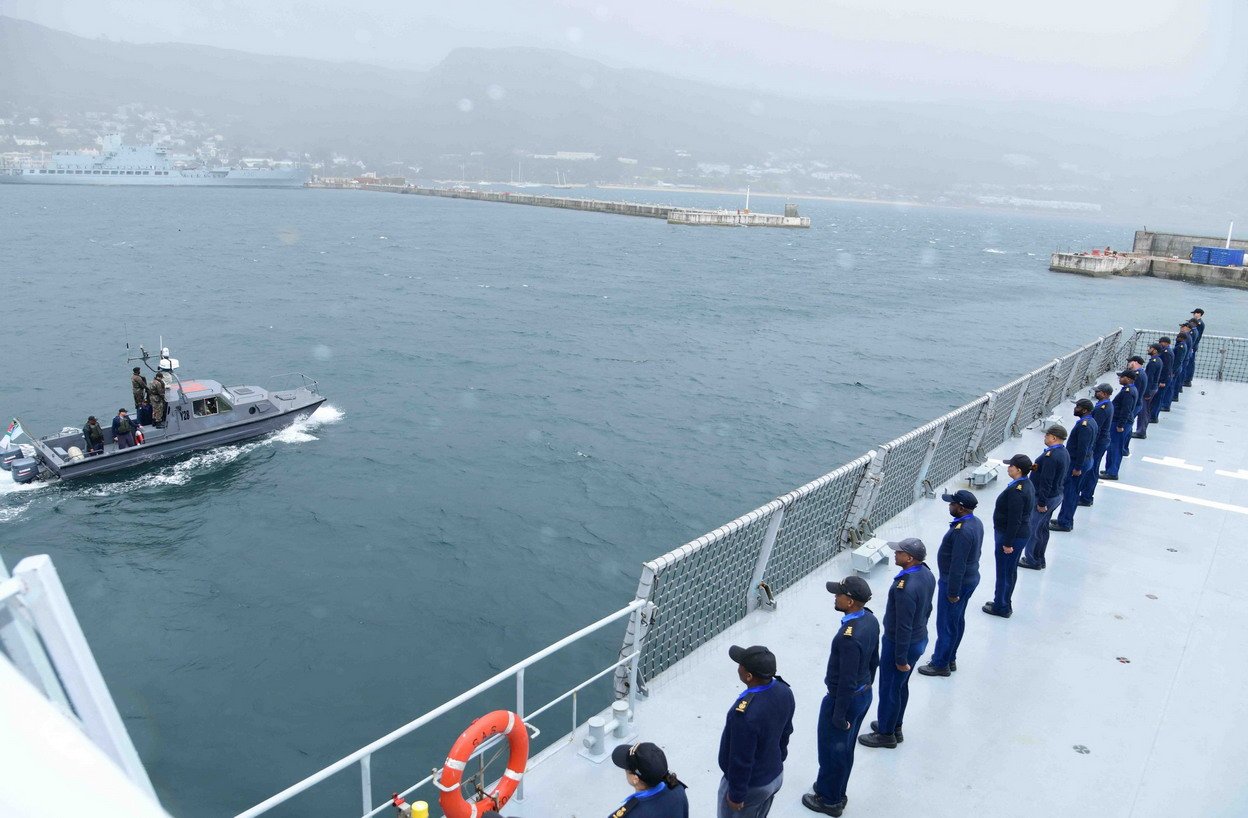

In the light of the fact that it is this year (2025) seventy years ago (1955) that the Simon’s Town Agreement was signed between South Africa and the United Kingdom, and that it was abrogated fifty years ago (1975), it is appropriate that this agreement and its consequences be revisited.
South Africa is supposed to be the guardian of the strategic Cape sea route, but its Navy has unfortunately declined significantly. By looking at the Simon’s Town Agreement and its consequences, as well as the consequences of its demise, insight can be gained with regard to the importance of the Cape sea route and South Africa’s role in its defence. In the light of the present-day changing global geopolitical context, the question can indeed be posed: Is it time for a new Simon’s Town Agreement?
The 1955 Agreement
From 1795 until 1803, and again from 1806 until 1910, the Cape Colony was under British rule. Although the Union of South Africa to a large extent became an independent state when it was established in 1910, Britain’s Royal Navy (RN) still retained control over the Simon’s Town Naval Base.
In 1948 the National Party (NP) won the election and soon transformed South Africa into an apartheid state. The NP also endeavoured to transform the then South African Defence Force (SADF) into an Afrikaner-dominated entity. In September 1954, the Minister of Defence, Mr FC Erasmus, led a delegation to London, where negotiations with Winston Churchill’s Conservative Party government took place with regard to regional defence in Southern Africa. It was felt that the development of nuclear weapons, the rise of the Soviet Union as a maritime power, and the challenges associated with the Cold War, called for fresh thinking. Erasmus also made a formal request for the transfer of the RN’s Simon’s Town Naval Base to South Africa.
Negotiations continued in Pretoria and in Simon’s Town in October and November 1954. Notwithstanding reservations in certain British circles, the basic Simon’s Town Agreement was concluded on 30 June 1955: The Simon’s Town Naval Base would be transferred to the SA Navy, but the RN (and its allies) could still use it in times of war; the SA Navy had to be expanded, and Britain would sell naval vessels and other arms to South Africa.
The Naval Base was formally transferred to South Africa on 1 April 1957, albeit that the ceremonial transfer only took place the next day. In practice, the SA Navy acquired one second-hand Type 15 frigate, three new Type 12 frigates, five small “Ford” Class seaward defence vessels, and ten “Ton” Class coastal minesweepers from Britain, while the SA Air Force bought eight Shackleton maritime patrol aircraft, sixteen Buccaneer maritime strike aircraft, and sixteen Wasp anti-submarine helicopters. This enhanced the capabilities and strength of the SADF, and enabled it to henceforth defend the Cape sea route better than ever before in collaboration with the RN and the navies of other Western powers.
Troubled waters
It is common knowledge that the NP’s domestic policy of separate development (apartheid) immediately elicited opposition both on the home front as well as abroad. The events at Sharpeville on 21 March 1960 led to even greater condemnation and international isolation. However, even after the Republic of South Africa (RSA) was established on 31 May 1961, the country to a large extent retained cordial military relations with many Western countries, mainly because of the strategic value of the Cape sea route. SA Navy vessels continued to embark on flag-showing cruises to other countries, and foreign “grey diplomats” (warships) frequently visited South African ports. From time to time, naval exercises were also conducted between SA Navy and RN ships; sometimes also involving ships from other navies.
In 1964, a change of government took place in the United Kingdom. The new Labour Party government no longer wished to deploy the RN on a large scale globally, and consequently did not place that much emphasis on the defence of the Cape sea route, and was no longer prepared to sell arms to South Africa in accordance with the Simon’s Town Agreement. Britain’s Conservative Party once again governed from 1970 until 1974, and supplied arms to the RSA on a limited scale, but when the Labour Party won the next election, the writing was on the wall. Consequently, on 16 June 1975, the British government unilaterally abrogated the Simon’s Town Agreement.
Exactly a year later, violent protests broke out in Soweto and other areas; the next year, Steve Biko died in police custody; the NP government banned several organisations and publications, and the SADF became embroiled in the so-called “Border War” (1966-1989). The RSA increasingly became a pariah state. On 4 November 1977, the United Nations imposed a mandatory arms embargo against South Africa, something that in particular negatively affected the SA Navy, because France cancelled the delivery of two corvettes and two additional submarines.
A new beginning?
The political negotiations of 1990 to 1994 and the concomitant first-ever truly democratic elections, initially created excellent opportunities for the SA Navy. For the first time in nearly two decades, the Navy could deploy ships on tailor-made flag-showing cruises. A large number of foreign “grey diplomats” now also, once again, visited Simon’s Town as well as other South African ports, including ships from African and Asian countries that previously shunned the RSA.
Unfortunately, the halcyon days did not last. The RSA’s defence budget is under immense pressure, which also impacts negatively on the SA Navy. Ships and submarines are not always refitted as required, which means that few units are in commission, and training at sea is limited, which in turn means that less experience is gained at sea, and morale can be undermined. It has been quite some time since an SA Navy ship has been deployed in the Mozambique Channel as part of the counter-piracy “Operation Copper”, and the last tailor-made flag-showing cruise took place as far back as 2017. The Navy’s ability to take part in meaningful exercises at sea – including with foreign navies – is limited. However, under trying circumstances, there are still SA Navy personnel who work miracles. But for how long will this still be possible?
A new Simon’s Town Agreement?
South Africa is supposed to be a maritime nation. Geographically, the country is a large peninsula, with oceans forming three of its borders. The country has a coastline of approximately 2 800 km, and at least 90 % of its trade flows through its ports. Given the fact that the Cape sea route is a maritime choke point, its strategic significance has increased in the light of the present-day tense and unstable international geopolitical context. South Africa’s authorities, and citizens in general, cannot afford to suffer from a land rat mentality and from “sea blindness”.
According to open sources (including SA Navy publications in the public domain), the SA Navy at the moment has – at least on paper – three submarines, four frigates, three multi-mission inshore patrol vessels (MMIPVs), a combat support ship and a hydrographic survey ship, plus a number of harbour and other small craft. To be in a position to properly patrol our coastal waters and exclusive economic zone, to be able to project power over distances, undertake elaborate flag-showing cruises underpinning foreign policy, to be able to where necessary provide humanitarian support to African and other countries, and do search-and-rescue work, the SA Navy should, ideally – and over and above the ships already referred to above – have at least three additional MMIPVs, four fairly large offshore patrol ships, as well as a second combat support ship. South Africa should also have at least two powerful ocean-going salvage tugs. Funds must also be available to ensure that at least fifty per cent of ships can be deployed at any given time.
The facilities in the Simon’s Town Naval Base are most likely not fully utilised. The United Kingdom and other European countries are probably not interested in stationing warships permanently in Simon’s Town. But what about the United States of America? And the People’s Republic of China, Russia or India? Where does the Simon’s Town Naval Base fit into the present South African government’s foreign (and military-strategic) policy?
Internationally, South Africa must be neutral in the true sense of the word, and must, under all circumstances, retain absolute control over the Simon’s Town Naval Base. In an effort to ensure the safety of our landward and seaward borders, the SA National Defence Force must be properly funded. As far as the SA Navy is concerned, the government should, so to speak, conclude a new “Simon’s Town Agreement”; not with any foreign country, but with the citizens of the RSA. This agreement must, inter alia, determine that the SA Navy will in all respects be empowered (financially and otherwise) to be able to achieve its mission, namely to provide balanced and combat-ready naval defence capabilities for the defence of South Africa and all its people, and by implication for the protection of the Cape sea route.
André Wessels is a Senior Professor (Emeritus) and Research Fellow in the Department of History at the University of the Free State, Bloemfontein. He is the author of a large number of publications on twentieth-century South African military history, in particular on the SA Navy, including his comprehensive book, A century of South African naval history: The South African Navy and its predecessors, 1922-2022 (Naledi, 2022, and 2nd edition, 2023).