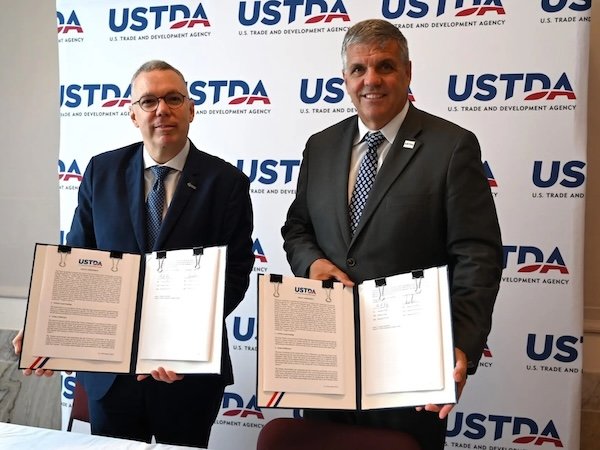
The US Trade and Development Agency (USTDA) has agreed to fund a feasibility study for a plan to extend AFR-IX Telecom’s Medusa subsea cable along Africa’s western coastline.
The 8,760km Medusa system – which is scheduled to be ready for service in the fourth quarter of this year – currently features 17 landing points in Cyprus, France, Greece, Italy, Malta, Portugal, and Spain on the north Mediterranean coast, and Algeria, Egypt, Libya, Morocco, and Tunisia on the south coast, with a design capacity of 480 Tbps on 24 fibre pairs.
In a statement issued last Friday, the USTDA said it will assess the technical and commercial viability of extending the Medusa cable from the Mediterranean Sea to Africa’s Atlantic coastline, although it didn’t elaborate on how far south the cable is expected to run.
Norman Albi, CEO of AFR-IX and Medusa Africa Submarine Cable System, said extending the Medusa cable could increase digital access for hundreds of millions of people in up to 22 African countries, and facilitate essential services like cloud computing, government communications, and financial transactions.
“The Medusa Africa Submarine Cable System will be transformational for digital connectivity along Africa’s Atlantic coast, creating new opportunities for innovation, commerce, and social inclusion in the region,” Albi said in the statement. “USTDA’s support is truly catalytic– turning an ambitious vision into a bankable project and accelerating the partnerships needed to bring it to life.”
The US government also sees the extension as necessary to “counter efforts by malign global actors to compromise critical infrastructure, and strengthen long-term digital partnerships with the United States,” said USTDA acting director Thomas R. Hardy.
“USTDA’s involvement in this project will help secure it against untrusted infrastructure providers that could manipulate markets, intercept data, and conduct surveillance to the detriment of the United States and our African partners,” he said.
If nothing else, extending Medusa would add more redundancy along the western coast route. Last year, the WACS, ACE, Main One and SAT3 subsea systems were damaged in one go by an undersea rock fall near Côte d’Ivoire that disrupted internet connectivity in numerous countries, including Côte d’Ivoire, Liberia, Burkina Faso, Mali and Guinea.
The Medusa system, first announced in 2022, is funded by AFR-IX, Orange and CEF (Connecting Europe Facilities) grants from the EU. The system is being built by Alcatel Submarine Networks (ASN).