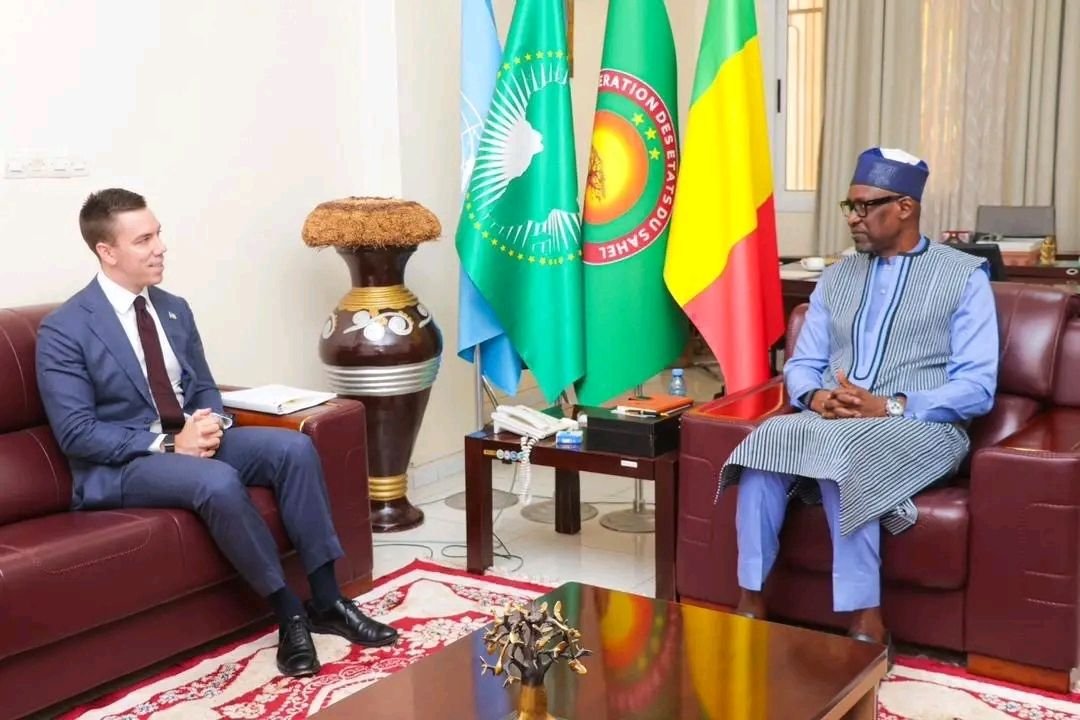

In February, United States (US) Senior State Department Official Nick Checker visited Bamako to reaffirm Washington’s respect for Mali’s sovereignty, and reset bilateral ties after ‘past policy missteps’ through renewed security and economic cooperation. Similar messages were conveyed to Nigerien Prime Minister, Ali Lamine Zeine.
These diplomatic overtures build on security-for-minerals visits in 2025 by other senior US government officials. They also coincide with a US strategic push to secure critical mineral access – despite nearly 70% of global refining capacity remaining under Chinese control.
In early February, Washington announced Project Vault, a critical minerals strategic reserve, and hosted its first critical minerals ministerial with 54 countries. The US designates 60 minerals – including lithium, cobalt, rare earths and graphite – as ‘critical’ due to their essential role in energy transition and defence technologies, coupled with geopolitically vulnerable supply chains.
Beyond its oil and gold endowments, the Sahel region is emerging as a strategic node for critical minerals extraction. Mali is projected to become Africa’s second-largest lithium producer in 2026 with reserves estimated at 890 000 tonnes. Niger holds approximately 454 000 tonnes of uranium reserves, representing 5% of global production. The region also hosts significant manganese deposits and other critical minerals.
The US’ conciliatory outreach to Bamako and Niamey thus appears driven less by a policy shift than by strategic interests linked to US critical mineral needs.
Washington’s response to the Sahel coups and the region’s pivot towards Russia has for some time been more measured than that of the European Union (EU) and France. While suspending cooperation in line with its legal requirements following the coups, the US sustained high-level outreach across Joe Biden and Donald Trump’s administrations. For example, Niger’s coup designation was delayed to safeguard the US’ US$100 million Agadez drone base and prevent Russian security penetration.
Still, the US’ recent outreach is significant as it recalibrates the diplomatic landscape around the Alliance of Sahel States (AES), made up of Mali, Niger and Burkina Faso. Alongside Russia and China, the US is the third UN Security Council power engaging the Sahel’s military governments. This complicates efforts by the African Union (AU) and Economic Community of West African States (ECOWAS) to deter coups.
The underlying signal to West Africa’s potential coup plotters is that political endurance can yield international reengagement, especially for resource-rich states.
The EU adopted a renewed Sahel approach in late 2025 after its principles-based posture alienated AES capitals, yet divisions persist over implementation, with France notably reluctant. Amid transatlantic tensions, pressure to accelerate normalisation may increase, further reinforcing AES diplomatic leverage.
The key question, however, is whether this security-for-minerals approach can yield win-win outcomes for Sahelian states beyond diplomatic recognition.
The ‘American solution’ presented to Mali in 2025 reportedly included equipment packages, intelligence support and potential ground deployments. But would it deliver results that neither France nor Russia have managed to achieve since 2013?
Washington rolled out multiple initiatives in the region from 2002 onwards, including the Trans-Sahara Counterterrorism Partnership, annual Flintlock exercises and surveillance drone bases in Niger. Despite US$3.3 billion security assistance over 20 years, US efforts have neither contained the jihadist surge in northern Mali nor prevented its spread into Burkina Faso and Niger.
The crux of the matter is that kinetic approaches have not only failed but, at times, aggravated the human security environment, regardless of the external partner involved.
Economically, Trump’s approach faces a core paradox. Dismantling the US Agency for International Development and rolling back the Millennium Challenge Corporation deprive the US of the development and infrastructure financing tools needed for robust Sahel reengagement.
Meanwhile, if eligibility to the African Growth and Opportunity Act for AES countries were restored, it would be largely symbolic. Mali and Burkina Faso exported only US$4.6 million and US$3.7 million respectively to the US pre-coup, while Niger’s figures (US$94.6 million in 2021, US$73.1 million in 2022, US$46.9 million in 2023) reflect no consistent commercial dynamic.
The security-for-minerals approach also faces significant political constraints. Mali’s Goulamina and Bougouni lithium assets remain under Chinese control, while Russia’s Uranium One holds the only exploration permit for Bougoula, making US reallocation unlikely.
Bamako’s reliance on Moscow and Beijing for military support and diplomatic backing – particularly buffering ECOWAS and EU pressure – creates strong disincentives to recalibrate. Given that sovereigntist narratives underpin the government’s legitimacy, any reversal would carry domestic costs.
Mali and the US could nonetheless engage in lithium exploration, while expanding cooperation into other sectors, as reflected in recent US gold mining permits. However, this depends on improved security, underscoring yet another dilemma facing the US approach.
In Niger, uranium exploitation is under intense political pressure. While China is involved only in the Azelik mine, authorities have nationalised SOMAIR – previously jointly operated with France’s Orano – and revoked Orano’s permit for Imouraren, Niger’s largest uranium deposit. Niamey’s reported attempt to market over 1 000 tonnes of yellowcake co-owned with Orano has further escalated diplomatic tensions with Paris.
These developments unfold against the backdrop of possible Iranian interest in Niger’s uranium sector. Broader Niamey-Tehran rapprochement efforts have previously raised US concerns.
Unconceded uranium deposits could nonetheless underpin US engagement. Sales at international market prices could address Niger’s long-standing grievances over below-market French contracts. If deals include infrastructure, technology transfer and training, they would position the US as a credible alternative, addressing both geopolitical risk and development needs.
Ultimately, AES states are in the middle of a volatile geopolitical contest and should weigh US overtures with caution. Trump’s foreign policy is unpredictable: the same sovereignty now respected in the Sahel was disregarded in Venezuela and treated as negotiable in Greenland.
Whether exclusive access to the Sahel’s critical minerals has become a core US objective remains unclear, but this conciliatory approach may be the carrot – with Trump’s maximum pressure playbook not far behind. In this context, hedging remains the prudent course.
Written by Djiby Sow, Senior Researcher, ISS Regional Office for West Africa and the Sahel.
Republished with permission from ISS Africa. The original article can be found here.