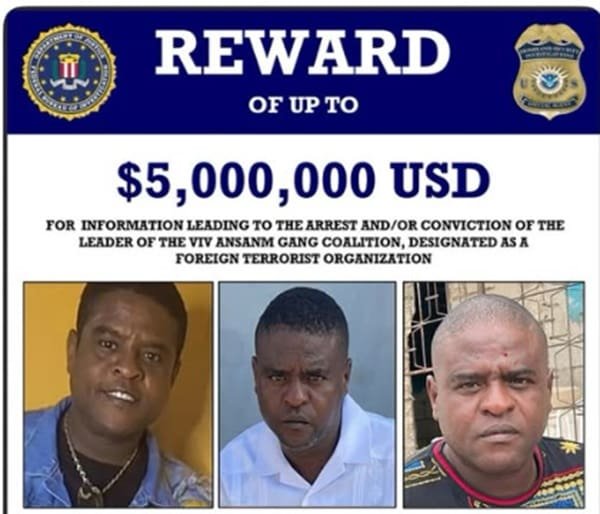

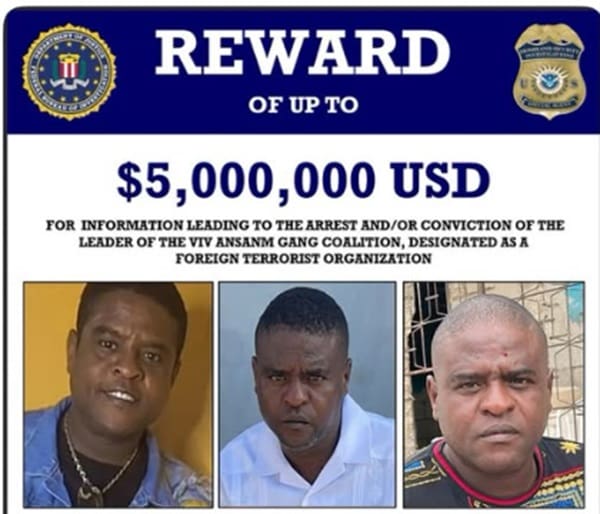
In a dramatic turn of events, the U.S. government has moved to arrest notorious Haitian gang leader Jimmy Cherizier, widely known by his alias “Barbecue.” A former police officer turned warlord, Cherizier has emerged as one of the most powerful and violent figures in Haiti’s deepening crisis, heading the G9 Family and Allies gang coalition that has terrorized the capital and paralyzed the nation’s institutions.
This bold step by U.S. authorities signals a widening international effort to crack down on transnational gang networks, with far-reaching implications for Haiti’s security, sovereignty, and struggling government.
– Advertisement –
A $5 Million Bounty and Criminal Indictment
The U.S. Department of Justice announced that a federal grand jury in Washington, D.C., has unsealed criminal charges against Cherizier for conspiracy to violate U.S. sanctions, which were first imposed under the Global Magnitsky Act in 2020. His American associate, Bazile Richardson, was also indicted and has already been taken into custody in Texas.
The U.S. State Department has placed a $5 million reward on Cherizier’s head under its Transnational Organized Crime Rewards Program, offering the sum for information leading to his arrest and conviction.
The Rise of “Barbecue”
Once a member of Haiti’s National Police, Cherizier rose through the ranks of street violence to become the de facto power broker in Port-au-Prince. He founded the G9 alliance in 2020—later evolving into Viv Ansanm, a federation of armed gangs that has launched coordinated attacks on state facilities, executed massacres, and taken control of major transportation corridors.
He is widely believed to have orchestrated or overseen numerous atrocities, including the La Saline massacre of 2018, where at least 71 civilians were killed and hundreds of homes burned. Other killings in Bel-Air and Grand Ravine have also been linked to his network.
Despite these accusations and repeated international condemnation, Cherizier has operated with near impunity in Haiti, often appearing in public and issuing statements to media. He portrays himself as a revolutionary fighting against political corruption and social injustice—a claim dismissed by rights groups and U.S. officials.
– Advertisement –
Defiance in the Face of Justice
In a defiant message following the indictment, Cherizier responded publicly to the charges:
“If the FBI wants me, I’m here.”
The statement, delivered via a recorded video, highlights the continued power vacuum in Haiti and the challenges foreign governments face in enforcing law and order within the country.
Diaspora Funding and U.S. Involvement
The U.S. indictment reveals that Cherizier’s operation extended beyond Haiti’s borders. Prosecutors allege that funds were solicited from Haitian diaspora communities in the U.S. and funneled through wire transfers to purchase weapons, pay fighters, and support his militant campaign against the Haitian government. This use of U.S.-based networks prompted the Justice Department to pursue criminal charges under federal law.
His associate, Bazile Richardson—a naturalized U.S. citizen—was described as a key conduit in the financing structure, allegedly traveling between the U.S. and Haiti to support the gang’s operations.
The Broader Crisis in Haiti
Haiti has been gripped by a humanitarian and political crisis for years, made worse by the 2021 assassination of President Jovenel Moïse, the collapse of its elected institutions, and the inability of interim governments to contain escalating gang violence. Armed groups now control much of the capital, and kidnappings, fuel blockades, and killings are widespread.
The indictment and bounty come as part of a broader U.S. strategy to isolate and dismantle gang leadership, particularly as the Trump administration faces pressure to address migration, regional security, and the influence of transnational criminal organizations.
Legal and Diplomatic Questions
While the charges and reward are a strong signal, Cherizier remains at large in a country where law enforcement is overmatched and often compromised. Analysts note that extraditing or apprehending him may require cooperation from foreign peacekeepers or Haitian forces—neither of which currently have the capability to guarantee such an outcome.
Moreover, the move raises critical legal questions about U.S. jurisdiction over foreign nationals operating within their own borders. However, by tying Cherizier’s actions to U.S. sanctions violations and financial transactions within the U.S., the Justice Department has found a legal basis for pursuing his arrest.
A Turning Point or Symbolic Gesture?
Critics argue that while the charges are significant, they may do little to curb Cherizier’s influence on the ground unless matched by a broader international enforcement strategy. Haiti’s weak judicial system, rampant corruption, and the lack of effective security forces continue to offer fertile ground for gang rule.
Yet for many Haitians, this move is a rare sign of accountability.
“We’ve waited years for someone to take action,” said a Port-au-Prince resident, speaking anonymously for safety. “Even if they don’t catch him, at least the world is watching now.”
Conclusion
As the U.S. intensifies its efforts to dismantle criminal networks fueling Haiti’s collapse, the spotlight now turns to Jimmy “Barbecue” Cherizier—a man who has become both a symbol of Haiti’s descent and a central figure in its potential recovery.
Whether this marks the beginning of meaningful justice or merely another chapter in Haiti’s cycle of violence will depend not only on arrests, but on rebuilding the fragile state left in the gangs’ wake.