
• Business
  • Markets
  • Politics
  • Crypto
  • Finance
  • Intelligence
    • Policy Intelligence
    • Security Intelligence
    • Economic Intelligence
    • Fashion Intelligence
  • Energy
  • Technology
  • Taxes
  • Creator Economy
  • Wealth Management
  • LBNN Blueprints
  • Business
  • Markets
  • Politics
  • Crypto
  • Finance
  • Intelligence
    • Policy Intelligence
    • Security Intelligence
    • Economic Intelligence
    • Fashion Intelligence
  • Energy
  • Technology
  • Taxes
  • Creator Economy
  • Wealth Management
  • LBNN Blueprints

Unlocking the secrets to brain diseases

Simon Osuji by Simon Osuji
August 24, 2023
in Technology
0
Unlocking the secrets to brain diseases
0
SHARES
3
VIEWS
Share on FacebookShare on Twitter

When proteins get stuck at solid: unlocking the secrets to brain diseases
Nanoscale scan image showing protein condensate interaction. Credit: The University of Sydney

Many diseases affecting the brain and nervous system are linked to the formation of protein aggregates, or solid condensates, in cells from their liquid form condensate, but little is known about this process.

Related posts

Dangote Refinery produces Euro-standard fuels, refutes import allegations – EnviroNews

Dangote Refinery produces Euro-standard fuels, refutes import allegations – EnviroNews

February 5, 2026
Lagos urged to review ban on cart pushers to address waste challenges – EnviroNews

Lagos urged to review ban on cart pushers to address waste challenges – EnviroNews

February 5, 2026

This liquid-to-solid transition can trigger the formation of what are called amyloid fibrils. These can further form plaques in neurons causing neurodegenerative diseases such as Alzheimer’s.

Biomedical engineers at the University of Sydney, in collaboration with scientists at the University of Cambridge and Harvard University, have now developed sophisticated optical techniques to monitor at close range the process by which these protein aggregates form.

By testing a protein associated with amyotrophic lateral sclerosis—ALS disease, which affected astrophysicist Professor Stephen Hawking—the Sydney engineers closely monitored the transition of this protein from its liquid to solid phase.

“This is a huge step forward to understanding how neurogenerative diseases develop from a fundamental perspective,” said Dr. Yi Shen, lead author of the research published in the Proceedings of the National Academy of Sciences (PNAS).

“We can now directly observe the transition of these critical proteins from liquid to solid at the nanoscale—a millionth of a meter in scale,” said Dr. Daniele Vigolo, a senior lecturer in the School of Biomedical Engineering and a member of the University of Sydney Nano Institute.


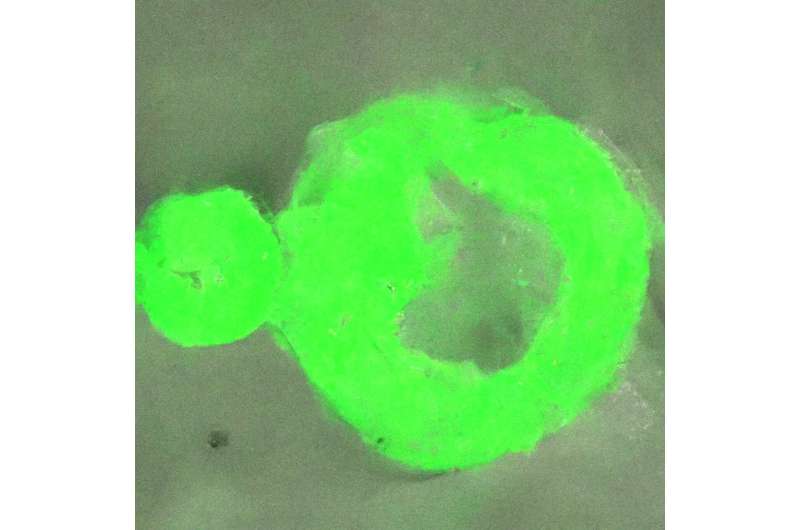
3D confocal microscopy scan of a FUS protein condensate incubated for 24 hours showing the characteristic core-shell structure unveiled by this research. Credit: The University of Sydney

Proteins regularly form condensates during liquid-to-liquid phase separation in a wide range of critical and healthy biological functions, such as the formation of human embryos. This process assists biochemical reactions where protein concentrations are critical and also promotes healthy protein–protein interactions.

“However, this process also increases the risk of dysfunctional aggregation, where unhealthy aggregates of solid proteins form in human cells,” said Dr. Shen, who is an ARC DECRA Fellow in the School of Chemical and Biomolecular Engineering and also a member of Sydney Nano.

“This can lead to aberrant structures associated with neurodegenerative diseases because the proteins no longer exhibit rapid reversibility back to liquid form. It is therefore crucial to monitor condensate dynamics, as they directly affect pathological states,” she said.

The world-first nanoscale optical observation of this process has allowed the team to determine that the transition from liquid to solid protein starts at the interface of the protein condensates. This window onto the phase transition also revealed that the internal structures of these protein agglomerates are heterogenous, where previously they were thought to be homogeneous.

Dr. Vigolo said, “Our findings promise to greatly improve our understanding of neurogenerative diseases from a fundamental perspective.

“This means a promising new area of research to better understand how Alzheimer’s disease and ALS develops in the brain, affecting millions of people worldwide.”

More information:
Yi Shen et al, The liquid-to-solid transition of FUS is promoted by the condensate surface, Proceedings of the National Academy of Sciences (2023). DOI: 10.1073/pnas.2301366120

Provided by
University of Sydney

Citation:
When proteins get stuck at the solid phase: Unlocking the secrets to brain diseases (2023, August 24)
retrieved 24 August 2023
from https://phys.org/news/2023-08-proteins-stuck-solid-phase-secrets.html

This document is subject to copyright. Apart from any fair dealing for the purpose of private study or research, no
part may be reproduced without the written permission. The content is provided for information purposes only.


Source link

Previous Post

Dubai Updates Crypto Laws To Include Staking Via Custody

Next Post

Do Blue-Light Glasses Help with Eyestrain?

Next Post
Do Blue-Light Glasses Help with Eyestrain?

Do Blue-Light Glasses Help with Eyestrain?

Leave a Reply Cancel reply

Your email address will not be published. Required fields are marked *

RECOMMENDED NEWS

Piasecki Conducts Milestone ARES-DV Flight, Signals Potential for Military Use

Piasecki Conducts Milestone ARES-DV Flight, Signals Potential for Military Use

1 year ago
Polaris Spaceplanes to Build Hypersonic Test Vehicle for Germany

Polaris Spaceplanes to Build Hypersonic Test Vehicle for Germany

11 months ago
President Museveni Meets Delegation from White House

President Museveni Meets Delegation from White House

1 year ago
Threads expands search to ‘most’ English and Spanish-speaking countries

Threads expands search to ‘most’ English and Spanish-speaking countries

2 years ago

POPULAR NEWS

  • Ghana to build three oil refineries, five petrochemical plants in energy sector overhaul

    Ghana to build three oil refineries, five petrochemical plants in energy sector overhaul

    0 shares
    Share 0 Tweet 0
  • The world’s top 10 most valuable car brands in 2025

    0 shares
    Share 0 Tweet 0
  • Top 10 African countries with the highest GDP per capita in 2025

    0 shares
    Share 0 Tweet 0
  • Global ranking of Top 5 smartphone brands in Q3, 2024

    0 shares
    Share 0 Tweet 0
  • When Will SHIB Reach $1? Here’s What ChatGPT Says

    0 shares
    Share 0 Tweet 0

Get strategic intelligence you won’t find anywhere else. Subscribe to the Limitless Beliefs Newsletter for monthly insights on overlooked business opportunities across Africa.

Subscription Form

© 2026 LBNN – All rights reserved.

Privacy Policy | About Us | Contact

Tiktok Youtube Telegram Instagram Linkedin X-twitter
No Result
View All Result
  • Home
  • Business
  • Politics
  • Markets
  • Crypto
  • Economics
    • Manufacturing
    • Real Estate
    • Infrastructure
  • Finance
  • Energy
  • Creator Economy
  • Wealth Management
  • Taxes
  • Telecoms
  • Military & Defense
  • Careers
  • Technology
  • Artificial Intelligence
  • Investigative journalism
  • Art & Culture
  • LBNN Blueprints
  • Quizzes
    • Enneagram quiz
  • Fashion Intelligence

© 2023 LBNN - All rights reserved.