

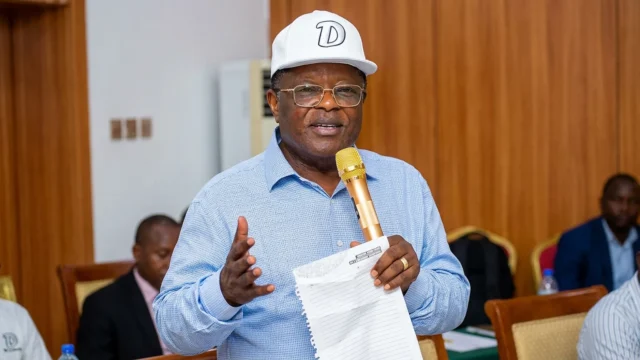


Nigeria’s road construction landscape is quietly changing, and the shift is becoming difficult to ignore. Minister of Works, David Umahi, believes the country’s indigenous contractors are now proving they can handle complex national infrastructure without relying heavily on foreign expertise.
During an inspection visit to a major federal highway project in Afikpo, Ebonyi State, Umahi pointed to what he described as growing technical confidence among Nigerian engineering firms. The inspection focused on a key stretch of the road network under the infrastructure programme launched by Bola Ahmed Tinubu.
From the minister’s view, the performance of local contractors on the Nigeria legacy road project connecting southern Nigeria to Abuja shows a new phase in the country’s construction capacity. He said several Nigerian firms now begin work even before receiving full mobilisation funds, describing the approach as a sign of commitment to national development.
According to Umahi, the emerging nigeria indigenous contractors highway construction capacity reflects a shift in mindset within the sector. Contractors are now acting more like long-term development partners rather than simple project vendors.
The road corridor under construction stretches from Calabar through several communities in the South-South and South-East regions before connecting to routes leading toward the Federal Capital Territory. Officials say the transport corridor is designed to boost trade movement and reduce travel time across key economic zones.
Umahi explained that the first phase alone covers about 125 kilometres and carries a contract value of roughly ₦454 billion. The project is being executed through the EPC+F model, where the government pays a portion of the cost while contractors secure additional financing.
He noted that 30 percent of the contract has already been paid while contractors raise the remaining funds through financing partners. For many observers following nigeria infrastructure development under tinubu administration, the financing structure represents an attempt to speed up delivery without placing full pressure on government budgets.
One element drawing attention is the use of concrete pavement technology for federal highway construction. Unlike conventional asphalt roads, concrete highways are expected to last longer and require less maintenance over time.
Engineers involved in the project say the design lifespan could reach a century if properly maintained.
The technical difference is clear. Asphalt roads dominate Nigeria’s highway network and usually require major repairs every 10 to 15 years. Concrete pavement roads, though more expensive initially, often last several decades longer. The trade-off is higher upfront cost but significantly lower maintenance spending.
This shift is becoming central to discussions around long term concrete pavement highway projects in Nigeria.
Beyond the road surface, the project includes major bridge construction. One structure stretches roughly 700 metres with 25 spans, while another bridge measures close to 1.5 kilometres.
Umahi said progress on the ground suggests the completion timeline could improve if work continues at the current pace. “If the contractors maintain this speed and we allow about nine extra months, the project may finish earlier than planned,” he said while speaking to reporters during the visit.
About 11 kilometres of dual carriageway has already been completed along parts of the corridor, an early milestone officials see as proof of steady progress.
To accelerate work further, the minister directed contractors to install another concrete production facility in Onueke. The idea is to allow construction to advance simultaneously from different points.
Analysts tracking economic corridor highway project connecting calabar to fct believe the route could transform transport logistics between southern ports and central Nigeria. Faster cargo movement may eventually reduce haulage costs for businesses.
Umahi also used the inspection to address public behaviour around national projects. He urged young Nigerians to support development efforts rather than attack public projects online.
He argued that national infrastructure succeeds only when communities cooperate with contractors and government agencies.
Local authorities have also played a role in easing construction challenges. The Ebonyi State government helped resolve compensation issues for properties affected by road expansion.
Officials say further compensation payments are currently being processed for additional property owners along the route.
From a broader perspective, the federal government sees the corridor as part of a larger economic integration plan. Improved road connectivity could support industrial growth, strengthen security patrol routes and encourage regional trade.
For many observers, the story behind the project goes beyond a single highway. It signals a growing confidence in nigeria indigenous engineering firms delivering mega road infrastructure projects—something that could shape how future national highways are built.



