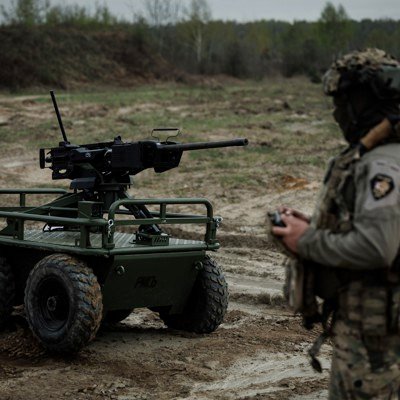
Video from the Ukrainian military’s first-person drones has captivated millions, but the footage offers only a narrow view of a robotics revolution that is reshaping combined-arms warfare.
Air and ground robotic systems in a wide variety of mutually supporting roles are bringing about a true robot military, writes Jack Watling, a senior research fellow for land warfare at the Royal United Services Institute, or RUSI. His new paper traces the evolution of Ukrainian robot doctrine from simple target spotting to coordinated movements by flying and crawling robots that navigate the battlefield and fight alongside humans.


The shift was born of necessity, Watling writes.
“Political developments in Washington interrupted the provision of military–technical assistance, disrupting Ukraine’s ability to coherently plan the equipping of its forces with its international partners. As a result, Ukraine doubled down on a method which delivered results and was under its control: drones,” he writes. “Two dedicated UAV regiments, and two non-standard brigades of the Armed Forces of Ukraine…are pioneering the use of novel equipment,” as in air and ground drones.
Watling also notes that the heavy use of drones by both sides has led to a new way to conceptualize the battlefield. The frontline forces of Ukraine and Russia are generally separated by about 15 kilometers of ground rendered all but impassable by legions of armed UAVs. Ukrainian war planners call this territory the “grey zone” or the “contested zone.” (U.S. Marines call it “close.”) Beyond it lies the “middle zone,” another roughly 15 km where troops muster weapons, sensors, and jammers. And behind that is the “deep zone” where you find drone factories, logistics centers, and “systems that cannot affect the contested zone but may do so in the future,” he writes.
The key to taking grey-zone territory is isolating elements of the enemy’s forces in the middle zone. So Ukrainian forces have learned to use drones to lay mines and traps to slow reinforcement and resupply efforts.
“This is largely done using bomber UAVs. This is then followed up with persistent interdiction missions by [first-person viewer or FPV] drones to prevent attempts to move equipment on foot or on light buggies,” Watling writes.
Once Russian forces are isolated, Ukrainians can mount an assault. Here, too, Ukraine is leading with robotics, which they use “disproportionately” more than the Russians.
“Ukrainian forces have concluded that this is ideally done with weapons mounted on uncrewed ground vehicles (UGVs), as their sustained fire, delivered from outside prepared fighting positions, makes them vulnerable to strike,” he writes.
Troops that push into new territory need fresh supplies, especially materials for fortifying their new positions. Here, too, the Ukrainian military, which lacks Russia’s big logistics formations, has learned to rely on robots.
“Equipment and materials for erecting positions with overhead cover can be delivered to the units by UAVs and UGVs. UGVs are disproportionately used for resupply in Ukraine,” Watling wrote.
Lessons for NATO
Those achievements hold lessons for NATO, according to several people who participated in a recent virtual meeting of government officials and civilian technology experts organised by GLOBSEC. The U.S. and other European militaries are developing new battle-robot concepts around Ukraine’s experiences. NATO and Ukraine recently tested new ways to counter UAVs. This effort, led by the NATO-Joint Analysis, Training And Education Centre, “aims to keep the alliance on the cutting edge and to support Ukraine,” a NATO official said.
More broadly, the war in Ukraine reveals the obsolescence of the way the large militaries of NATO members do many things, from force design to acquisitions to battlefield maneuver. Because enemy drones and sensors can reach so much more deeply into friendly territory, what NATO considers the “rear” isn’t as safe as modern force planning presumes. This argues for planning combat teams that are smaller and more nimble, writes Watling, who adds that military planners should push more command-and-control authority down to the brigade level.
In terms of equipment and vehicles, the paper shows that drone warfare exposes vulnerabilities that designers may not have considered. For instance, if your fancy new combat vehicle has rubber tires it might as well be a hockey goalie with no helmet. What’s most important: buy equipment that’s modular, so that broken parts can be quickly swapped out.
But NATO leaders don’t feel the same urgency to change, one of the participants in the GLOBSEC dialogue said. Limited resources and invading forces galvanized Ukrainian innovation, but alliance members have larger budgets, relatively sophisticated equipment, and no Russian forces on their territory. For example, Ukraine has created a command-and-control architecture that coordinates humans and robots, even under constant electronic warfare attack.
“We don’t” have that, the participant said, meaning NATO. “It has a lot to do with our policies, the way we approach sharing [intelligence] and and our dependency on fixed command control systems provided by big, big suppliers.”
NATO members have agreed to expand their defense budgets by the year 2029 and talk about funding innovative companies that are building ground robots and drones. But the participant said that much of the spending is going to established companies, not nimble innovators.
“What I see is that the steering in most European headquarters is still done based on investment budgets,” the participant said. “We just go on buying big stuff. It just continues. and I think that’s really the worse part.”